



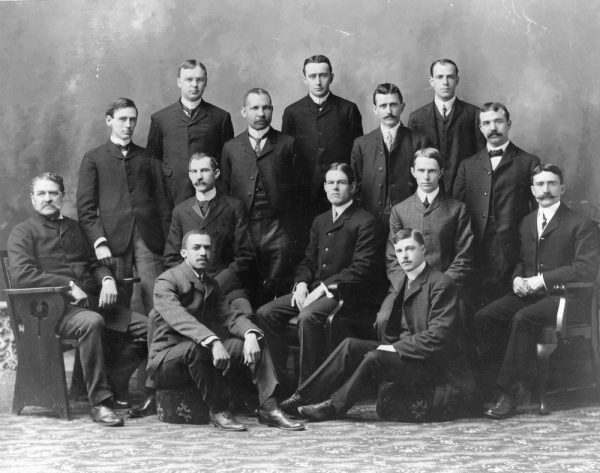
When the Northeastern University School of Law opened its doors in 1898, it was far from prestigious.
Originally associated with the Young Men’s Christian Association, or YMCA, a staff of five instructors taught classes covering criminal law, contract and torts, pleading, and property, according to the Northeastern archives. In the first six years of the school’s existence, 662 men enrolled, 42 graduated and 37 were admitted into the bar.
At the time, the undergraduate university was similarly small in size. It would be another century before it evolved from a commuter school to a global network of campuses.
Northeastern University School of Law, or NUSL, operated as a night school until 1930, when it enrolled enough students to become a day school. In a time when most law students were white males, NUSL set itself apart by catering to those who would not previously have had the opportunity to obtain a law degree, including immigrants and women.
“[Flexible admissions were] particularly attractive to a very large number of women who may have taken time out from their careers to raise kids, but then wanted a career and especially perhaps a more prestigious career than they may have had before they left the workforce,” said Professor of Law Emeritus Brook Baker.
But in 1953, under mounting financial pressure and enrollment declines, NUSL closed its doors. In addition to dropping enrollment rates, administrators were facing competition from other schools and no longer saw the law school as a worthy investment.

In the announcement of the closure, the university wrote that, as a whole, its enrollment increased from 4,790 to 13,164. But the law school’s enrollment sharply contrasted that, with a drop from 1,328 to 196 students in the same fifteen-year time span.
In 1956, after the last class graduated, NUSL shut its doors, a decision applauded by local media at the time.
“What Northeastern is doing, in fact, is shifting its educational energies to fields where the need is greater than it is for turning out law graduates,” The Boston Globe wrote in a 1953 editorial.
In 1953, the Boston Traveler Editorial, which ceased publication in 1967, wrote that, “Northeastern University, in deciding to close its law school, has shown that it has the courage to concentrate its strength where that strength will do the most good.”
But alumni did not take this decision lightly. Shortly after the closure, they started to rally for the school to reopen.
The university’s Board of Trustees gave the alumni one condition for Northeastern to reopen the law school: raise one million dollars.
“The Trustees finally decided to issue this challenge to them. If the sum of one million dollars could be declared for this purpose, the school would be reopened,” according to the document titled “Northeastern University School of Law A Brief History” from the university’s archives.
Accepting the challenge, alumni got busy raising a million dollars. It was agreed that when they reached half of their intended amount, Northeastern would take “timely steps” in the “direction” of reopening the law school. Then, $500,000 later, the university would reopen the school.
The alumni completed their fundraising mission, and the law school officially reopened in 1968. With new funds and a new dean, Tom O’Toole, NUSL decided that the law school would take on a public interest and social change focus.
Then-Northeastern President Asa Knowles had three requirements for the new NUSL: it had to have a cooperative education program, or co-op, high educational quality and a unique mission.
Richard Daynard, a distinguished professor who was present at the reopening of the law school, spoke about O’Toole’s philosophy while he was rebranding the law school. When NUSL was reopened, young people nationwide were rallying against the Vietnam War.
“And people were being ‘Clean for Gene,’” Daynard said in reference to young people’s support for Eugene McCarthy’s presidential bid. “And the young people were protesting the Vietnam War. And so [O’Toole] said this would be a school focused on social change and public interest in social change.”
Under Knowles’ leadership, the university expanded its distinctive co-op program. And as part of the reopening conditions, university administration said the law school must implement a co-op program. The program was, and remains, an unconventional part of NUSL’s curriculum. But the program, which helps students secure temporary job placements at various law firms, provided students with real work experience. Currently, NUSL remains one of the few law schools that offers co-ops in the U.S.
And unlike the traditional grading criteria of most law schools, NUSL incorporates a pass-fail grading system, providing students a narrative evaluation from professors and co-op employers instead.
Micah Slade, a second-year law student at NUSL, said that the school has an inclusive learning atmosphere to this day.
“I think it really just kind of boils down to professors really guiding students to be able to work with other students who have similar levels of passion and interest in topics, and you’re seeing actual results from that, which I think is cool,” Slade said.
Now, NUSL is the number one leader in law school co-op programs in the country, has a bar passing rate of 95.7% for first-time takers as of July 2024 and stands out from other Boston law schools because of its environment.
“It’s probably … the third piece of what we stand for, [which] is that we don’t encourage competition,” Slade said. “We encourage people to do very well, so we don’t need law schools to fine-tune people’s competitiveness, which was what law schools are very proud of doing.”