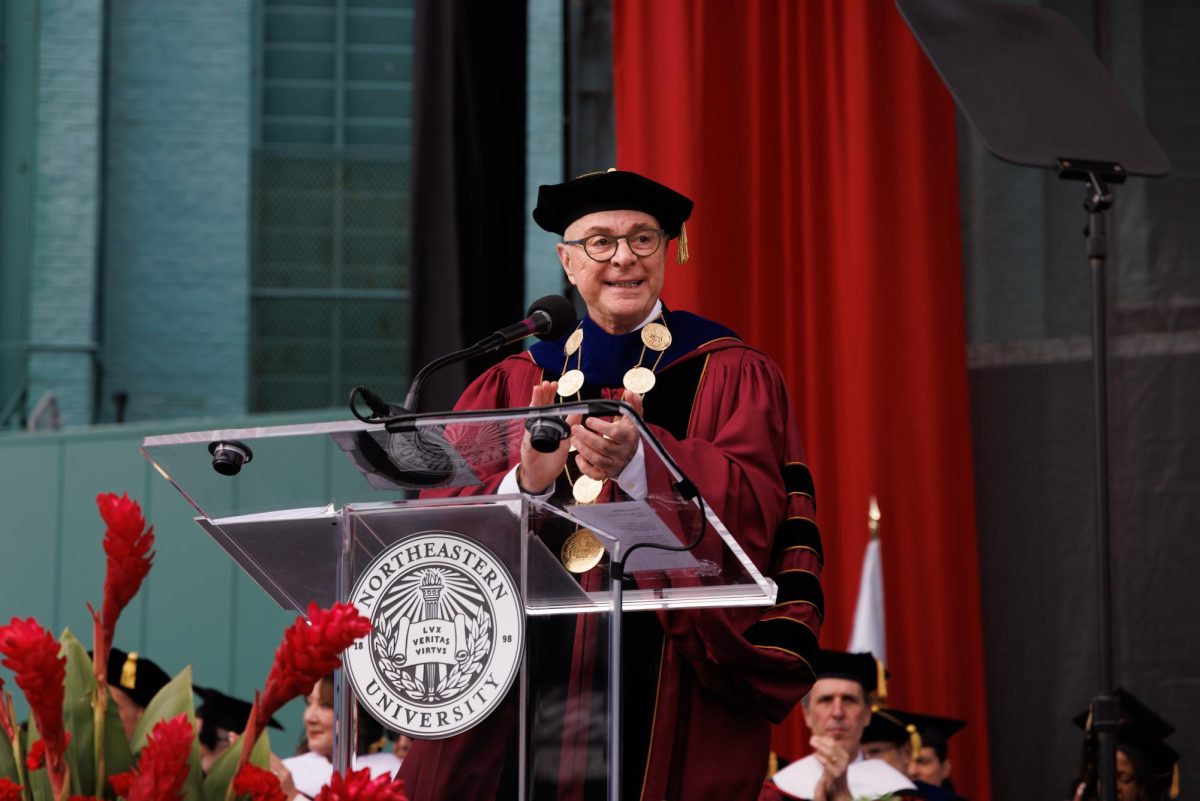
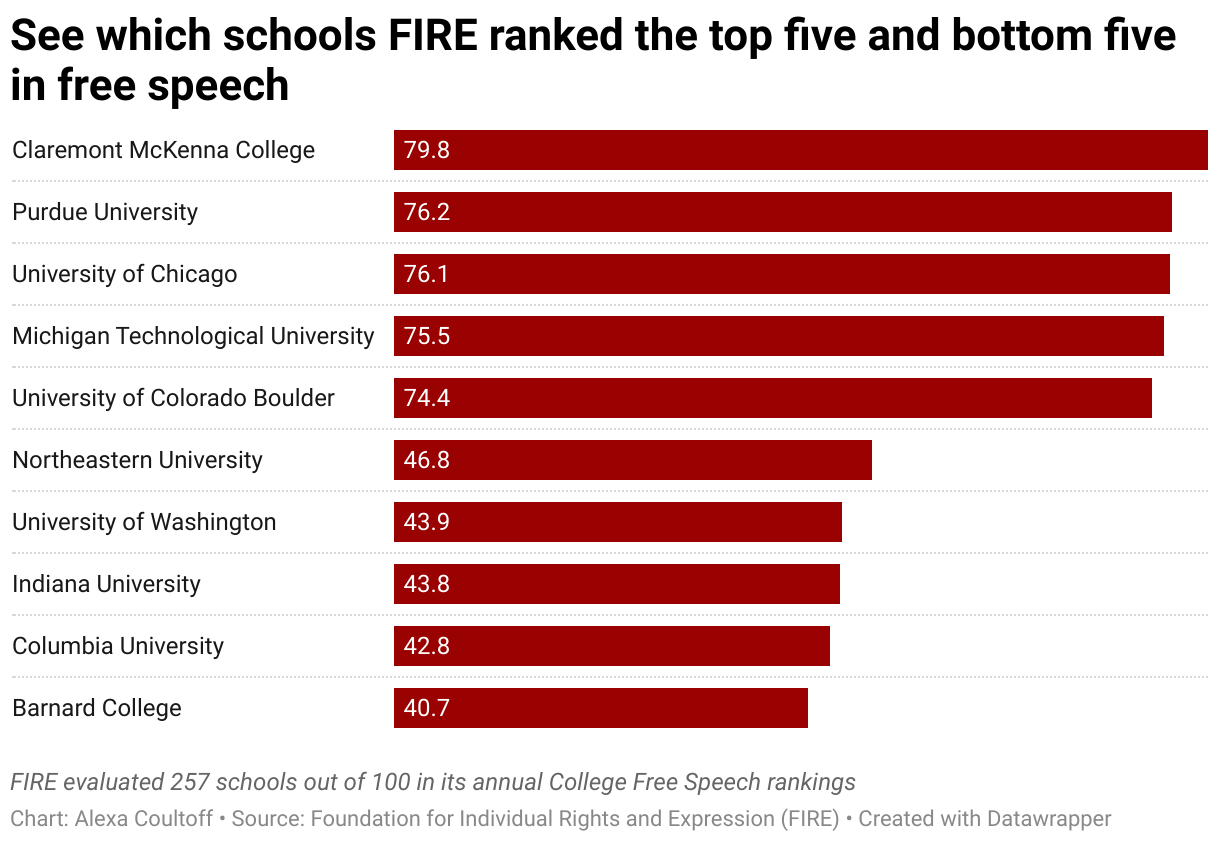
Northeastern claimed spot 253 out of 257 in the Foundation for Individual Rights and Expression’s annual College Free Speech rankings, dropping 75 places from the previous year’s ranking.
The report, released Sept. 9, collected data from more than 68,000 college students nationwide throughout the academic year. The rankings come after a semester marked by repeated federal government attacks on higher education institutions, and the organization said that most colleges earned around an “F” grade for free speech.
Northeastern declined to comment.
The Foundation for Individual Rights and Expression, or FIRE, first included Northeastern in its annual report in 2022-23, giving it 37.6 out of 100 points and a ranking of 155 out of the 203 evaluated colleges and universities. Although Northeastern’s score increased in 2024 and 2025 reports to 37.8 and 42.1, respectively, its overall ranking dropped each year.
“The rankings come at a notable moment for free speech on college campuses: clashes over the Israeli-Palestinian conflict, a vigorous and aggressive culture of student activism and the Trump administration’s persistent scrutiny of higher education,” the report reads.
This year, Indiana University, Columbia University and Barnard College claimed the bottom three spots while Claremont McKenna College, Purdue University and the University of Chicago ranked the highest.
The report evaluates universities in six areas using student responses: comfort expressing ideas, self-censorship, disruptive conduct, administrative support, openness and political tolerance. Northeastern students indicated their comfort expressing ideas increased, but they reported more self-censorship, less openness on campus, and less administrative support and political tolerance for their ideas. FIRE surveyed 268 Northeastern students for the 2026 report.
Northeastern attracted FIRE’s attention in April after a student group canceled a speaker event when university administration required it to provide a list of attendees. The talk, titled “Israel’s Attack on Gaza: The Question of Genocide, and the Future of Holocaust and Genocide Studies” was set to feature Raz Segal, an Israeli historian and associate professor of Holocaust and genocide studies at Stockton University.
Northeastern’s Center for Student Involvement has policies for all events held on campus, which may include requiring registration and Northeastern University Police Department presence. A university spokesperson told The Huntington News in April that the student group did not go through proper procedures to hold the event.
In a letter dated April 25, FIRE Campus Advocacy Program Officer Aaron Corpora wrote to several Northeastern administrators condemning the university asking the student group for a list of attendees.
“If Northeastern is to live up to its free speech promises, it must commit to no longer require attendance lists for expressive events,” Corpora wrote. In this year’s report, FIRE categorized the canceled event as a “deplatforming” incident and attributed it as to why Northeastern drastically slid down the rankings list.
Last semester, the Trump administration took particular aim at several high-profile universities, notably Columbia University and Harvard University. But despite a steady flow of attacks, Northeastern has yet to be publicly singled out.
Shortly after President Donald Trump began his second term, Northeastern published its “Navigating a New Political Landscape” FAQ page, which has been continuously updated to address the rapidly-changing realm of higher education. The “answers” are not signed or attributed to any university officials.
Under its “Research and Teaching” section, the university addressed concerns around academic freedom, which has for months sparked debate among faculty. The conversation around freedom of speech on campus predates the second Trump administration and prompted the formation of an academic freedom committee within Northeastern’s Faculty Senate in November 2024.
“As described in the Faculty Handbook, the university does not impose limitations upon the freedom of faculty members in the exposition of the subjects they teach,” the Feb. 12 update to the FAQ said. “Faculty members are always expected to exercise appropriate discretion and professional judgment in all facets of their teaching and research and abide by Northeastern’s policies.”