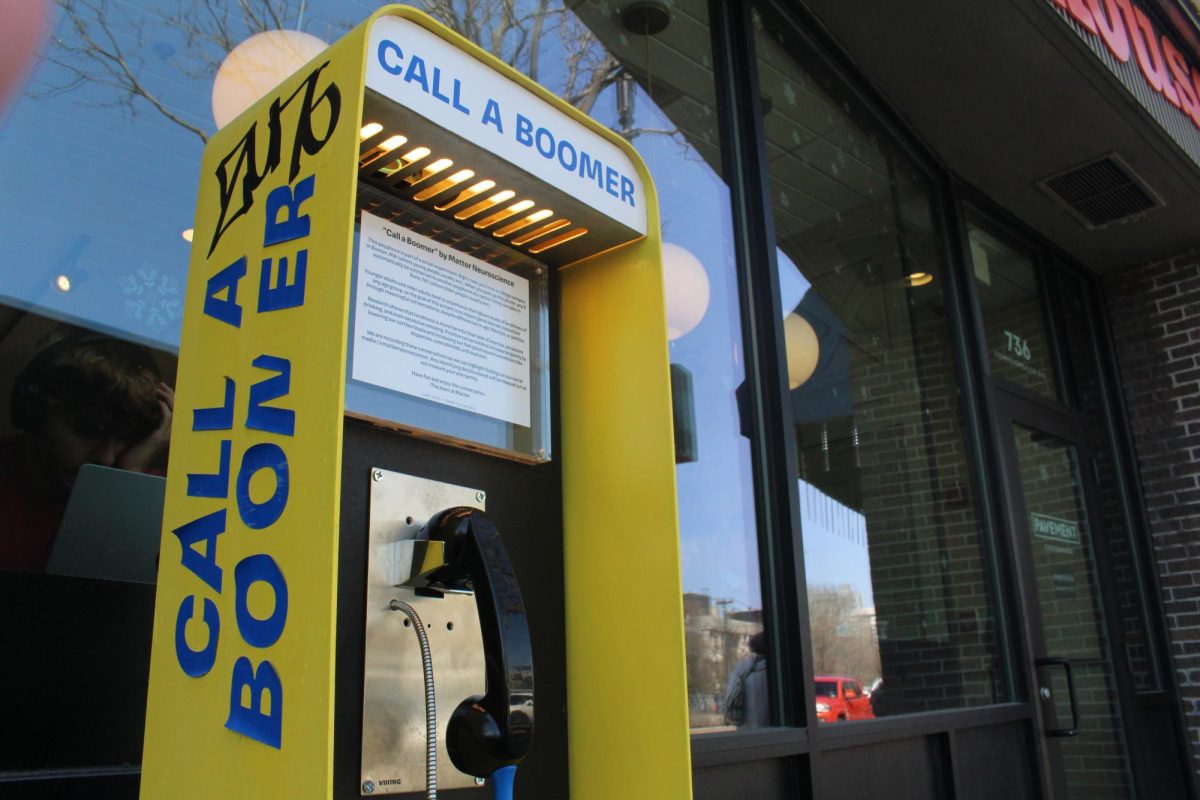
“Call a Boomer” was the phrase written in bold blue lettering on a payphone located in front of Pavement Coffeehouse on Boston University’s campus. And the phone did just that, connecting users directly to an apartment complex for older adults in Reno, Nev.
The phone appeared at the beginning of March — one installed in Boston, and the other residing in the game room of Sierra Manor, inscribed with the words “Call a Zoomer.”
Sierra Manor is an apartment-style living facility managed by the northern California & northern Nevada affiliate of Volunteers of America, or VOA NCNN, an affordable housing and human services nonprofit organization.
“[The Call a Zoomer phone] helped lessen the loneliness and isolation by broadening the opportunities for connection for our residents,” said Heather Bolen, community administrator for Sierra Manor. “They just lit up,” Bolen said of the residents at Sierra Manor when answering phone calls from Zoomers, or those in Generation Z.
The payphone was installed by Matter Neuroscience, or Matter, a startup aimed at “advancing human happiness for our collective good,” according to its website.
“Matter is a happiness company,” said Calla Kessler, a social strategist at Matter. “We are focused on helping people live a happier life by helping them understand their brain’s feel-good neurotransmitters and the positive emotions that they create and the daily actions they can take to activate them.”
Matter has conducted clinical research at Stanford University and Maastricht University in the Netherlands studying human brain activity to evaluate how the activation of neurotransmitters associated with human happiness can improve health and extend lifespan.
“The motivation was to bridge that generational gap,” Kessler said. “Younger adults and older adults are two demographics that experience loneliness at high rates, and so we wanted to give them an opportunity to connect because happiness is rooted in our relationships with each other, whether it’s friends, family, community or even just positive interactions with strangers.”
One in three adults over the age of 60 will experience some degree of social isolation, and approximately 50% are at risk of loneliness. Similarly, 67% of Generation Z report being lonely, the highest of any generation, according to the Cigna Group 2025 report on loneliness in America.
The installation process involved sourcing payphones from Facebook Marketplace and Craigslist to refurbish. Matter then installed a reprogrammed “Voice over Internet Protocol” phone, which uses an internet connection rather than traditional phone lines to make calls, with one direct line. Once the phones were ready, all that was left to do was figure out where they should go.
Matter decided on Pavement Coffeehouse at Boston University because of the high foot traffic and the significant number of college-aged students in the city. Logan Ivey, a social media producer for Matter, helped develop the partnership with Sierra Manor as a former VOA NCNN employee.
College students play a significant role in decreasing loneliness among older adults through other programs. For instance, Perfect Pair, a student organization at Northeastern and a chapter of a larger network, facilitates one-on-one friendships between students and older adults.
“We can tell how much they appreciate us being there, just by the little things and how they always tell us how much they’re thankful for us,” former co-president of Perfect Pair Christine Shin, who graduated in the spring, told The Huntington News in November 2025.
The Call a Boomer project is not the only payphone-related experiment Matter has run. In February, the startup introduced “The Party Line,” consisting of one payphone in Abilene, Texas, with the phrase “Call a Democrat” on it, connected to a payphone in San Francisco, with the phrase “Call a Republican.”
This project found that 70% to 80% of calls were reported as positive, and even when a conversation began with politics, it often broadened to include their lives. Matter noted on its Instagram that the word “love” was used 398 times in these phone calls.
The Party Line was removed at the start of April, followed by the installation of Call a Boomer and Call a Zoomer phones in mid-April.
“We want people to connect because connection and relationships are the bedrock of a happy life,” Kessler said. “So the whole idea was born of, ‘How can we connect people that might not connect otherwise?’ We want to bridge these connections in a polarized world. Connection was the common thread.”