To those in the food industry, “protein” is the magic word.
For months, “protein maxxing” has proliferated on social media as big-name brands line shelves with products packed with protein: protein bars, protein tortilla chips, protein Pop-Tart dupes, protein cookies, protein soda. And food and drinks already high in protein, like milk and yogurt, are being pumped with even more.
“For whatever reason, protein is like the new it girl, if you will,” said Darin Detwiler, an associate professor of food safety at Northeastern.
But the extent to which this protein fad is helpful is up for debate. Protein intake needs vary based on several factors, including sex, activity level and medical history. The newest Dietary Guidelines for Americans for 2025 to 2030 increased the daily recommended protein intake from around 0.8 grams to between 1.2 and 1.6 grams of protein per kilogram of body weight per day. The guidelines, which were released in January, told Americans to “prioritize protein at every meal” with both plant- and animal-based sources.
As Americans put on blinders and focus on just the protein content of their meals, they may neglect other vital nutrients, experts say. Dr. Michelle Dalal, a board-certified pediatrician and medical director of Northeastern’s Health and Counseling Services, said protein needs vary among individuals. She said the emphasis should be on eating a well-balanced diet which also includes fiber‑rich carbohydrates and healthy fats.
“Sometimes I worry that social media, yes, can provide some helpful information, but as we know, there also can be some widespread misinformation,” said Dalal, who earned her undergraduate degree in nutritional sciences. “And those extreme protein targets are not necessarily evidence-based.”
Protein is one of the three main macromolecules alongside carbohydrates and fats and plays an essential role in muscle repair, enzyme and hormone production, as well as immune function. Too little of it in the diet can lead to not feeling full, hair loss or swelling, and too much may lead to digestive issues and dehydration, especially if fluid intake is not increased, Dalal said.
She added that high-protein foods may contribute to weight gain if they also contain high amounts of sodium, saturated fats or added sugars. Detwiler said that consumers may be attracted to the protein content and ignore other nutritional information.
“It’s easier to say more protein or higher protein than it is to say more processed [or] ultra-processed,” Detwiler said.
But as many Americans set high protein targets, brands are paying attention. As of March, Dunkin’ Donuts is serving “protein milk” that “delivers a creamy, familiar taste without a chalky texture or aftertaste.” Chipotle introduced a high protein menu, where one burrito bowl can climb up to 81 grams of protein and a “high protein chicken cup” offers 32 additional grams of protein. At Starbucks, you can order from a list of “protein beverages” including a vanilla protein latte, an iced caramel protein matcha and a caramel protein latte, each around an $8 price point for a grande.
Rachel Rodgers, an associate professor of counseling psychology, said that unlike past fitness fads that advise people to cut back, “protein involves consuming more, and that is something the food industry finds much more appealing.”
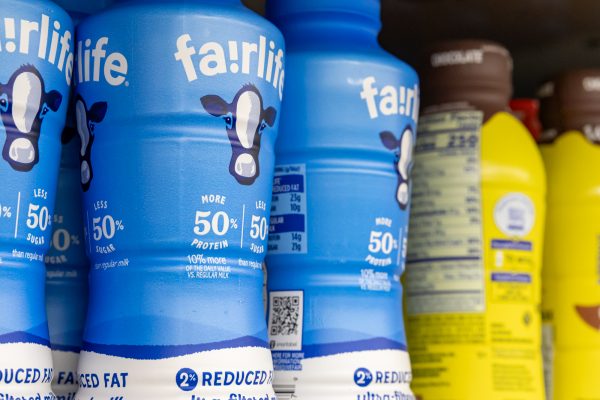
And with these colorfully-wrapped protein bars or frothy protein beverages, consumers are often shown fitness ideals. Ruby Sulter, a third-year international business major, works out around four days a week in addition to dancing and is a personal trainer. Sulter said she’d led an active life for as long as she can remember but strays from products that boast a high protein content, opting for foods naturally high in protein and other nutrients.
“I couldn’t afford to eat one of those every day,” she said of protein bars, which can retail for up to $4 for a single bar. “You’re spending a ton of money on them, when there are better quality protein sources for much cheaper that are better for your body in general.”
A higher protein count sometimes means an increase in other nutrients like sodium or saturated fats, too. If a product is labeled as high protein, but the protein is not derived from a whole food source like chicken or milk, it is considered processed, Detwiler said.
“If you see ‘high protein,’” he said, “you’re essentially saying it’s highly processed, in most cases.” (Other countries, he pointed out, require labels if a food is highly processed, a move American food lobbies have historically strongly opposed.)
And in many cases, products engineered to be higher in protein also often come with mile-long ingredient lists. “How do you ensure that there is transparency and traceability with such a long list of ingredients in these highly processed foods?” Detwiler said.
For Alessandra Medina, a second-year business administration major who is a member of Northeastern’s club weightlifting team, pre-made protein products are difficult to digest. “I’ve noticed that a lot of pre-made, protein-marketed products are really harsh on my stomach,” she said. “I try to be kind of mindful when it comes to pre-made products or packaged products that are marketed to be high in protein.”
The push to eat as much protein as possible may transcend an individual’s nutrition goals. To Rodgers, the protein maxxing trend fits into discourse surrounding body image.
“Muscularity and well-defined muscles have increasingly been a part of appearance ideals across gender,” she said. “But more recently, muscularity has also been emphasized as a desirable physical trait for women, and that has been facilitated to some extent by the rise of things broadly considered to be ‘fitspiration’ on social media.”
The point at which molding one’s nutritional goals around protein intake crosses over into disordered eating varies, Rodgers said.
“I personally consider any form of eating by rules as something that takes us into the realm of eating in a way that is specifically targeting weight and shape and appearance. Which is, if not a form at least, a precursor to disordered eating,” she said.
And in a world packed with protein, Dalal said to focus on balance: “Our goal is really to encourage whole, nutrient-dense foods.”