The Fashion Society at Northeastern, or TFS, hosted its annual spring fashion show, “Synesthesia in Motion: A Fashion Sonata,” at the Boston Center for the Arts Cyclorama April 5.
A sonata, as TFS describes it, is “a story told through sound” — a structured musical composition written in movements that explores a central theme, expressed here through sound and fashion.
The show unfolded across five consecutive sections, each visually interpreting an original classical score composed for the evening and performed by a live orchestra. Conducted from the center of the Cyclorama’s round interior, the ensemble played as models walked in a spiral around the seated audience.
To open the night, Matt Issa-Abbas, a rising fourth-year professional music major at Berklee College of Music who composed the show’s score, announced, “For your best viewing experience, we highly encourage guests to look to the music as inspiration for the outfits. Color, fabric and structure all play a role in making our story come to play. We are excited for you to go on this journey with us.”
Organizers estimate that approximately 400 guests attended, many of whom arrived dressed for the occasion. From the opulent venue to the circling photographers, the show felt like a professional production. “We didn’t want it to feel like a school event,” said Julia Hus, rising fourth-year international business major and vice president of TFS.
TFS has been planning this fashion show, traditionally its main spring event, since last May. The venue came before the theme, with the Cyclorama’s unique architecture inspiring the show’s evolution.
Angelina Manolios, rising-fourth year computer science major and president of TFS, proposed the sonata theme alongside other members, and it was ultimately selected by popular vote from the club’s executive board.
“I personally wanted one continuous story,” Manolios said. Typically, she said, fashion shows feature four sections divided by an intermission, but “Synesthesia in Motion” ran five musical movements without an intermission.
The fabrics, colors and music worked cohesively within each movement, collectively building a narrative as the show progressed. It began with a simple melody and soft, flowing fabrics. Silks and chiffon in pale pinks and reds caught the light as models moved. The second movement kept the same airy textures but shifted the palette, deepening into blue-greens layered in satin.
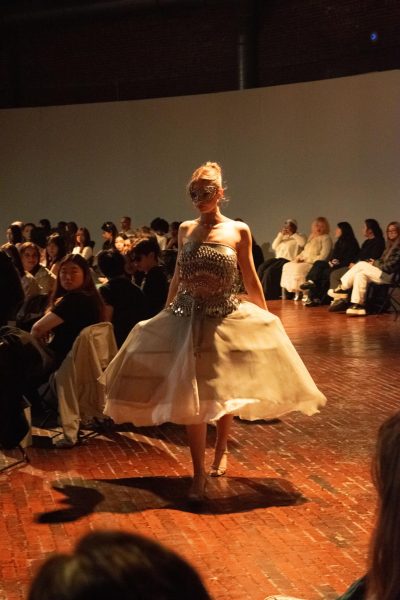
After the first two movements, the pace and tone of the music shifted, taking on a more intense quality. Section three arrived like a rupture, completely unlike anything that came before. The first model, dressed in a white two-piece, took on an anxious countenance as she walked with a tense, searching gaze. Then, to the audience’s surprise, a second model in black emerged from among the seated crowd and stepped in to follow her.
The audience visibly stirred, their attention fixated on the runway. This third movement consisted of a suspenseful series of alternating white and black looks featuring elaborate headpieces and veils, followed by feathers, mesh and metallic fabrics, none of which had appeared before.
The next movement answered with heavier textures, velvet and denim, returning to the blue-green palette of movement two but with more gravitas. The show culminated in gold and silver, with structured, sculptural looks that included accordion-folded gold wings, one model lifting and spreading as she walked, and a wide, structured skirt with a sequined silver top that audibly clinked.
Each model paused at the center of the spiral to pose before continuing their exit, the choreography deliberate and shaped by the venue. This effect was a year in the making, the result of coordinated work across music, styling and marketing.
Manolios’ vision was to tell a story through the arc of a classical composition. Last fall, she reached out to Issa-Abbas — who had composed the electronic score for last year’s show — hoping he could connect her with someone for the classical commission.
“He was actually like, ‘Oh, wait, my two sides are the electronic and the classical stuff.’ So it was just perfect from the start,” Manolios said.
Manolios prepared a detailed music guide outlining each section, and Issa-Abbas built the score around it through multiple drafts. He also conducted the eight-person orchestra, made up entirely of Berklee students, throughout the show.
Behind the scenes, the team coordinated modeling, styling, hair and makeup, events and marketing. Each team had its own committee, lead and executive board point of contact. (The styling team alone comprised 34 stylists.)
Manolios and Hus supported every group along the way, with Hus contributing mostly to styling.

Hus set the tone with quality and thematic guidelines, balancing quality standards with creative autonomy. Manolios walked as the final model in a sheer gold overlay gown with a matching swirl-patterned ribbon scarf around her neck.
“I never wanted the looks to be casual,” Hus said. “It shouldn’t look like your model is just wearing a jacket — it should be something that looks like it should be on a runway. More couture is my vibe.”
In the final week before the show, she reviewed every look from dress rehearsal and sent individual notes to each stylist, pushing for cohesion across sections. Hus said the day of the show was remarkably calm in contrast to the chaos of previous years.
“Our [executive board] was very organized and they’re just really reliable,” Hus said. “Things went very smoothly, and the actual show itself played out super well.”
For Manolios, who had been carrying this vision since last May, the final movement was the big payoff. The gold and silver looks closed out a show that had taken almost a full year to build, each the result of dozens of people working toward something that, from a seat in the Cyclorama, looked seamless.
When the final movement concluded, all 58 models returned to walk the spiral together one last time. “The journey is just as important as the section five gold, euphoric feeling that you feel at the end,” Manolios said.