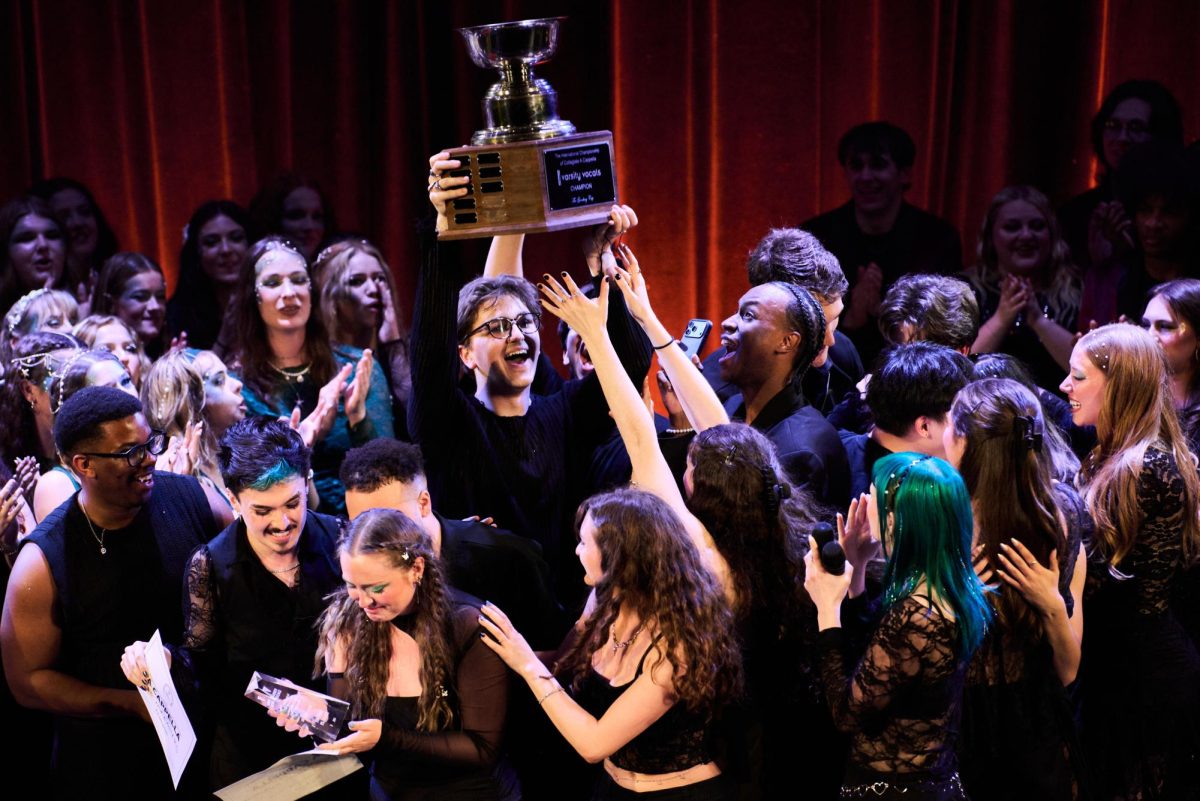
For the first time in nine years, The Nor’easters returned to the stage at The Town Hall in New York April 25 and won first place in the International Championship of Collegiate A Cappella, or the ICCA. Earning 447 points at the final round, Northeastern University’s oldest a cappella group achieved the second-highest score in ICCA Finals history, setting a new record from their 2013 and 2017 ICCA wins.
The ICCA, founded in 1996, is the “real-life ‘Pitch Perfect.’” This year, 432 groups participated across nine regions in the United States, Canada and the United Kingdom. The groups qualified for the competition via video submission before competing in the quarterfinal and semifinal rounds, with one group from each region advancing to the finals. Competing groups were scored by a panel of judges in categories of vocal performance, visual performance and subjective rank.
At The Town Hall, the Nor’easters weren’t in the audience awaiting their set — they were in the basement, hearing the stomps of their competitors performing in the theater directly above them. The group drew ninth in the performance order, not taking the stage until late into the night.
The Nor’easters’ 10-minute set consisted of four songs: “Welcome To My Island” by Caroline Polachek, “Where Is My Husband!” by Raye, “Hopedrunk Everasking” by Caroline Polacheck and “The Moment I Said It” by Imogen Heap.
“Where Is My Husband!” was soloed by a trio comprising Tulip Ghosh, a rising third-year business administration major at Northeastern, Sarah Sovak, a rising second-year vocal performance major at Berklee College of Music and Allie Fosnot, a rising fourth-year contemporary writing and production major at Berklee College of Music. “Hopedrunk Everasking” was soloed by Olivia Zegers, a rising fourth-year music major at Northeastern. The opening and closing songs were soloed by outgoing fifth-year health science major Julianna Zannikos, who won the “Outstanding Soloist” award at the quarterfinal, semifinal and final rounds for “The Moment I Said It.”
Their set was titled “Desire” and was centered around a feeling of wanting more, Fosnot, the group’s music director, said. The word “desire” appeared in each song in the same melodic format, jumping out over hypnotic, droning lines evoking the sirens of Greek mythology who lured sailors to their deaths.
“It’s really just kind of an ode to our sopranos,” Fosnot said. “There’s so many floating soprano lines and really, really high parts that I think is something that sets us apart from everyone else, because it’s so unique.”
In 2025, The Nor’easters won second place at semifinals behind Northeastern’s Pitch, Please!, who advanced to the final round. This year, every member of The Nor’easters was fully invested in “Desire,” Fosnot said.
“The goal at the end of the day was having a set that we all collectively believed in, because I think that was where we ran into struggles last year when we did it, we weren’t all fully in it,” Fosnot said. “But now, I really feel like we have that vision achieved where we all want something more with this and we all truly believe in it.”
In their eight-year ICCA hiatus, The Nor’easters participated in other a cappella competitions, winning the 2019 National A Cappella and Choral Convention and the 2023 Boston Sings [BOSS] competition.
“We hadn’t realized how much the ICCA had changed since 2017 when the group won,” said Carlos Noel, a 2026 Harvard Medical School graduate and assistant music director of The Nor’easters. “We found that a lot of groups had stories or themes with their set, which is an approach we didn’t take last year. So that’s something we really prioritized this year, making sure our set made sense cohesively and had a narrative or at least a theme that an audience could follow.”
To prepare for this year’s ICCA, The Nor’easters rehearsed four times a week for three hours at a time. Nathan Yoon, a rising fourth-year business administration major, joined the group in fall 2025 and immediately jumped into competition mode.
“When I first joined the group last semester, they always talked about, ‘Oh, you’ll sound like a Nor’easter by the time we do competition,’ and I never really understood what that meant,” Yoon said. “But now that we’re in competition, I could feel how much my voice has developed.”
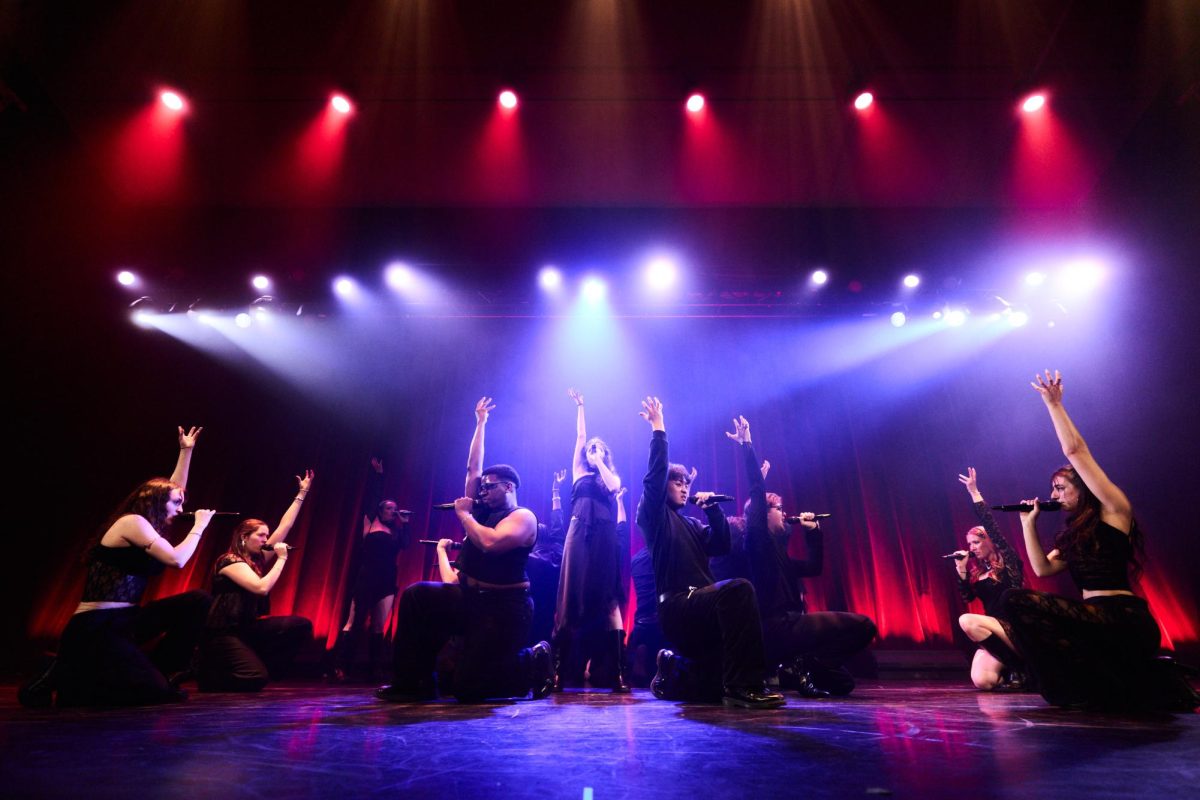
Fosnot said that their 2026 set contained references to their previous competition sets through their choreography. Miguel Aninon, a former member of the group who graduated in 2023, choreographed the entire set. The group knelt in a formation leaning toward Zannikos, who stood in the center, opening the set with a soaring soprano note that pushed into a powerful, emotional battle cry as the rest of the ensemble burst in with a heavy “wall of sound,” shooting their hands up into the air.
The “wall of sound” is the group’s signature sound, which they often pair with their “Nor’easters face,” a scrunched, angry and severe look. This specific bright, resounding tonal quality has become The Nor’easters’ brand, stemming from years of refining their sound through competitions and performances.
The choreography featured sharp movements that fell into soft, gradual follow-throughs. During “Where Is My Husband!” the group was playful and sassy, yet still swiftly executed their choreography like a perfectly regimented unit, flipping their hands back and forth during the bridge á la Beyoncé’s “Single Ladies.”
The tone quickly shifted as they transitioned into “Hopedrunk Everasking,” which contained the set’s most vulnerable moment. The group laid down on the stage as Zegers sang, writhing inward to form tight circles around her as she finished the song. Her voice, agile and emotional, conveyed a devastating brokenness at the end of her solo before Zannikos reappeared for “The Moment I Said It.” A powerhouse soloist, Zannikos’ performance was backed by the arrangement’s weaving of ensemble voices, an electronic-sounding, fast-moving progression toward another “wall of sound.” Her voice navigated seamlessly between belting and riffing up to extremely high soprano notes.
The set ended with the group standing at the front of the stage in a straight row. They held their fists clenched at their sides before slowly raising their arms, fingers outstretched and flexed, locking the movement in straight above as Zannikos slid into a clean F#6 note. When they ended their set, Yoon said the audience erupted into the loudest cheers he had ever heard.

The set was arranged by Fosnot and Blake Farfan, an alumnus who graduated from Northeastern in 2024. In rehearsals leading up to finals, Fosnot would often arrange on the spot, moving certain vocal parts around or tweaking minor details to perfect the set’s sound. The group went through several iterations of the set’s ending between semifinals and finals.
Throughout the preparation process, Fosnot said that alumni members would frequently attend rehearsals, offering critiques and feedback for the set. She said many of The Nor’easters’ alumni members attended finals, some of whom had been in the group when they won the ICCA in 2013 and 2017.
“The reason all of us wanted to join this group is because of what the alumni have created for us,” Yoon said. “They built the foundation, and it’s a lot to carry that forward, or to carry their legacy on. But at the same time, our alumni network is so, so supportive.”
Noel, who competed in the ICCA with his undergraduate a cappella group at William & Mary, said that competing with The Nor’easters felt different.
“We know our ceiling potential in The Nor’easters is very high just because the audition process is so rigorous,” Noel said. “Everyone in the group is a very excellent singer, and we know that with good leadership and a good plan, we can go very far. … I think with this group, it’s more about upholding this legacy, which is an element I didn’t really think about when I was competing before. That adds some stress, but it also adds a lot of motivation to do well, because we know what this group can and has done in the past.”
After the judges announced the third and second place groups, time slowed as a prolonged nervous anticipation followed. Yoon had his eyes closed, hands gripping the shoulders of the two group members standing next to him. Then, in one surreal moment, The Nor’easters heard their name announced as the 2026 world champions of collegiate a cappella.
“I honestly think at some point, everyone probably cried,” Yoon said. “It was insane, but we were just so filled with joy, tears of joy.”