On a Friday night in Fields Corner, customers fill every seat at JustBook-Ish. Families, elders, children and friends pack themselves into the snug space, eager for the competitive night of slam poetry ahead.
“We like to think of this as a community meal: We come to get fed,” said Emmanuel Oppong-Yeboah, the City of Boston’s poet laureate, welcoming the crowd to JustBook-Ish.
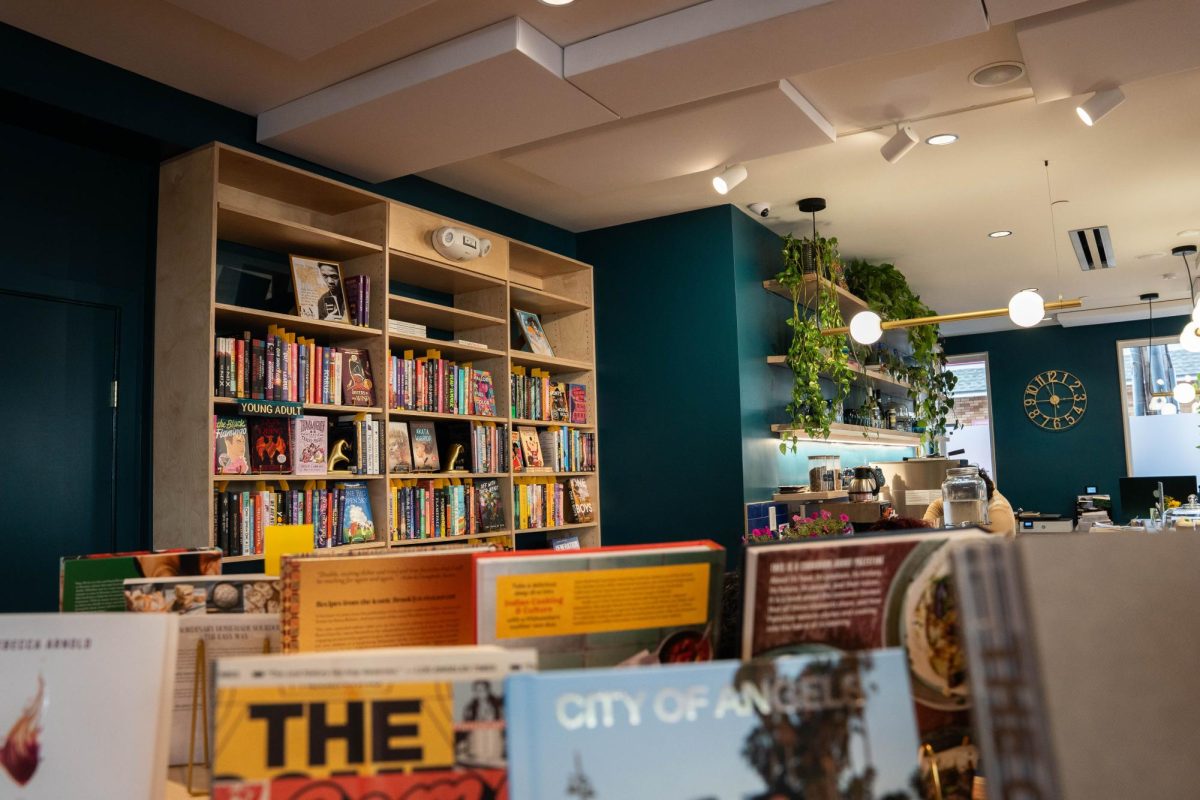
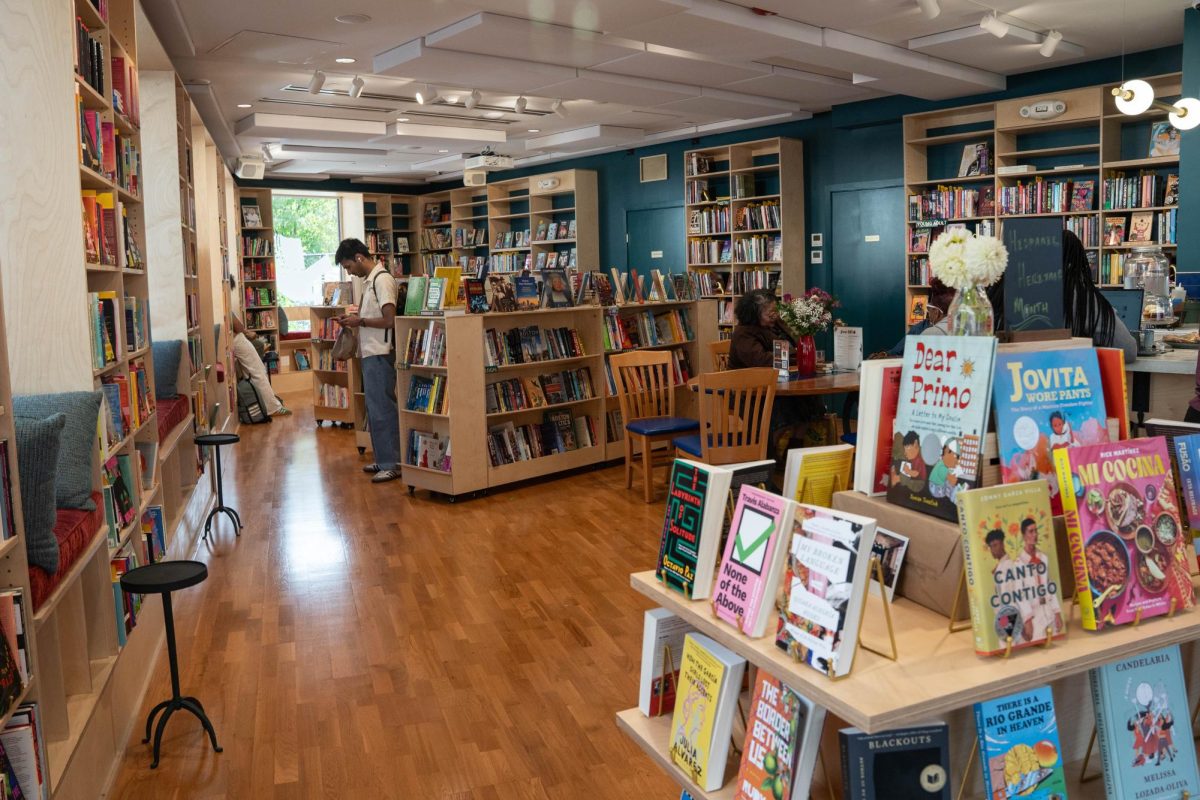
JustBook-Ish, located at 1463 Dorchester Ave., may technically be a bookstore, but since its opening in late 2024, it has grown into something more. “We identify as a literary gathering space, which is to say that we’re interested in both the literary aspect as well as the gathering,” said Porsha Olayiwola, the co-founder of JustBook-Ish who formerly served as Boston’s poet laureate.
The store’s origins date back to 2013, when Olayiwola walked into Haley House, a local nonprofit with a social enterprise cafe in Nubian Square, with the idea of creating a slam poetry team. Bing Broderick, co-founder of JustBook-Ish, then working at Haley House, watched as Olayiwola assembled a team that went on to win three national awards.
Nearly a decade later, in 2022, when Broderick stepped back from his role at Haley House, the two reconnected. When they learned about an open retail space in Fields Corner, the idea for JustBook-Ish began to take shape.
“We suddenly had to raise the money to do the build-out. We had to start a nonprofit, too,” Broderick said. “We learned a lot, but every step of the way we were putting one foot in front of the other.”
The result is JustBook-Ish — a space that functions as part bookstore, part event venue, part nonprofit, part cafe and overall as a welcoming space for the community.
“Sometimes I’ll be walking home from work or school and I’ll see something happening. It always just looks like a place that’s full of life, and I love that,” said Veronica Burnier, a third-year communication and classical studies student at the University of Massachusetts Boston.
For Olayiwola, each phrase carries weight. Culturally curated means representing the diverse local community and fostering conversations that don’t happen everywhere. And locally inspired means actively listening to the community and making sure the store’s ethos matches its surroundings. (Fields Corner, which is the heart of Dorchester, sits in one of the most diverse ZIP codes in the country.)
“We’re interested in making sure that the programming and the books reflect the aesthetic of really American arts culture,” Olayiwola said. “I don’t know that we’re that radical, but I know that our politics lean that way. I think we’re moving out of love.”
For Olayiwola and Broderick, being locally inspired in a place like Fields Corner means being responsible for uplifting a community whose stories have long been overlooked in literary spaces.
Their mission is evident in the store’s weekly programming. In recent months, JustBook-Ish has hosted an event on decapitalizing death, a memoir talk with a queer Muslim author held anonymously online to protect them from harassment and a talk with an legal organization for tips on interacting with federal immigration agents.
“We have the fear and we move past it, we’re brave in the face of [the current political climate],” Olayiwola said.
For Thomas Reilly, a 28-year-old field service engineer who lives up the street from JustBook-Ish, the store became a space and community he didn’t know he needed.
“The books were not as much of an appeal because before I started coming here, I don’t think I had read a book in about 12 years,” Reilly said. “If I don’t force myself to go places and do things, I just won’t. I’ll just sit around and do nothing. So this is a very low-friction space that I can go to, spend some time at a house, interact with people,” he added.
That need to connect runs even deeper for communities facing political pressure, oppression and attacks on their identities, said Silvia Dominguez, an associate professor of sociology at Northeastern.
“I think there’s an attack on people of color, there’s an attack on women and there’s an attack on low-income people. You really need a place like this bookstore to recover from the attack,” Dominguez said.
Dominguez sees the value of third spaces, places separate from the two main spaces of work and home, as two-pronged; they create space for identities to be acknowledged, understood and celebrated,and they are a place where politics can develop. Third spaces foster the exchange of ideas and create the opportunity to participate in open discourse; two things Dominguez believes are fundamental to democracy.
For Reilly, the value of a place like JustBook-Ish extends beyond leisure.
“A secular community space like this is really, really important because a place where you can form community with people often only comes from very specific, financially tied or religious institutions,” Reilly said.
Olayiwola expressed gratitude for the community’s appreciation for JustBook-Ish.
“We wouldn’t be here without you being here. I feel exceptionally grateful and also know that it’s necessary,” she said.
As the poetry slam was coming to an end, Oppong-Yeboah closed the night with a cento — a poem composed on the spot from one line of each poem performed that evening. Then he turned his attention to the audience, asking, “Do you all feel full?”