Northeastern’s Center for International Affairs and World Cultures, or CIAWC, invited three experts to its annual “State of the World” panel Nov. 13 to discuss topics including international security, strategy, cooperation and artificial intelligence.
The State of the World series is a panel that brings leading scholars together to discuss and reflect on key issues currently shaping the world. This year, several topics were up for discussion, including growing tensions between Ukraine and Russia, China’s expanding role on the global stage and national and international security in the U.S., China and the EU.
Moderated by the Director of CIAWC, Mai’a Cross, the panel included Associate Dean of Studies of Boston University’s Pardee School of Global Studies Kaija Schilde, Northeastern Assistant Research Professor of Political Science Xiaoxiao Shen and Boston College Associate Professor of Political Science Jennifer Erickson.
Cross began the panel with a question to Schilde, whose research focuses on military spending, defense reform, innovations and independence in transatlantic relationships. Cross asked whether the recent changes to European defense are a fundamental, long-term shift or merely a short-term adjustment to the “crisis” in the region.
“I am firmly in the camp of saying that, structurally, European security has changed significantly and probably permanently towards a more security-oriented position that is centered around the EU, not as much around NATO,” Schilde said. “So I see the EU as the key 21st century, or for the next part of the 21st century, security actor in Europe.”
The conversation transitioned into a discussion of international cooperation and China’s international relations. In 2025, China and Russia deepened ties as their leaders clashed with President Donald Trump in an ongoing trade war. An already-tense relationship between China, Russia and the U.S. has been exacerbated by divergent approaches to leadership, foreign relations strategy, energy resources, nuclear testing and arms control.
“On the arms control side, in theory, the U.S. wants very much to participate in nuclear arms control if China is at the table,” Erickson said. “From the U.S.’s perspective, why restrain yourself when your rising competitor doesn’t have any restraints on its nuclear arms control? But if we flip this and we say, ‘Well, let’s look at this from the Chinese perspective,’ if you’re China, and you have 500 warheads and the U.S. has over a thousand, you’re not really interested in constraining yourself yet either — or ever.”
The three panelists also discussed artificial intelligence, or AI, with each offering reservations about the rapidly developing technology. Shen said deepfakes — realistic AI-generated images, video and audio recordings created using large amounts of data — and misinformation could undermine decision-making about security.
“In an intense environment, [deepfakes] can really trigger real military responses before anyone has the time to really verify the matter or not,” Shen said.
Schilde noted a time a few years ago when one of her daughter’s friends, who was 11 at the time, told her that she believed Russia’s invasion of Ukraine was deserved, and that the U.S. was partially to blame for expanding NATO.
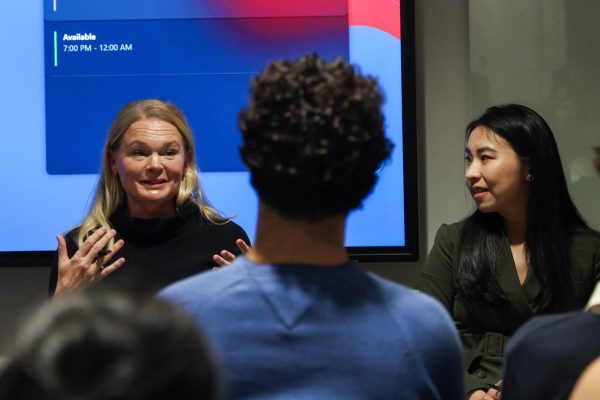
“There is so much weaponized disinformation that I want to turtle, and I want to dig a hole and put myself in it — about just what’s gonna happen with AI on top of that,” Schilde said. “Because this stuff is generated in propaganda centers in the [Global] North, it’s not generated in the [Global] South. It’s going to hurt people and it’s going to hurt people everywhere.”
At the end of the panel, Cross asked the speakers what policy recommendations they would suggest to improve international relations, strategy and security.
Schilde suggested a further crackdown by the EU on loopholes in illicit economies, particularly money laundering and white collar crime. She related this to when the U.S. cracked down on terrorism and illicit economies after 9/11.
Erickson and Shen mentioned pushing more for international cooperation and agreements among various countries and people on issues like climate. Erickson suggested incorporating and seeing other kinds of agreements, such as different kinds of guidelines and political agreements, take place. Shen proposed involving the Global South and private sectors, particularly tech companies, in the security dialogue, forming cooperation at a smaller scale between individual people, like scientists, in different countries, and investing more digital literacy resources in the next generation.
Some students, including Leonardo Chen, a fourth-year computer engineering major, noted the conversation around international cooperation was interesting.
“I think breaking down international cooperation and talking about smaller things, like transnational drug law enforcement or international aid, and starting small there and building up to a bigger treaty, made a lot of sense, and it was really cool to hear,” Chen said.
Other event attendees said their understanding of European politics and international relations was strengthened by the discussion. Stina Dewes, a second-year political science and economics combined major, said the event further expanded on issues not discussed in her core classes.
“I loved that it was very pro-European, and I liked the take of AI governance and how China is kind of trying to take a leadership role in that and how that might shape the triangle of power between these three players, the U.S., EU and China,” Dewes said.
Peter Tepatti, a third-year cultural anthropology major, said the panel offered him insight for his own work.
“My studies and research focus on human rights and identity, so I found it highly compelling, the discussion on geopolitics, because that is not really where my experience lies in so it added more nuance and layer to my own research,” Tepatti said.