Northeastern hosted its annual “A Tribute to the Dream: Voices of Past, Present, and Future” event Jan. 15, honoring the legacy of Martin Luther King Jr. and highlighting students and faculty who uphold and embody his values.
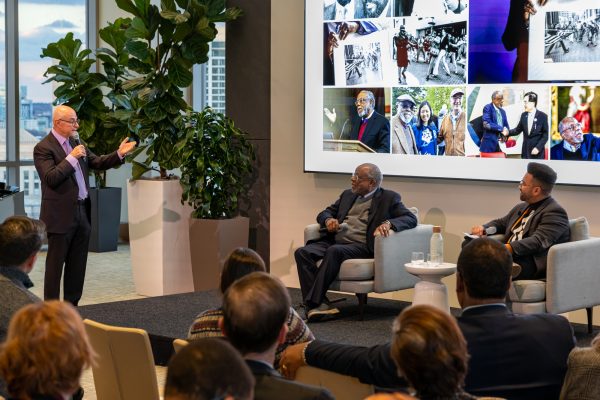
Held on the 17th floor of East Village, the event drew a large audience of students, alumni, faculty and community members. Dr. Martin Luther King Jr. graduate fellows Eiyannah Orphelia, who is pursuing a master’s degree in public health, and Brian Kazinduka, who is pursuing a master’s degree in artificial intelligence, served as co-masters of ceremony.
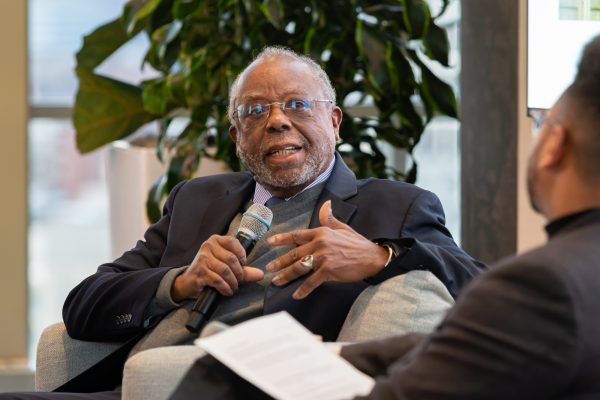
This year, the program honored Ted Landsmark, a distinguished professor of public policy and urban affairs in the College of Social Sciences and Humanities and a long-time civil rights advocate. During the event, Landsmark praised how King did not just preach to crowds but also lived his values.
“[King] was an inspirational person, whose inspiration was not limited,” Landsmark said to the audience. “He was willing to put his body on the line in terms of participating in demonstrations and actions, but he was also willing to sit down with policymakers to make specific recommendations on policy actions that could be taken, that would open voting, employment, childcare and a range of other things.”
Landsmark emphasized the importance of returning to King’s values, especially in moments of social and political uncertainty.
“It’s important as a reminder of how we need to be consistent in reflecting on our ethical values,” he said, emphasizing the need to “be open, honest, curious and committed to positive values in all of the work we do.”
The event spotlighted the university’s Dr. Martin Luther King Jr. Graduate Fellowship, which grants scholarships to six graduate students each year, covering tuition and fees. According to the program’s website, recipients of the fellowship “should be, but not be limited to, students of African origin [who] demonstrate high leadership standards and have a record of community service.”
The program opened with music from Northeastern alumni Alan Rias and David Langford. Together, they performed the traditional gospel hymn, “If I Can Help Somebody” by Alma Bazel Androzzo.
Following their performance, Northeastern alumnus Zolan Kanno-Youngs took the stage to moderate a discussion with current MLK Graduate Fellows Azariah Baker, Sebastian Caicedo, Chikamadu Okafor and Amari Turner.
Kanno-Youngs, who graduated from Northeastern in 2016 with a degree in journalism, currently works as a White House correspondent for The New York Times, covering President Donald Trump and his administration.
Kanno-Youngs asked fellows to reflect on how King’s work continues to shape their goals in public service, education and advocacy. Caicedo and Okafor, who both earned undergraduate degrees in 2024 from the Bouvé College of Health Sciences, spoke about applying King’s teachings to present-day challenges in healthcare as they continue their studies in Northeastern’s master’s of public health program.
For example, Caicedo emphasized his wish to work with marginalized communities who do not receive much healthcare attention. “I want to tackle health disparities,” he said in an interview with The Huntington News after the panel? “I want to make sure people’s voices are heard and represented.”
Caicedo said that participating in the event felt important at a time when historical narratives can become distorted.
“I think it’s very important to share Dr. King’s message because I feel like there’s a lot of times when history can be rewritten and where things are lost or forgotten,” Caicedo told The News. Okafor echoed Caicedo’s sentiments about the importance of remembrance and how it can be translated into action.
“[The event] also gives an opportunity to hear from older generations and learn from what they went through, and hear their advice for how we, as a younger upcoming generation, can make more headway in areas of advocacy and service in other communities,” Okafor said.
Much of the Jan. 15 event highlighted Landsmark’s legacy beyond Northeastern, specifically how he is widely recognized for being the subject of the Pulitzer Prize-winning photograph “The Soiling of Old Glory.” The photograph, taken in 1976 by Stanley Forman during Boston’s desegregation busing crisis, depicts white teenager Joseph Rakes assaulting Landsmark with a flagpole bearing the American flag.
“I couldn’t really hold any anger towards the kids themselves because I felt they were being manipulated by policies that had unfairly, unfairly, discriminated against minorities in Boston,” Landsmark said.
As a college student, Landsmark took part in the Selma marches and the March on Washington for Jobs and Freedom, where King delivered his iconic “I Have a Dream” speech. Today, Landsmark combines his civil rights work and educational expertise to host an annual conference on equitable policy engagement.
A video message from Boston Mayor Michelle Wu played at the event praised Landsmark’s work and influence on civic life in the city. “He was, and still is, the man who has spent every day building a better Boston, one where justice and opportunity belong to everyone,” Wu said in the video.
Wu also highlighted Landsmark’s work as an educator.
“At Northeastern, Professor Landsmark has taught generations how to cause ‘good trouble,’ empowering students to take on and improve the systems that affect our city and country,” she said.
The event continued with a video about Landsmark’s life and career, featuring remarks from Northeastern President Joseph E. Aoun, Distinguished Professor of Law Margaret Burnham, Boston City Councilor Edward Flynn and broadcast journalist Callie Crossley.
Following the tribute video, Kanno-Youngs joined Landsmark onstage for a one-on-one conversation. They were then joined by Aoun, who called Landsmark a “thinker and a doer” and praised his work as an “inspirational leader.”
“When you’re describing King, you’re describing yourself,” Aoun said to Landsmark.
In an interview with The News following the event, Landsmark reflected on the complexities of modern leadership, especially in the age of artificial intelligence and constant public scrutiny.
“This is a very complicated world, and having experience with the vagaries of ethical behavior is really important,” Landsmark said. “Northeastern opens opportunities to gain that experience through experiential learning.”
Reflecting on King’s legacy, Landsmark urged young people not to grow complacent in the face of modern injustices.
“Dr. King was exemplary in providing the kind of ethical leadership that we’re going to need, particularly in a world of digital complexity and challenges to authenticity,” Landsmark said.
As the event ended, Landsmark’s message was clear: King’s legacy is most meaningful when paired with action.
“This is not a time to be complacent. It is a time to take advantage of the innovations that are now available to us as educators and as activists, to turn around a number of things that work against social justice,” he said.