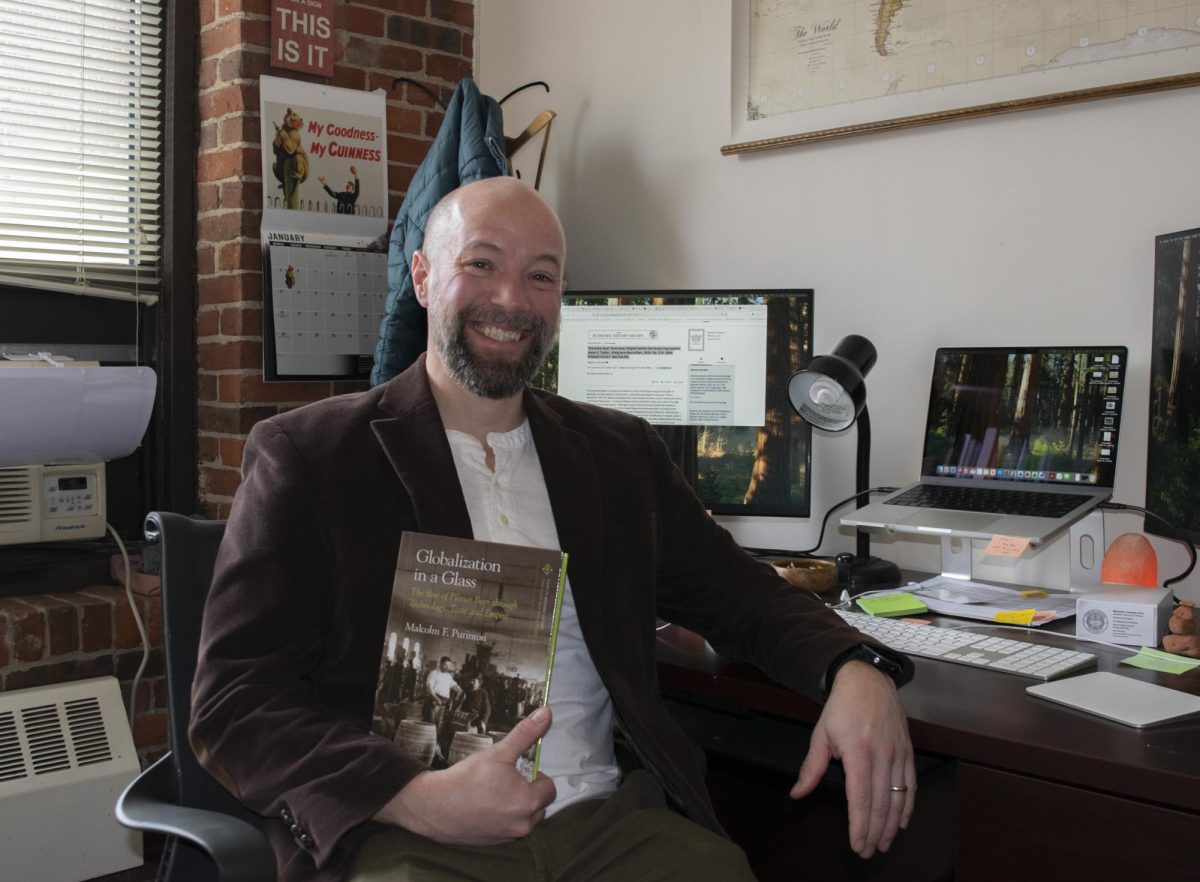
Malcolm Purinton, Northeastern’s resident beer historian, did not always consider the study of alcohol to be a legitimate academic pursuit. But when he dove into the history and significance of alcohol in cultures across the world, he realized the depth hidden in the subject.
“Beer and alcohol is a lens to look at the world. It is a lens to look at society, economics, business, education, trade, empire, migration,” Purinton, who is an assistant teaching professor of history at Northeastern, said. “[It’s a way to look at] the history of the world and our species through something that is often problematic and controversial.”
Purinton always had a vested interest in beer and began brewing his own in 2002 after earning his bachelor’s degree in theatre from Hampshire College. He was attending beer festivals around Boston at the time when he met the publisher of the Yankee Brew News, who asked if Purinton wanted to write for the publication. Purinton is still a columnist for the site.
His formal journey into the study of alcohol began at Northeastern, where he pursued his master’s degree in history.
While taking a class on African colonialism, Purinton’s instructor Katherine Luongo, an associate professor of history and international affairs, encouraged him to write a paper on beer and alcohol after he mentioned his interest in beer and brewing.
Purinton, who was studying the history of religion at the time, initially felt that writing about alcohol was “crazy.”
“I was learning Arabic, I was diving into that world when beer came along,” Purinton said of his research into the Middle East and religious history. “I thought, wow, learning German is a lot easier than learning Arabic and going to Europe is probably a lot easier and delightfully cooler, both politically and climate-wise, than the Middle East. It just sounded like a lot more fun.”
He chose to submit a literature review examining how people have studied the history of Africa through alcohol. From there, he let his curiosity drive his research and identified a gap in the research market.
“Much of what had been written about beer and alcohol was focused on looking at people who weren’t drinking — so, looking at Prohibition, looking at religious societies — one of the reasons being they had so many sources they could draw from,” he said. “Obviously, it’s more fun to talk about people who are drinking, so that’s why I said, ‘I’m going to take a hard left.’”
After completing his master’s degree, Purinton remained at Northeastern, where he earned a doctorate degree in history. He specifically focused on the sociocultural connections between empires, trade and technology in the history of beer and brewing, culminating in his dissertation titled, “Empire in a Bottle: Commerce, Culture, and the Consumption of the Pilsner Beer in the British Empire.”
In 2023, Purinton published a book titled “Globalization in a Glass: The Rise of Pilsner Beer through Technology, Taste and Empire.” The book examines the development and spread of pilsners in the 19th century as a global style of beer.
Today, Purinton teaches a range of history classes at Northeastern, including “The World Since 1945,” “History of Capitalism and Business, Colonialism and Imperialism” and “Taste of History: A Global Exploration of Food and Drink.”
When students find out about Purinton’s specialization, their eyes often go wide; some chuckle, while others ask if he’s kidding. The biggest misconception people have about what he does, he said, is that his expertise is only about beer and alcohol. The subject can actually offer a lens into power dynamics and local economies. Even Mesopotamia’s Code of Hammurabi, one of the earliest and most complete known legal texts, had many rules regarding beer, he said.
“[There has] always been control of beer and alcohol because of the psychotropic elements of intoxication,” he said. “Across societies and time, there is control over who drinks, how much people drink, where they drink and who produces alcohol. You can break down the relationship of power with alcohol to look at gender, race and class.”
Purinton added that the study of alcohol is particularly fascinating because of its ubiquity throughout human culture and time. Humans have been drinking and eating for as long as they’ve been around, making the study of alcohol a unique pathway when studying the development of societies across the world.
“[Alcohol] is something that is always there, whether it is approved of or something that people speak out against,” Purinton said.
Because of its widespread and ubiquitous nature, trying to show the significance of the field was difficult, and Purinton struggled at first to gain academic acceptance.
“I had to find the right person who saw the potential that I did for this,” he said. “Cultural and social history were just starting to catch on, food history was just starting to catch on, but looking at alcohol seemed a little bit further afield.”
To overcome this, Purinton found a way to “use beer and alcohol to weave through dramatic changes in societies, economics, politics and political relationships” that occurred during the age of high imperialism in the late 19th century. He connected each of these broader categories with beer and created a narrative that showed drastic change in human relations and society.
Purinton believes that food and drink history is an easy entrance into looking at complex topics and broader historical themes and emphasized that it is important for historians to engage with non-academic audiences.
“‘History doesn’t often repeat itself, but it rhymes.’ I think that’s Mark Twain,” Purinton said. “Engaging with the public is the way that you can help them understand the importance of learning the past. And that’s not just learning about the mistakes of the past to not repeat them, but also learning about the positive aspects of the past, in order to intentionally repeat them. Maybe choices politically, economically, socially did not work in the 1930s, but could work right now.”
Although humans have a complicated relationship with alcohol, Purinton recognizes that beer is about more than just getting drunk. He highlights how tap rooms, public houses and breweries can create communities outside of the home or workplace, known as third spaces.
“We’re seeing a decline in alcohol consumption overall. I think the public should recognize that beer is a lot of things, and has represented a lot of things. Tap rooms are kind of the new version of a German beer garden where they generally are third spaces, everyone is accepted,” he said. “Seeing these spaces as more of a community gathering space than a place of intoxication. The public should recognize the importance of having that space in your community…and the power of the local economy for these spots.”
Purinton emphasized that his specialization is not just beer, it’s beer as a lens to look at the world.
“People think it’s just, ‘Oh you’re just looking at people drinking,’ and in a way I am, but it’s more about the connections between people, the choices in types of commodities, the choices of production, the choices of consumption,” Purinton said.