Molly McAlevey had never played rugby before she joined Northeastern’s club team in her second year. This isn’t uncommon for Northeastern women’s rugby — almost no one on the team has prior experience.
The Huskies don’t use their club status — or having to train almost the entire team in the sport’s rules and plays from scratch — as an excuse. From Sept. 13 onward, Northeastern remained undefeated, and the team has racked up national and conference championships for years. After scoring 94 points in the 2025 season — tripling the second-highest scorer in the league — McAlevey is undoubtedly Northeastern’s star, even with only four years in the sport under her belt.
“Honestly, I wouldn’t be surprised if you see her on the main stage within the next few years here or even hopefully by the Olympics,” head coach Keith Cattanach said.
What makes her good is her “craziness,” McAlevey said. “It immediately clicked.”
She missed the practice where the rookies learned to tackle, but that didn’t stop her during her first scrimmage.
“For lack of a better way to say this, I went balls to walls and I just started tackling people,” McAlevey said.
McAlevey considered transferring out of Northeastern during her first year, but after she joined rugby, she decided to stay. She graduated in the fall with a degree in psychology but plans to pursue rugby after college through national and professional teams.
Northeastern women’s rugby is all about community — it’s how the team retains nearly 100 players every year. To ensure no player gets left behind, the team supports three rosters: A-side, which plays mostly DI teams; B-side, which plays mostly club teams in-conference; and C-side, which plays mostly DIII club teams. McAlevey made the A-side her first year.
“It’s basically a culture thing,” Cattanach said, referring to the club’s policy to not make any cuts to the teams. Still, positions on each team are up for grabs every week, meaning performance standards are high.
“You may play the first game of the season and then someone else may step up, and they’re going to [get] the opportunity, so it’s a competition pretty much weekly. It’s not like a bad thing, but it’s more of a, ‘Hey, I’m going to push my teammate because of it,’” Cattanach added.
Grace Preston, a fourth-year computer science and criminal justice combined major who joined the team the same season as McAlevey, described the environment as close-knit and with drive. The team promotes mentorship by pairing up veterans and rookies throughout the season and hosts a clinic each summer for local high schoolers.
“We love to win and everything, but above all else, we really value our friendships and the community that we build on the team,” Preston said. “We’re competitive as a team, but we’re not competitive amongst each other.”
McAlevey immediately knew she was going to invest a lot into rugby, but she first saw a future in the sport after she was invited to the USA Rugby U23 Top 40 ID & Development Camp in the summer of 2024.
“When I first read that email, I got so excited,” she said. “I immediately called my mom.”
The following summer, she attended the USA Rugby U23/U20 XVs Development Camp, where she was switched to the position of eight-man and flanker from her previous role as second row or lock. She stuck with the position for the 2025 season.
“I’ve loved that transition, because I am a psycho who loves to just run around, but also make those big hits,” McAlevey said.
That same summer, she was invited to tour with the National Collegiate Rugby All Americans, a select opportunity for only the best players in each league. She played games in Newcastle, England, and had the opportunity to watch women’s rugby on perhaps its largest stage — the World Cup.
“It’s just really exciting to see what the goal is, like the 2029 World Cup,” McAlevey said. “How can I find success and emulate what those players are currently doing and keep growing to reach that point and surpass it by 2029?”
In the first practice back for the fall season, McAlevey made sure to share the insights and skills she gained from world-class coaches with the Northeastern team.
“She learned so much, and she not only took that experience for herself, but she then shared the knowledge that she learned with everyone else and was so humble about the whole thing,” Preston said.
After an undefeated season in-conference, everything was on track for McAlevey to lead the way to Northeastern’s third consecutive national championship.
Then, in a rush of adrenaline during the conference championship game against the University of Connecticut, McAlevey took a bad hit to the shoulder that she played off. The team won the championship title 55-5, but two days later, McAlevey could hardly lift her arm. Her doctor said she wouldn’t be able to play for at least the next two games.
The team was going up against the University of Notre Dame, the No. 2 seed in the quarterfinals — not an easy matchup. She is so valuable to the team that the coaches had to strategize to account for her absence, with Cattanach calling it “a big gap.”
“At the same time, the team stepped up. They did. They didn’t miss a beat,” he said.
McAlevey traveled to Ohio with her arm still in a sling and ready to cheer. “Truly, she had such an impact, even though she wasn’t physically playing those games,” Preston said.
The team beat Notre Dame in the quarterfinals 41-7 and the University of Virginia in the semifinals 38-24. Two weeks remained until the team would head to Houston, Texas to take on the University of Colorado Boulder Dec. 7. McAlevey was determined to get back on the field one last time.
After her doctors figured out there was no structural damage to her shoulder, they told her they “physically can’t stop [her] from getting back on the field,’” McAlevey said.
It wasn’t the perfect game; McAlevey’s shoulder still didn’t feel right, and she was concerned a hit she took in warm-ups had gotten her reinjured. She took some Advil and told her coach about the incident, but she wasn’t going to be sidelined — she needed to play. She would graduate at the end of the semester, making the game her last in red and black.
“I was like, you know what, there’s no option now to say I can’t play, even though in my heart I was like ‘Ouch,’” McAlevey said. “I was really, really anxious going into that game because I thought I was not going to do well because I was in so much pain.”
But she forgot the pain five minutes into the game. The atmosphere was “electric,” McAlevey said, with the jumbotron displaying the Huskies’ family and friends who had come to support them. After Northeastern scored twice, it became apparent that the Huskies were the favorite to take the title home.
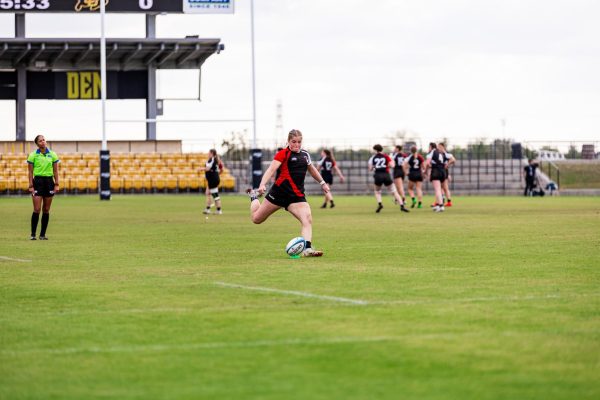
“[McAlevey] bounced right back into it. She had a little rough start in the first half, but then she got her groove about maybe a third of the way in,” Cattanach said. “She had some key plays on the outside. Her conversion kicks were spot on.”
Not only did Northeastern win 44-10, but McAlevey was named the finals MVP.
“The thing that made her MVP was not only having amazing plays, but being a very supportive teammate when she doesn’t have the ball,” Preston said. “When she has the ball, we all trust her to do everything amazing, and she really takes control of the game when she has the ball.”
Cattanach agreed: “It’s decision-making and then being a powerhouse in the field. That’s why she’s the key element.”
McAlevey entered the 2026 Women’s Elite Rugby draft to play for the Boston Banshees, and the finalized team will be announced late January. The draft is unique, allowing players to apply for specific teams if they do not want to move.
“I think any team would be lucky to pick her up,” Cattanach said. “I’m just hoping the big stage of USA Rugby pulls her up.”