At Northeastern, thousands of students swipe into dining halls every day. The rush between classes, eagerness to catch up with friends and large portion sizes mean one thing: some food will go uneaten. But what happens to leftovers?
Northeastern has a multitude of waste reduction initiatives integrated into its on-campus dining halls, from partnerships with food composting companies to offering reusable plates, cutlery and to-go boxes. Despite these initiatives, students report still seeing significant food waste.
Jack Gore, a second-year cybersecurity major, said he frequently sees unwanted food thrown away.
“Last year, one of my suitemates, he would throw out so much food he would cover it with a napkin,” Gore said.
Gore tries to keep food waste in mind when filling his plate.
“I think about [food waste] a solid amount. I try not to grab too much food that I won’t like,” he said. “Or if I’m unsure about food, I’ll only grab a little bit of it so as to not waste it.”
Karla Quinde, a second-year health science major, said she has thrown away uneaten food in the dining hall because she didn’t want it. She explained that concerns about waste have changed how much she takes.
“I do try to get less if I’m not eager to eat it,” Quinde said. “I’ll try to get less, just to not waste as much food as I normally do.”
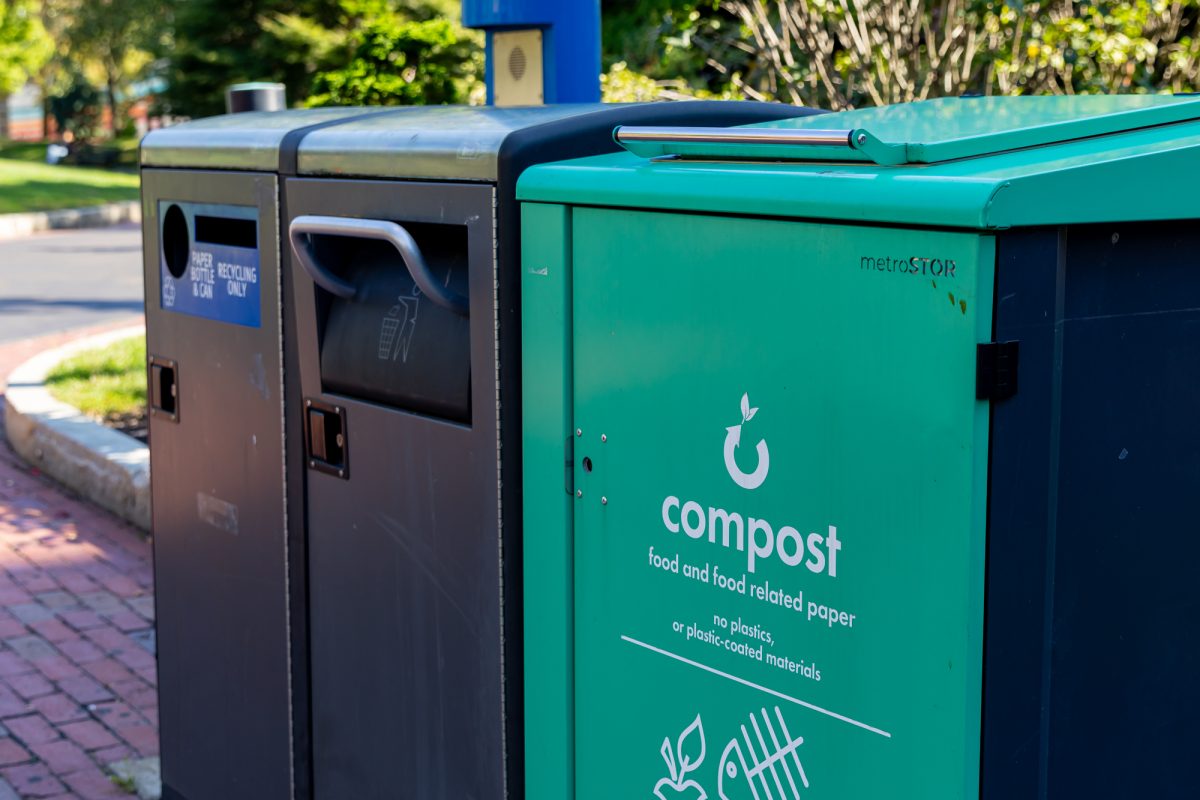
According to the Northeastern dining website, food scraps are composted through a partnership with Casella Waste, a company that turns collected food waste into fertilizer, with “clearly marked receptacles in major dining halls.” Leftover pre-packaged items, like sandwiches or salads, are donated to local food banks, and dining services promote reusable containers, trayless dining and ceramic mugs to reduce single-use waste, the website reads.
Northeastern promises to minimize its impact on the environment through its food waste reduction program “Waste Not,” which is used to “track, measure, and reduce the amount of kitchen food waste in our facilities on campus.”
While these initiatives are embedded into the dining hall experience, food waste still persists. Sabrina Yang, a first-year performance extended realities major, said waste is noticeable on a daily basis.
“I think it’s a pretty big issue because I always see food waste on the table, and I personally also have a lot of food waste,” she said.
Yang said the amount of waste no longer surprises her but that she “never” considers waste when selecting food.
Ying-Hsuan Cheng, a first-year Explore Program student, thinks part of the problem is staff overserving students and tries to communicate with them about her portions.
“If I want more or less, I will just directly tell the workers,” Cheng said.
To help mitigate food waste on campus, Composting at Northeastern University, or CANU, have been working to educate the community on the impact of food waste and the importance of reducing it.

Mitra Ruel, a fourth-year environmental science and chemistry combined major and president of CANU, explained how the club’s composting initiatives aim to reduce waste.
“We kind of started out as an initiative to bring composting and make that more available to students on campus, and that’s expanded throughout the years,” Ruel said. “[Currently], we work with facilities, and they’ve been amazing. We brought the student side of it, saying ‘Students want this, students need this’ and facilities worked with us to try and make that possible.”
Many of CANU’s efforts are focused on doing a “better job educating people” on what you can compost, trash, recycle or save.
Composting is also an important part of Northeastern’s sustainability initiatives, both in residence halls and dining halls, through its partnership with Casella Waste.
“[Northeastern] is signed into a program that [runs] the compost through an anaerobic digestion machine … and it is turned into electricity for the school,” said Mitchel Corteguera, a second-year environmental science and economics combined major and director of external relations at CANU. “[NU] makes a certain amount of money selling it and then gets electricity back as well.”
This academic year, staff started to be responsible for composting instead of students. This is to better prevent contamination, according to CANU.
Beyond composting and recycling, Northeastern “prioritizes the purchase of cage-free eggs, reduced antibiotic poultry, sustainable seafood, and fair trade coffee,” according to the Northeastern dining website.
Northeastern works to reduce single-use plastic on campus by providing plant-based straws in dining halls and no longer offers single-use plastic bags in campus retail locations, according to the Northeastern University Sustainability Commitment. The university also has a ReusePass program that offers reusable boxes for students to take food in and then return for washing.
In January, two food vendors in the Curry Student Center, Choolaah Indian BBQ and Kigo Kitchen, made reusable containers available to customers as part of a new pilot program meant to cut back on single-use plastic waste and continue efforts to fulfill the promise of the Reduce, Reuse, ReNU pledge, which has been signed by hundreds of Northeastern students.
Through a partnership with Re:Dish, customers can get their food packaged in reusable containers and discard them at one of two designated bins in Curry. Re:Dish picks up the used containers and brings them to an off-site location where they are washed and sterilized.
The university also aims to buy local produce from places such as Fantini Baking Company in Haverhill, MA, Fresh Point Produce in Hartford, CT, and Hood Dairy in Lynnfield, MA, according to the Northeastern dining website.
“I think it’s more on students, because there are some stands where we [take] the food individually,” Cheng said. “So I think we should be better aware of … the amount of food that we get.”
Deputy Campus Editor Elizabeth Chalmers assisted in reporting this piece.