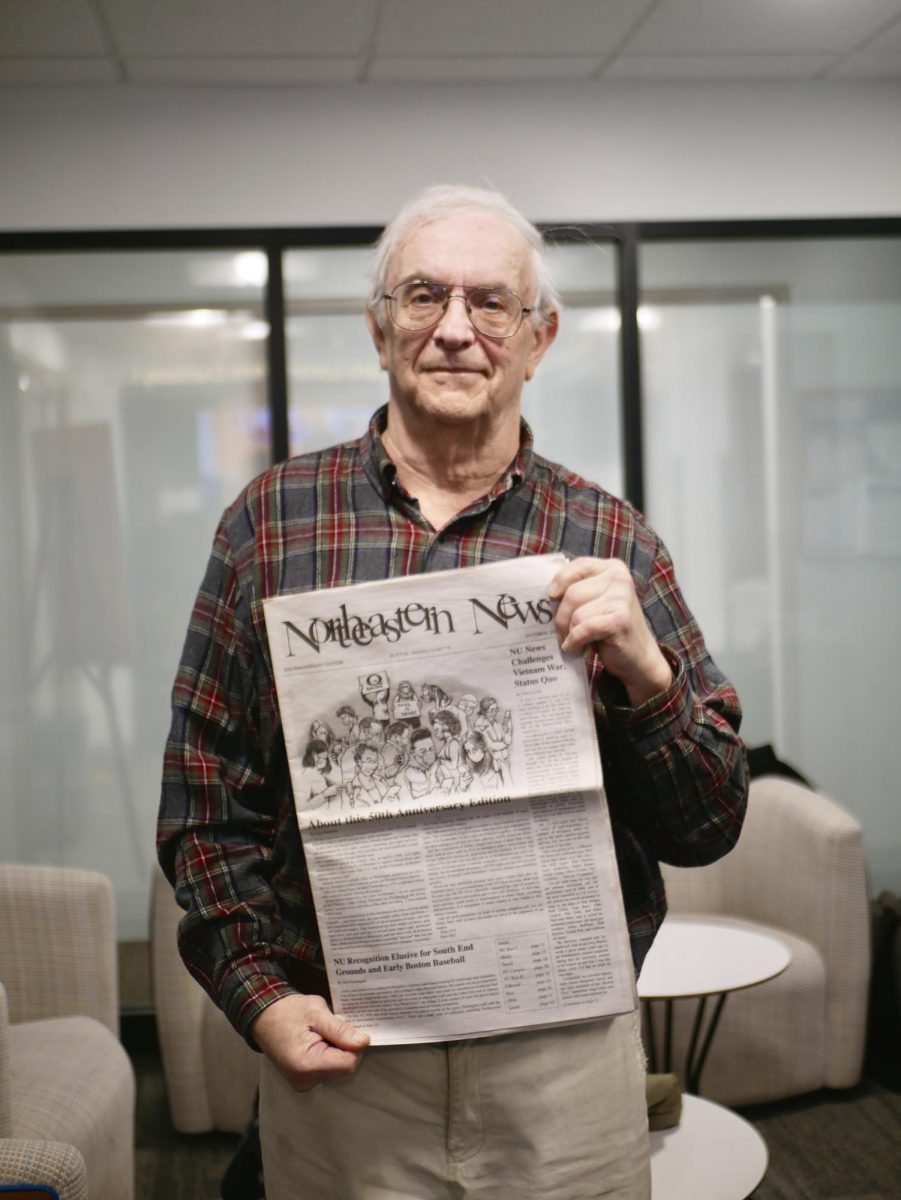



Before he was interviewing President Donald Trump for The New York Times, Zolan Kanno-Youngs’ beat was Northeastern baseball.
For his first assignment with The Huntington News, he met with long-time baseball coach Neil McPhee before the start of the 2012 season. When he began furiously writing down every word from the interview by hand, McPhee stopped him. “‘There’s no way you’re going to get all my words right. You need to record it,’” Kanno-Youngs recalled him saying.
McPhee didn’t let any journalist covering his team “half-ass it,” said Kanno-Youngs, who joined The News in the spring of his first year. Throughout his time as a beat writer — first for baseball, then men’s basketball — the coaches treated him as a professional journalist. “But with that respect also comes expectation,” Kanno-Youngs said.
After graduating from Northeastern with a degree in journalism in 2015, Kanno-Youngs wrote for The Wall Street Journal as a general assignment writer and covered the New York Jets and Brooklyn Nets on the weekends before taking on the New York Police Department beat full-time.
But Kanno-Youngs’ ascent in the field of journalism began with reporting on college sports for The News and WRBB, Northeastern’s student-run radio station, experiences he said a classroom environment can’t replicate.
“Pretty early on, you’re doing reporting. You know what it’s like to have a mistake in a piece and have a coach call you, mad at you and how do you handle that,” he said. “That’s something you don’t get in the classroom.”
Kanno-Youngs covered home baseball games and wrote recaps afterward, often while also providing broadcast coverage for WRBB and giving play-by-play commentary. During his first semester on The News, he described himself as a “pretty horrible match” for his editors, often working on drafts right up to the print deadline.
At the time, he worked with editors and writers Sarah Moomaw, Todd Feathers and Jennifer Smith. It was Jillian Saftel Young, the sports editor, who he would keep up with late-night drafts. (“I was just trying to make the article perfect. The editor would kindly be nudging me to get my copy in.”)
As a sports reporter, most of his time was spent in the field, where he would communicate with editors through emails and calls. In his spare time, Kanno-Youngs would meet editors in coffee shops to workshop rough drafts and game recap structures.
“It was like, I have this team of people who love this stuff, and they’re almost like student tutors for me,” he said of his editors.
At the time, The News was newly independent, having rebranded from The Northeastern News to The Huntington News in 2008. For the young journalists leading the paper, he said it was “a source of pride.”
“What an incredible thing, right? You have this operation committed to providing students at Northeastern information that they can use and potentially news that the university was not revealing to them,” Kanno-Youngs said. “They’re not relying on the approval of any sort of faculty member. This is just based off of the public interest.”
For his first co-op, he joined The Boston Globe’s bustling sports desk. Shortly after starting the co-op, he applied to an open position on the city desk to earn extra income, where he took interest in reporting outside of sports.
“I caught the bug for news, the idea that each sentence and each word carries the potential for human impact,” Kanno-Youngs said of his time at The Globe.
In his third year, he was asked to write a weekly column for The News breaking down topics like the “American Dream” and diversity at universities. He was pitching new stories week to week and exploring his writing voice with more analytical prose than before. A beat also holds writers accountable: “If you have a beat that you have ownership with, if you suck, people will know why it sucks,” he said.
He stepped away from The News in his fourth year due to a busy schedule. After college, he drifted further away from his roots in the sports world, but a decade later, he’s not convinced he’s left it behind entirely. The deadline-driven nature of college sports reporting prepared him well for politics.
“[In] sports reporting, you’re doing some of the most deadline writing, that tight, high-pressure deadline writing that people do in journalism,” he said. “I’ve never really thought of it as I pivoted too hard.”
In January, he was one of four New York Times journalists to interview Trump, pressing him on immigration enforcement tactics and U.S. involvement in Venezuela.
Kanno-Youngs was an eager student journalist first, and now, he tries to be a resource to those coming up after him.
“I think that [it] is important for the student journalists to have an [alumni] network that they can go to for advice here,” he said.
His advice to students is to keep writing and to always be empathetic and intentional. Most importantly: Don’t stop being a fan of other journalists.
“There’s a lot of great work out there to be inspired by,” he said.

covered basketball for WRBB in addition to The News, providing commentary and
writing recaps after games. Photo courtesy Zolan Kanno-Youngs.