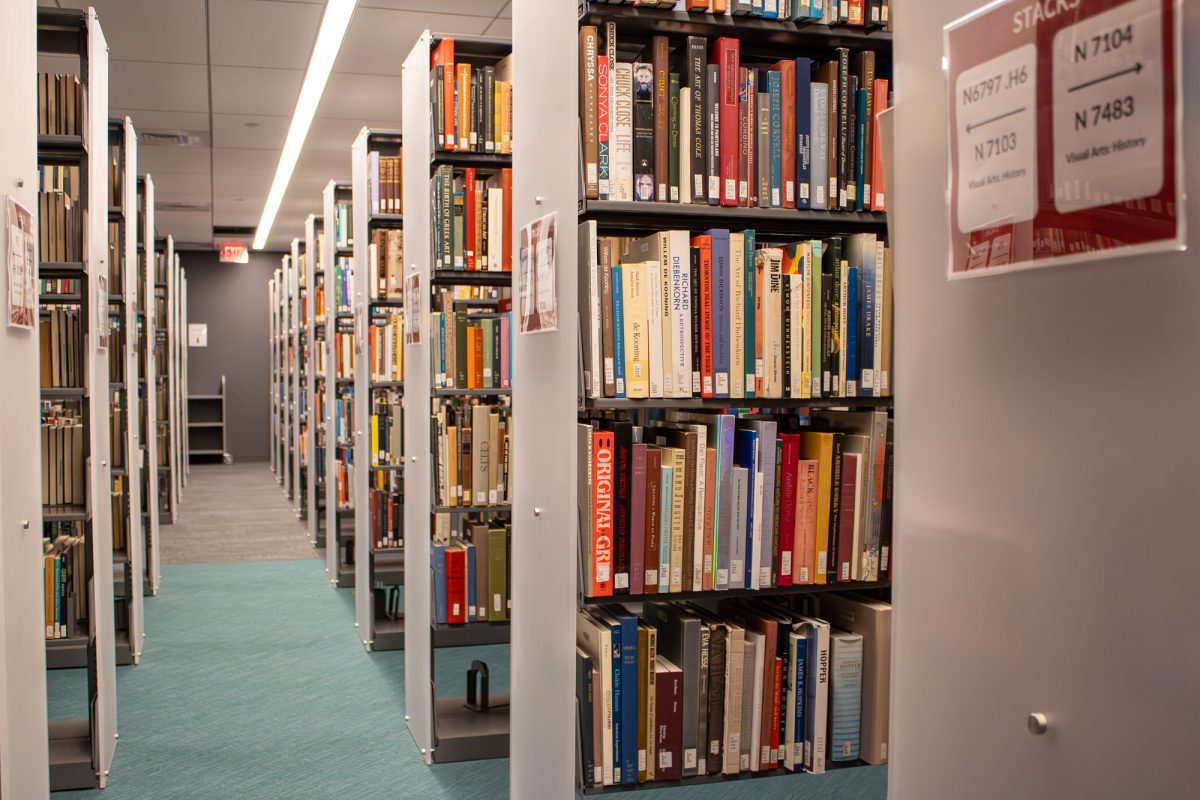
For most people, the idea of a typical library includes countless shelves of books. But Northeastern’s Snell Library doesn’t quite fit that picture. As a result, a myth questioning the existence of physical books in Snell Library has spread across campus and online.
Rachel Sbar, a third-year environmental studies and political science combined major, recently discovered that the myth is just that.
“I found out there were books [in Snell] like three days ago,” Sbar said. “Great revelation.”
The rumor that Snell is devoid of books began to circulate during COVID-19, when many of the university’s physical volumes were moved off shelves and out of the library for storage. During this time, students still had access to the book collection, but it took a lot longer to check them out as they were quarantined in between uses.
Digitizing the library was an effective way to speed up the checkout process, limit the spread of the virus during the pandemic and provide students located across Northeastern’s global campuses access to materials.
“It’s very easy to use,” said Ava Mandel, a fourth-year health science and psychology combined major, referring to the digital library. “You just look up what you need and either someone’s using it and you have to wait a few days or you check the next day.”
During this transition, the library increased its collection of digitized media to include around 1.4 million ebooks, 150,000 electronic journals and 180,000 streaming videos. A large portion of the university’s archive material has been digitized as well, which students can access through the Digital Repository Service.
With the shift to digital content, the university sent the majority of its print materials to an off-site storage facility. After pandemic restrictions were lifted and a multi-year renovation project was completed, Snell Library placed many of the university’s most used print volumes back into the basement level of the library.
Within this section of the Snell basement, there is a surplus of children and young adult texts, books on Boston and its history and a collection of books written by Northeastern faculty. Despite the library’s abundance of books, some students still aren’t aware of just how many books there actually are.
“I still don’t know what kind of books they really have over there, and I love to read,” Mandel said. She didn’t know books were back in Snell “until pretty recently, because I also didn’t know that there was a basement downstairs until they renovated it.”
In addition to physical collections, students and researchers can access rare and archival content online using the Artists’ Book Collection or the Archives and Special Collections. If a student can’t find what they are looking for, they can access additional physical copies through Scholar OneSearch, an online library portal, or by talking to a library team member who can help locate the materials.
Rachel Thorne, a second-year environmental and sustainability sciences and chemistry combined major, said the Scholar OneSearch system is a “very convenient” way to access a book out of archives.
“The only downside I had with [Scholar OneSearch] is the website was a little confusing at first in terms of finding the book,” Thorne said. “Once the website found the book I wanted to request, it was super smooth from there.”
So yes, there are books in the library. Snell’s resources haven’t disappeared, they just became digital. The basement’s back walls are lined with books — you just have to know where to look for them.