Mercedes Sensinger makes her way to a table in the back corner of Caffè Nero to meet a friend for a study date. Surrounding her are other college-aged students, sipping on caffeinated beverages with laptops plugged into wall outlets.
Sensinger, a third-year English and linguistics combined major, said she chooses to make the half-mile walk from Northeastern’s campus to the Caffè Nero on Westland Avenue rather than work at Snell Library during finals season because of the library’s aesthetic features and tendency to be crowded.
“Snell got ruined for me after my freshman year when they started renovating everything,” Sensinger said. “I hate the fluorescent lighting. [Caffè Nero] has books, and warm lighting, comfy chairs and a fireplace.”
Before heading to Caffè Nero that day, Sensinger said she still checked Snell for a place to study but found it to be “packed full.”
Boston is home to more than 30 universities and colleges, and business owners in the city are aware of the abundance of college-aged customers. As a result, cafes often equip spaces with outlets and free Wi-Fi, encouraging students to ditch the library and work off campus.
Student enrollment on Northeastern’s Boston campus totals 43,904 undergraduate and graduate students combined, according to the City of Boston’s 2024 Student Housing Trends Report. Yet, the university only has one library open 24/7: Snell Library.
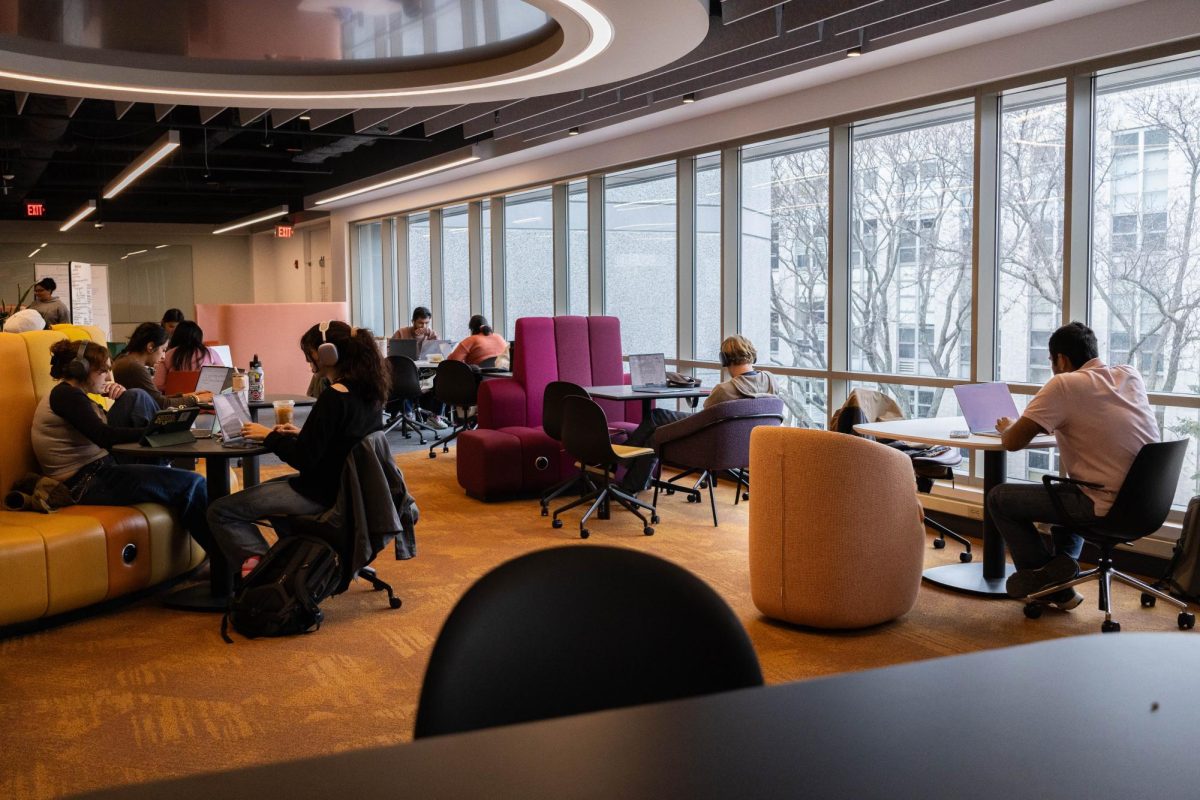
Students said they have qualms with the environment at Snell Library for reasons including seating shortages, noise or simply because it doesn’t provide the right “vibe” for them to feel motivated. Many say that utilizing spaces to study off campus has been crucial to their academic success.
Kate DellaPorta, a clinical psychologist who specializes in therapeutic coaching and owns a private practice in Boston, said it’s important for students in college to have more than one place to study.
“I always recommend my clients to find at least two places to study that are not their dorm room,” DellaPorta said.
These alternative spaces are particularly essential for students at Northeastern living in “forced” double or triple rooms, or formerly single or double occupancy rooms that have been converted to house two or three students, respectively. These rooms, most prevalent in residence halls like East Village and International Village, can be cramped, making in-dorm studying difficult.
While Snell Library offers reservable group and individual study rooms, only a fraction of the four-floor library contains designated silent study zones, something that DellaPorta said is essential for student success.
“The features of the space are also important in determining how effectively students may get work done there,” DellaPorta said. “People need quiet spaces and not a lot of visual stimuli.”
A two year long construction project that was completed in 2023 added more than 1,000 seats for students by removing a large portion of the library’s on-site books. Even with its capacity of 3,100 total seats, the university’s growing enrollment numbers mean that for every seat available at Snell Library, there are roughly 14 students competing to sit in it, according to a Huntington News analysis.
Joanna Weaver, an associate teaching professor of psychology at Northeastern, agreed that a distraction-free work environment is key to a productive study session.
“Find a place that is devoid of other attractions. If you try to work in your dorm room or someplace where you have easy distractions, you won’t get the same benefit,” Weaver said.
She added that distractions aren’t necessarily eliminated when students go to Snell.
“I find the physical layout of Snell a bit shocking,” Weaver said. “[It was] likely designed by someone who thinks social interaction is going to enhance studying. But there needs to be quiet floors, and there needs to be chairs where you are not looking at other people.”
During renovations, 100% quiet study corners were added to Snell. These silent study spaces exist on every floor of Snell, and there are as many as 200 seats in these areas on the fourth floor. There is also a silent study space on the third floor exclusively for graduate students.
However, in spring 2025, 76% of students voted to pass a Student Government Association referendum that called on the university to reinstall policies that would make some floors of the library completely silent.
The university worked with MGA Partners Architects, a boutique architecture firm located in Philadelphia, to design the renovation, according to a May 15, 2023, Instagram post from the firm. Some additions to the library included real plants and white noise machines. MGA Partners Architects held a furniture lab and had students test out seating options and provide feedback.
A study done by the American Journal of Education and Technology in 2023 on students at Saint Joseph College of Baggao confirmed that multiple aspects of library services, such as cleanliness, availability of resources and comfortable lighting, “were perceived to have a substantial impact on students’ academic endeavors.”
Rocky Cole, a second-year business administration and communications combined major, has started taking advantage of the new Starbucks in the basement of Churchill Hall.
“I really enjoy working there because it reminds me of my favorite coffee shop I would work in at home,” Cole said. “If you’re at a cafe, you can get some nice food and energize yourself. At Snell, you have to leave the table if you want to go get food.”
Pavement Coffeehouse, located right off campus on Gainsborough Street, is another of Cole’s favorite spots. She said that even though Pavement can get busy, she still always finds a seat. “In Snell, it’s like you’re searching for 20 minutes.”
Cafes, with their scattered conversation, light background music and sound of the espresso machine brewing, can actually offer a more productive environment for students than a completely silent library student zone, studies show.
One 2021 study completed by the University of Portsmouth and University College London showed that ambient noise is not solely a distractor when working. On average, participants in the study “gave more ideas in the presence of ambient noise than in silence.”
Students searching for this environment, though, don’t need to look too far from Northeastern’s campus to find these warm and focus-friendly refuges.
The central branch of the Boston Public Library, or BPL, is located in Copley Square, three stops away on the Green Line or a roughly 30-minute walk from Krenzman Quad. While it may be less convenient than staying close to campus, students say the trek is worth it for the infamous quiet reading room in Bates Hall.
Kate Yachimski, a second-year marine biology major, frequents the BPL when she needs to get a large amount of work done.
“Most of the BPL study rooms are dead silent, so it forces you to stay in a place for hours, which is exactly what I do,” Yachimski said. “Something about being on your phone in front of everyone else feels wrong. It’s almost like an internal pressure to be productive.”
This “pressure to be productive” is also known as body doubling, a focus strategy where another person’s presence provides accountability and boosts motivation, according to DellaPorta.
Another culturally iconic spot located much closer to campus is the Museum of Fine Arts, or MFA, which offers tables with outlet access for students wishing to study. All Northeastern students have unlimited free access to the space thanks to the University Membership Program between the MFA and more than 30 higher education institutions in Boston.
“We want students to view the MFA as a third space,” said Ashley Theilacker, an academic programs intern at the MFA.
Dalia Linssen, senior director of academic engagement at the MFA, said the museum is working to break down the stigma about bringing personal items to the museum or doing work.
“People feel like if they are in a gallery, they should only be looking at the art, but we’re trying to change that,” Linssen said.
Yamchimski, who lives in Burstein Hall, located directly across the street from the MFA, regularly utilizes her complimentary access to the museum.
“I like that people go there not to study. If I look around at Snell, everyone looks miserable and like they’re about to go crazy,” said Yachimski.“It’s cool to be surrounded by art and culture. It helps take the college out of my work.”