Innovative insights buzzed through the Interdisciplinary Science and Engineering Complex Feb. 21 during TEDxNortheasternU’s annual flagship conference gathering thought leaders from across the nation.
The event, titled “Refraction: Ideas Bend, Breakthroughs Unfold,” drew a crowd of over 150, spotlighting a Northeastern student speaker and industry leaders who gave seven presentations on topics ranging from medicine and architecture to navigating grief and burnout. Additionally, Eon Dance Troupe, one of the university’s Asian dance clubs, and one of Northeastern’s all gender acapella group, The Unisons, performed.
The conference aimed to “examine how challenges redirect our paths, how different cultural lenses reshape our understanding, and how moments of change reveal hidden possibilities,” according to the TEDxNortheasternU website.
Established in 2018, TEDxNortheasternU is a student-run organization and a subsection of the TEDx program, a nonprofit that hosts speaker series worldwide. Like traditional TEDx events, TEDxNortheasternU hosts presentation forums where speakers can bring their ideas and expertise to the university community.
This year’s program was a “culmination of team brains and the speaker’s messages,” said Ashritha Reddy-Kallem, a third-year international business major and TEDxNortheasternU’s community engagement director. For Amelia Willmann, the president of TEDx Northeastern, “a good talk is only as good as you want it to be with time and effort.”
The event’s first speaker, Dr. Diane Shannon, discussed how she helps women overcome burnout in medical fields. Shannon, a physician and writer who stopped practicing clinically after experiencing early-career burnout, spoke about empowering women in the medical field.
In a presentation titled, “Riding the Waves: Lessons from Surfing to Beat Burnout,” she discussed how a work trip to Mexico, which included surfing excursions, became the catalyst for her career transformation.
“Surfing is looking forward, and [you must] look forward from the daily grind,” Shannon said.
The second presentation, given by former Northeastern School of Architecture professor Chris Ryan, was titled “Third Places: Reimaging Architecture to Encourage Connection.” Through his presentation, Ryan examined the importance of “third places” in combating loneliness in online spaces.
Third places, a concept introduced in 1994 by Indian scholar and literary critic Homi K. Bhabha, are locations that are not a person’s workplace or home. These are often community spaces such as parks, libraries, pubs or coffee shops.
“Increased loneliness online is as serious as smoking and obesity,” Ryan said. The beginning of his speech discussed how the rise of social media has contributed to a greater need for “third places.”
Ryan shared that discovering climbing centers in his early childhood helped him forge community connections, leading him to dedicate his career to enhancing third places.
“The power of a climbing gym brings people together to experience the modern third space economy,” Ryan said.
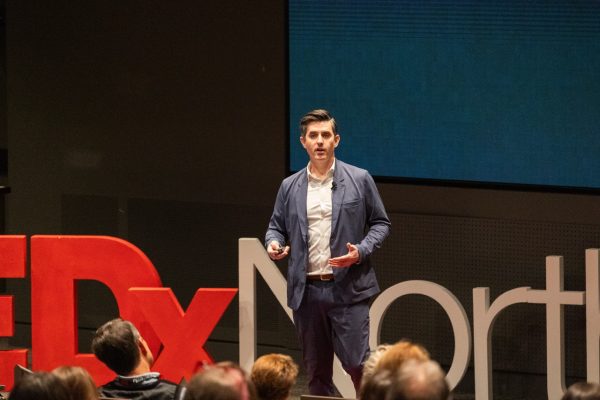
For Ryan, third places are “not just for kids” as “interaction with play” is beneficial to adults too.
Kelly Cervantes, a Northeastern alumna and author of the books, “Normal Broken: The Grief Companion for When it’s Time to Heal But You’re Not Sure You Want To” and “The Luckiest: A Memoir of Love, Loss, Motherhood, and the Pursuit of Self,” took the stage for the third presentation.
Titled “There are No Winners at the Grief Olympics,” Cervantes’ talk explained how the passing of her 4-year-old daughter taught her profound lessons about love and loss.
Cervantes proclaimed that one must never “diminish someone else’s grief [because] there is no finish line in healing.” Cervantes explained that after her daughter’s passing, many people did not want to discuss her loss as it left them “uneasy,” but she wanted to reminisce about her daughter.
Through her healing journey, Cervantes found that “downgrading grief” — or comparing someone else’s grief to your own — accomplishes nothing.
“Grief served with shame or with contempt and judgment does not allow you to heal,” she said. “We don’t move on from grief, we move forward with it.”
After a short intermission, Northeastern Associate Professor of Sociology and International Affairs Tiffany Joseph spoke about the intersection of race, immigration and the healthcare system.
In a presentation titled “Imaging a Better Healthcare System in the Face of Shifting Paradigms,” she combated misconceptions about Obamacare. Joseph explained that “Obamacare undermined healthcare access” because immigrants were excluded from receiving care, the most vulnerable minorities in need of medical treatment.
Joseph’s research found that “racial immigration scared people going to hospitals” because of people’s apprehensiveness about police and Immigration and Customers Enforcement officers. Her speech discussed how clients were intentionally missing medical appointments due to this fear.
The fourth presentation, titled “Why Didn’t Someone Stop This? How Leaders Fall into the Certainty Gap” discussed public safety in the food industry.
Darin Detwiler, an associate professor at Northeastern’s College of Professional Studies and expert in food policy and risk communication, described his time serving as a nuclear-engineer on a Navy submarine and how the dosimeter on the submarine controls the radiation of the ship. He connected how his experience working on the submarine emphasized his desire to conduct research on food safety within restaurants and conglomerates because, in 1993, his 16-month old son contracted E. coli from a classmate who ate Jack in the Box and died. Detwiler dedicated the rest of his career to ensure food safety is the top priority for companies.
“Everywhere you look, there are invisible threats and leaders who delay,” Detwiler said.
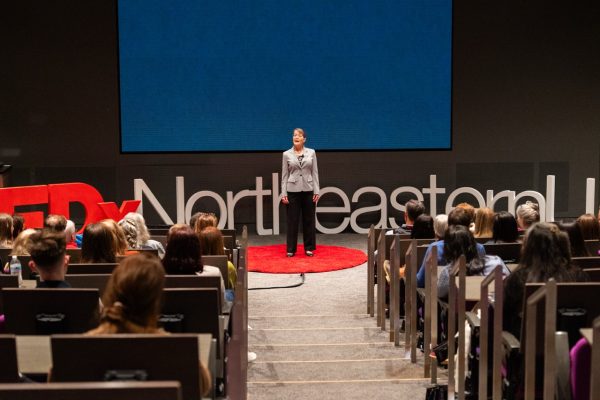
Demonstrating how companies prioritise profits over food safety, Detwiler found throughout his career that “doing nothing is still a decision.” He is featured in Emmy Award-Winning Netflix documentary: “Poisoned.”
Khushi Shah, a third-year computer science and business administration combined major at Northeastern, gave a presentation titled, “Girls Like Me: Why Empowerment Isn’t Enough.” Her speech discussed how, when girls are young, they are encouraged to achieve their dreams, but as they mature, society begins to offer unsolicited advice.
“The world claps for girls with ideas, not the ones executing them,” Shah said.
During high school, Shah created her own company called Drizzl, a patent-pending irrigation system utilized by Google, NASA and the Navy. Shah said that, at 17, when she began to speak with investors, companies were more interested in when she was going to get married and have kids — not her solution to a lack of water in Africa.
“Supporting women is essential, not integrated or exceptionalized. [Supporting women] shouldn’t be the default, it should be the norm,” Shah said.
The final speaker of the event was Rohan Venkatesh, a Northeastern alumnus and a former investment banker. His speech, titled “When Life Doesn’t Go Back to Normal,” discussed how he survived brain cancer. His speech began with him discussing how, at 28, he was achieving the epitome of success, when during one morning run half of his body started to stiffen.
Venkatesh began to use the analogy of a black swan to depict how he was feeling. For him, his “tumour was [his] black swan.” He found that once he heard his cancer diagnosis and was fighting every day, “time didn’t move forward, it simply reset.”
Venkatesh has been cancer free for five years, and his speech ended with a sentiment applicable to anyone: “Change can leave us the same, diminished or transformed.”