Uncanniness is the most elusive emotion for a horror movie to try to instill in its audience. Dread can be found by waiting in the dark, and shock can just jump from around a corner, but eerie uncanniness is hard to pin down. Defined by Sigmund Freud himself, the uncanny is “in reality nothing new or alien, but something which is familiar and old-established in the mind and which has become alienated from it only through the process of repression.” In essence, the uncanny is both deeply personal and intrinsically foreign, and by its very nature, hard to put a finger on.
Released May 29, “Backrooms” wrestles with just that. Beginning as a captioned picture of a vacant furniture store posted anonymously on image board site 4chan in 2019, the concept of the Backrooms, a labyrinthine otherworld that poorly mimics our reality, has graduated into a full-blown 21st-century folktale on the same level as Slender Man. Predominantly taking the appearance of unused office space, complete with grimy yellow wallpaper, shag carpets and buzzing fluorescent lights, the Backrooms are a seemingly infinite dimension of winding liminal space that anyone can fall into at any given time, one that first-time director Kane Parsons has captured in all its nebulous, intangible horror.
Parsons, also known by his YouTube moniker “Kane Pixels,” has been the predominant storyteller when it comes to the Backrooms legend. His 2022 found-footage series about the setting gained him enough fame to get tapped by A24 to direct his own movie at 20 years old. The aptly named “Backrooms” stars Chiwetel Ejiofor as Clark, an angry and emotionally repressed amateur architect in the mid-’90s who happens upon a portal to the Backrooms in the basement of his failing furniture store. Fascinated by the impossible place and seeking an escape from his bitter reality, Clark enlists the help of his reluctant employees to record and map this new dimension and discover whatever it is that lurks there.
However, after Clark goes missing, his distant, doubting therapist, Mary (Renate Reinsve), decides to go looking for him, unwittingly venturing into the Backrooms. It’s a sparse story, all things considered, but Parsons knows the true star of the film is the simplicity and uncertainty of the setting.
Ahead of the film’s release, the internet was rife with comments alleging that the 30,000 square-foot set was so true to form, byzantine and confusing, that cast and crew got lost during shoots — and that undersells the space. Appropriately appearing at first to be a collection of banal, unused corridors and lobbies, the sets of “Backrooms” quickly devolve into a nonsensical collage of René Magritte-esque surreality. Rooms loop back in on themselves, adopting pointless and seemingly impossible geometry, and are periodically populated with furniture that serves no purpose, some of which is phasing into the floor itself. All together, it generates a thick fog of menace through a false sense of familiarity.
Through nerve-shredding chase scenes, characters barreling through strange tableau after strange tableau in a directionless attempt to escape, the viewer is compelled to map out the impossible bounds of the space right alongside Clark and Mary. But what’s just as impressive as the actual set design is how Parsons uses it as the thematic spine of his story.
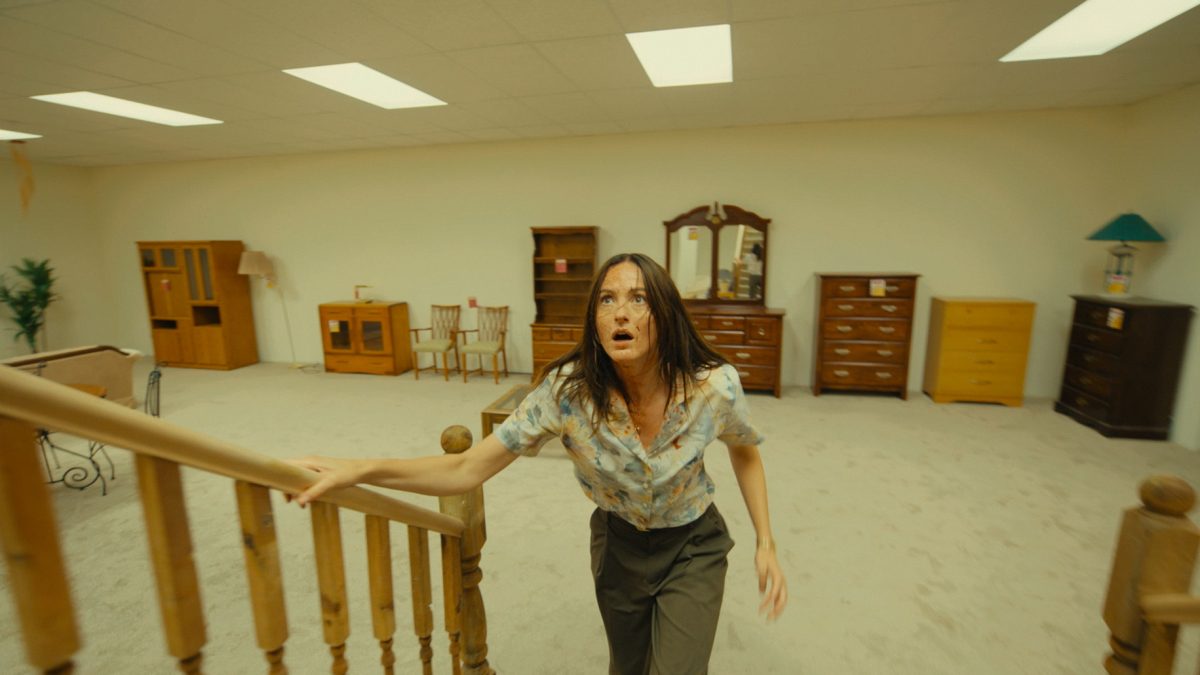
Just as the Backrooms themselves are a xerox of a xerox of our reality, the protagonists of the movie find themselves degenerating into stagnant, flanderized versions of themselves. Clark is a deeply unimpressive man, reeling from a divorce and decaying in a life he feels he doesn’t deserve. He wallows in his belligerence and deep-set selfishness, refusing to accept any responsibility for his failures, and escapes into the fantasy and freedom of his exploration of the Backrooms. His therapist, Mary, is not much better, coasting through her sessions without really empathizing with any of her patients, instead offering them platitudes and easy solutions. Her desire to help and simultaneous reluctance to actually hold her charges to task stem from her feelings about her own mentally ill, agoraphobic and abusive mother — feelings Mary refuses to touch.
Both protagonists are stuck in their respective liminal ruts, and unless they can let go of their pasts, Clark and Mary will eventually become Freudian doppelgangers of themselves, forever folding inward and reinforcing their own worst qualities.
Beyond the philosophical, “Backrooms” succeeds as a wonderfully constructed horror movie in all aspects. The cinematography is especially of note, with the camera devilishly lingering on scenes just long enough for the viewer to wonder if something is staring back out from the screen. Most notable are the sections shot from the point-of-view of camcorders, Parsons harkening back to the analog horror of his found-footage series. Additionally, the soundtrack, composed by Parsons and Edo Van Breeman, is deliciously subtle, creeping in at the edges of scenes and building until it’s droning like a siren.
On all counts, “Backrooms” excels, which is likely why the film’s greatest failing is that there isn’t enough of it.
By proportions, the film is split relatively evenly between time spent in our world and time spent in the Backrooms. The rooms are so captivating, however, that our time in them feels comparatively short, leaving the protagonists’ descent into madness somewhat rushed. The 50/50 split also causes certain aspects of Backrooms lore that Parsons originally established to be touched upon only in passing; chiefly, the scale.
In the YouTube series, the Backrooms are vast in ways that bring to mind the Library of Babel from Steven Peck’s “A Short Stay In Hell” — a place so massive, so random and so empty that the primary horror came from the ludicrous impossibility of escape. However, in order to facilitate the narrative, characters are wandering into and out of the Backrooms constantly, as if it were a very confusing hedge maze and not an infinite dimension conjured from the collective unconscious.
There is also the matter of A-Sync, the mysterious company that researches the Backrooms in both the original series and the film, organizing ill-fated research expeditions and covering up any trace of its connections with our earthly plane. A-Sync features heavily in the periphery of the film, but is only really there to do clean up and serve as a deus ex machina at the very end. It is a sad underuse of an interesting concept and a terrible waste of Mark Duplass, beloved horror alumnus who plays a scientist named Phil and does an okay job with what scraps he’s given.
All the same, one doesn’t yell at the chef if their meal left them licking the plate wanting more. “Backrooms” is a fantastic exploration of the best tall tale of the digital age, and, by the looks of its spectacular box office, is likely only the beginning of A24’s dalliance with this otherworldly complex. Parsons has truly created a labyrinth worth getting lost in.