You probably encountered “The Odyssey,” “The Iliad” and other Greek mythology in middle school English class, but seldom do students learn about lesser-known characters like Penelope, wife of the hero Odysseus.
At Lyric Stage, she was no longer a side character, but a central figure.
From Feb. 14 to March 1, Lyric Stage presented “Penelope” by Alex Bechtel, based on the Greek epic poem “The Odyssey,” a work of Greek mythology that traces Odysseus’s tumultuous journey home after the 10-year Trojan war. In the epic, he angers the sea god Poseidon and is forced to wander for a decade after the war. The journey leaves his beloved wife, Penelope, alone at home, fending off suitors vying for her hand in marriage.
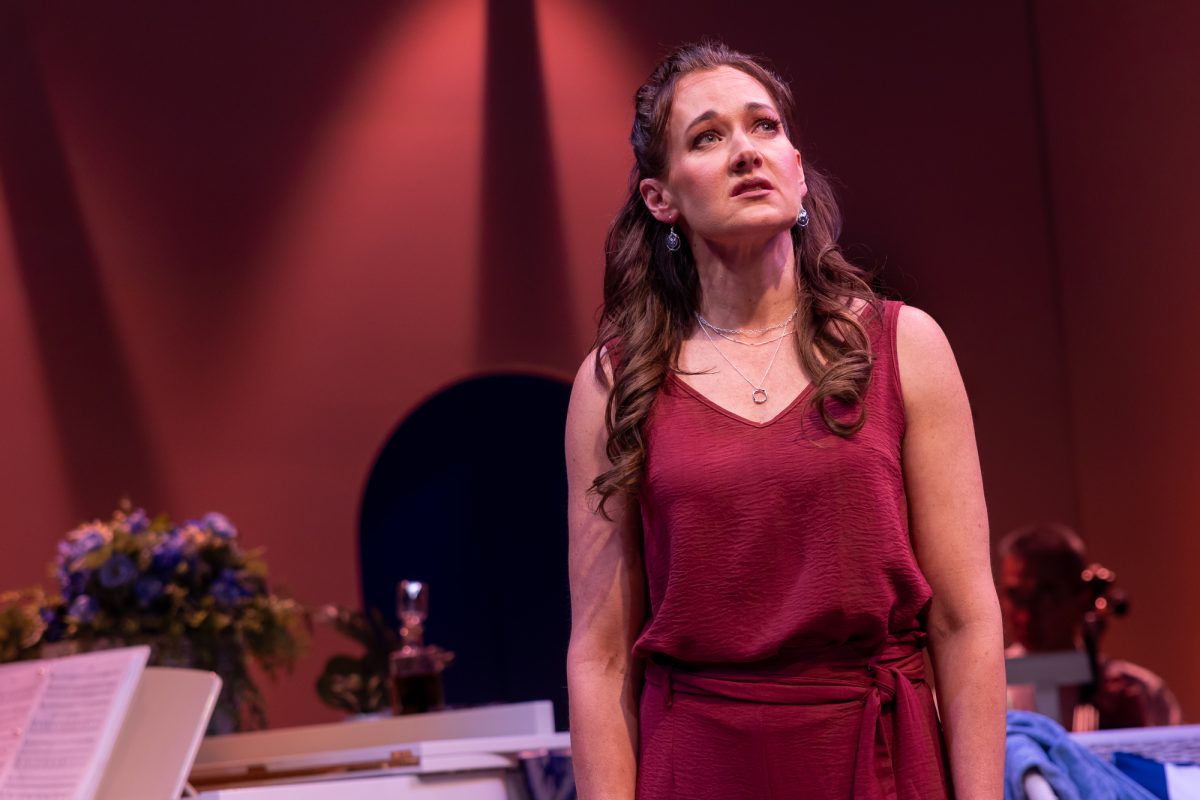
In the original story, readers aren’t exposed much to Penelope’s perspective on the ordeal, but “Penelope” changes that. In Bechtel’s modern adaptation of the classic epic, Penelope (Aimee Doherty) is the star of her own one-woman show. Audience members get exclusive insights into her thoughts through emotionally charged musical pieces such as “Prayer,” “Lose My Mind,” “Tired of Faith” and more.
As Penelope weaves and unweaves her history and her future (both metaphorically and on the loom), she longs for her husband, remaining loyal to him as she ignores the suitors bowing at her feet. The musical is a thematic paradox; on one hand, “Penelope” doesn’t feel modern at all, as the narrative revolves around a wife longing for her husband. On the other hand, it is a refreshing deviation to delve deeper into Penelope’s side of her and Odysseus’ love story — a side that has traditionally been overlooked.
Penelope has everything: leadership of a city, a mansion that overlooks the ocean and dozens of suitors looking her way. Yet, she is unable to find true happiness until her husband eventually returns from his 10-turned-20-year absence. Although Doherty is the only performer on the stage apart from the musicians, it is hard to be bored by her acting in her 80 minutes in the spotlight.

Doherty has a way of enrapturing audiences through her eyes. Sadness, happiness, trepidation — even in moments without music or dialogue — can all be seen in her eyes. During “Drunk Iliad,” for one, there were hints of mischievousness in her expression that left audience members giggling in their seats and wanting to take a sip of bourbon with her.
Doherty’s stamina is remarkable; she sings 10 pieces without much pause. However, as far as vocal technique, her performance was easily forgettable, lacking in flair and, for the most part, vanilla. It seemed like she was performing from the sheet music and its pre-written dynamic guidelines rather than from her inner artist. The beauty of a live vocal performance is that it allows the singer to add their own personal twist to the score, and viewers didn’t get that from Doherty’s renditions.
What really stole the show and audience members’ hearts was the instrumentals backing her vocals.
As the storyline ebbed and flowed between emotionally charged moments and happier, more humorous ones, the live band didn’t feel like an accompaniment, but rather a part of the show’s cast. A musical wouldn’t be a musical without the music, and the five-person band is proof that a production doesn’t need a whole orchestra to have good instrumentals.
Marissa Licata had excellent control of her violin and vibrato, stunning audiences with her melodic solo parts, in tune with Penelope’s weaving and the emotions she carried. With every stroke of her bow, high notes carried emotionally tense moments while the piano, played by Josh Goldman, held the unwavering bit of control left in Penelope’s life with a steady but soft staccato.
Ethan Wood’s command of the viola and Ben Swartz’s control of the violoncello added depth, texture and intensity to the musical scene. While each instrument had its own flair in the score, when played together by stellar musicians, audiences were transported to Ithaca.
You don’t need to be a fan of Greek mythology or Penelope’s story to enjoy this musical — Doherty’s acting strength makes Penelope’s character compelling. With a heart open to ancient heartbreak and ears open to goosebump-inducing strings and percussion, you’ll leave the theater wanting to learn more about Penelope and Odysseus’s love story post his return.