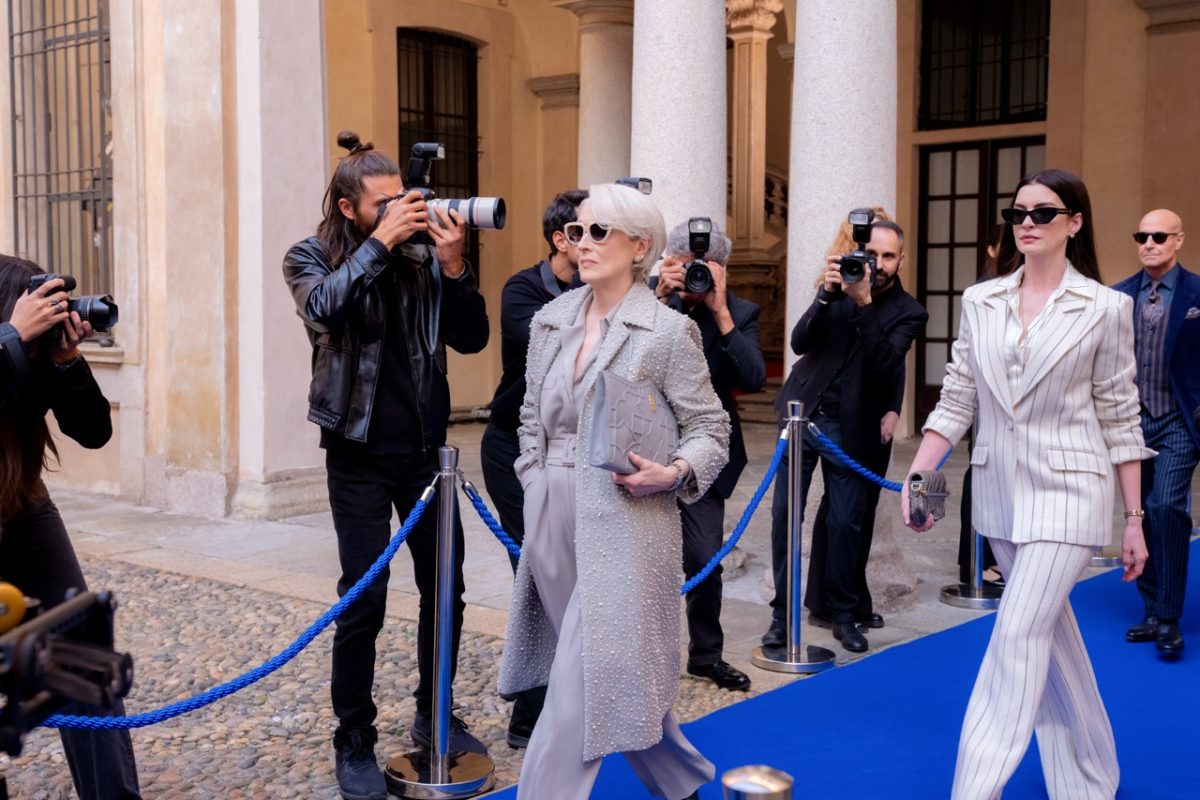
After a three-year hiatus, Mitski is back — and she’s now a Gothic homeowner scampering around on all fours, shattering milk bottles on the welcome mat, sucking blood, surviving a home invasion by Victorian carolers, sobbing, sticking her tongue out, making out with someone (maybe a caroler), killing a man in a beret, partying and possibly witnessing a virgin sacrifice. Or, at least, that’s what she’s up to in the music video for “Where’s My Phone?”
Under the guise of telling a story about a god-awful breakup, Mitski’s new album “Nothing’s About to Happen to Me” is a work of masterful, conceptual art. Counter to the tongue-in-cheek title, this album’s 11 tracks tell an action-packed story about a “reclusive, weird woman living alone in an old house,” Mitski said in an interview with The Current. The heroine mourns a lost love, encounters ghosts, moves to a big city, gets stalked by cats and loses her mind — all while the drums crash, the horns blare and operatic vocals roar. Mitski has returned with a characteristically gut-wrenching bang.
Track one, “In a Lake,” launches listeners into the tale; the narrator has already grown and moved away from a small town. With a folksy, slow-driving ballad that culminates in lush, grandiose instrumentals, the natural world blooms into the narrative; Mitski’s belting vocals revere the freedom of solitude, explaining, “In a lake, you can backstroke forever / The sky before you, the dark right behind.” Comparing swimming in a seemingly endless stretch of water to a large city, splashes of cars honking, wind whistling and traffic flows underlay the sound, promising that “in a big city, you can start over.” However, as the narrator recalls the smell of an old lover’s soap and laments past mistakes, this promise is immediately complicated and tossed with unreliability — one song in, and the narrator’s grasp on reality is already slipping.
“Where’s My Phone,” track two, is manically upbeat, brimming with rock noise, choir background vocals and self-effacing humor — I mean, seriously, where did she leave her phone? But, as always, there’s more to the story. Hard-hitting lyrics massage a painful knot of loneliness; the narrator confesses: “I keep thinking, ‘Surely somebody will save me’ / At every turn, I learn that no one will.” Projecting unrealized desire onto the unresponsive darkness above, she supposes that “If night is like you punched a hole into tomorrow / I would f*** the hole all night long.” Reverb at the end distorts a facetious “la-ti-da” bridge, repeating “pa pa pa” with ironic cheer. Mitski certainly knows how to tear your heart out and “yippee” at the same time.
“Cats,” track three, offers a mournful ballad and narrative stepping stone. The narrator is in a relationship that she knows is ending soon, yet despite this knowledge, she admits, “I won’t leave you ’cause I still love you / So it’s up to you if you choose to go / In the meantime, sleeping by my side / Our two cats, making sure I’ll be alright.” While listening, the image of the heroine stroking cats in her lap in time with the slow, restrained rhythm marks a new motif for Mitski, whose discography is populated with dogs, notoriously “I Bet on Losing Dogs” from the 2016 album “Puberty 2” and “I’m Your Man” from the 2023 album “The Land Is Inhospitable and So Are We.”
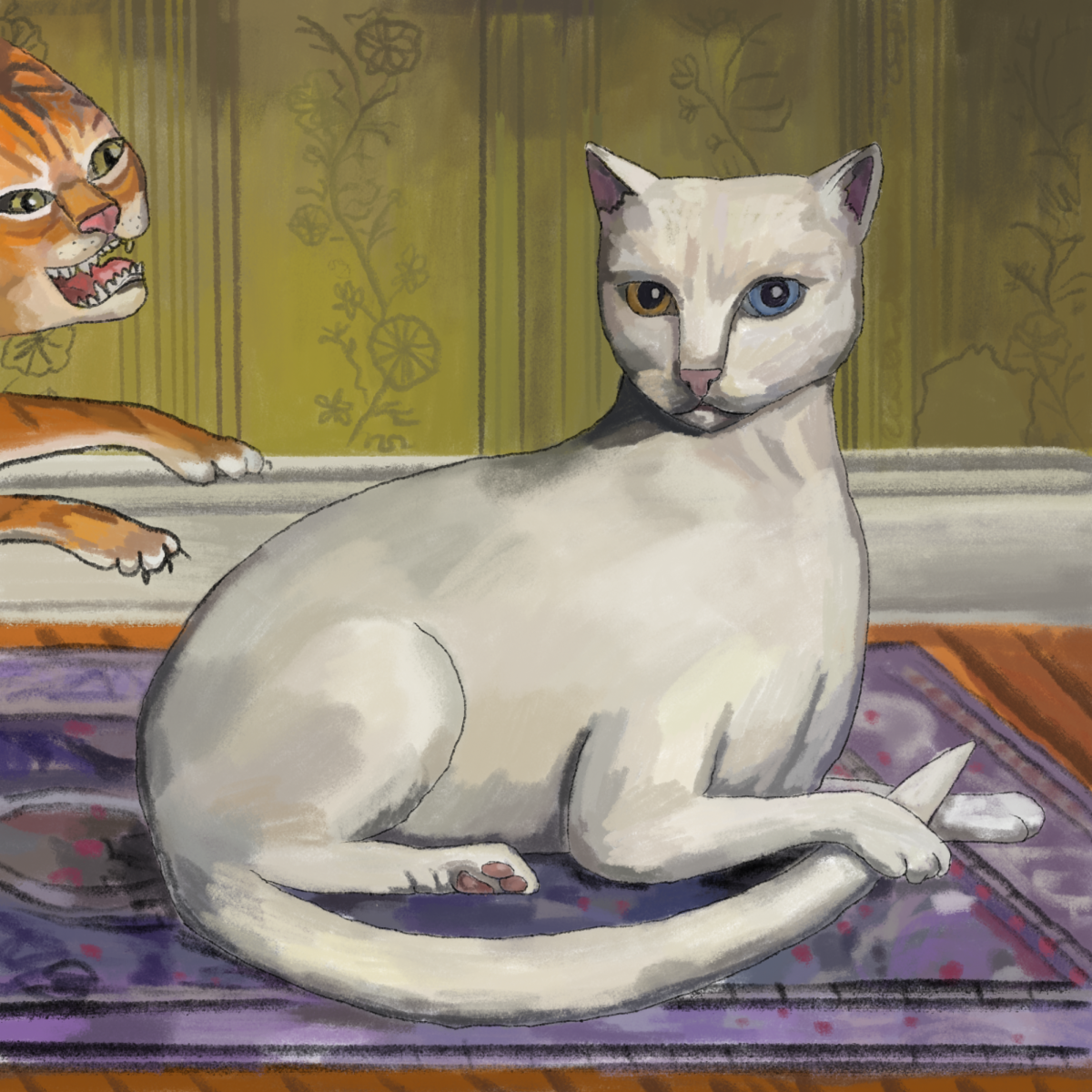
With a cat as the album cover, “Nothing’s About to Happen to Me” plays coyly with the gendered pitting of cats and dogs against one another throughout the album, weaving in allusions to feminist literature and prioritizing the heartbroken heroine’s interactions with the feline.
“[Cats] love you how they love you, and they do what they want. And I think often cats are demonized for that in a similar way that I think a lot of women maybe are misunderstood for that quality,” Mitski told The Current.
Track four, “If I Leave,” dissipates the joyous facade of “Where’s My Phone” and extinguishes all hope for the relationship that flickered dimly in “Cats” — the narrator is mourning the inevitable dissolution of her relationship, begging, “I couldn’t lose you / How could I lose you?” Even as she rationalizes an impulse to stay — “If I leave, somebody else will find you / But nobody else could see me / Quite as clearly as you” — both the listener and the narrator know the breakup is looming.
Departing from this yearning ballad, the next track, “Dead Woman,” growls with resentment, cutting darker, meaner and more menacing. The narrator speculates that her lover wishes her dead, and would posthumously muse, “‘She gave her life so we could have her in our dreams’ / ‘She gave her life so we could f*** her as we please.’” Imagining different ways to attempt suicide and fulfill these wishes, Gothic feminist tropes of the “madwoman” surface alongside archaic images of a drowned Ophelia and that of a more modern Esther Greenwood in “The Bell Jar.” The cutting, hammer-like instrumentals are unrelenting, and the entire track feels like a woman’s exhausted, guttural scream, embittered with a society negotiating her worth.
Track six, “Instead of Here,” is most reminiscent of Mitski’s 2018 album “Be the Cowboy,” with sorrowful, harrowing vocals isolated within a more stripped-down sound. If the narrator wasn’t at rock bottom before, she’s surely there now, proclaiming, “I’m not here, I’m where nobody can reach.” She is estranged from herself and flirts with a kind of psychic — if not literal — death.
“I’ll Change for You,” track seven, furthers the breakup storyline. Jazzy, weakly up-tempo instrumentals feel like a watery, chin-trembling smile that isn’t fooling anyone. The narrator sits in a bar alone, and the song is overlaid with snippets of glasses clinking, ice-rattling in a cup and soft laughter, sounds the narrator is overhearing. After being kicked out of the bar at closing, she speaks aloud to the night sky: “If you don’t like me now / I will change for you.”
Track eight, “Rules,” is a jarring follow-up to this crushing scene. Trumpets sound and Mitski’s voice counts cheerily to five, elaborating in Dua Lipa fashion on a set of dating rules: “Number one: I’ll come over / I’ll be dressed like your best idea / Number two, you’ll be gentle / Then number three, you will ruin me / Number four: I’m nobody’s anyone anymore / So, five, I’ll be alone for a while.” While summarizing what feels like a banal relationship trajectory — you date, you fight, you break up — the narrator dissociates, asking her ex, “When I leave my body / Please pretend that you don’t see / How I’m no longer there behind my eyes.”
A direct nod to the album cover – an oil and acrylic painting by the artist Marc Burckhardt of a white cat with heterochromia – track nine, “That White Cat,” rears its head with drilling drums resembling pelting rain and belting vocals. From the outside looking in, it feels as though the narrator has finally snapped, accusing a cat of watching her from the window, “marking my house.” The natural world creeps through the floorboards and the windowsills — wasps, possums, bloodsucking bugs and birds join the ghostly cat in stalking her like prey.
The following track, “Charon’s Obol,” references the coins placed on eyelids or in the mouth of the dead to grant their souls a safe passage into the underworld. The narrator feeds the dogs of the other dead girls who lived in the house prior, finding kinship within a long, ancient history of “hysteric” women. The mourning dogs gather like the old dogs haunting Mitski’s discography.
The final track, “Lightning,” begins softly, then flares with the thunderous crash of drums and buzzing electric guitar — aptly reminiscent of a lightning strike. The narrator does not fear the storm nor death; in fact, she dreams of reincarnating as the lightning itself and hails “the rain running like ghosts on the roof.” In this poetic end, the narrator transcends her body and house, dissipating into the darkness of the night, reborn.