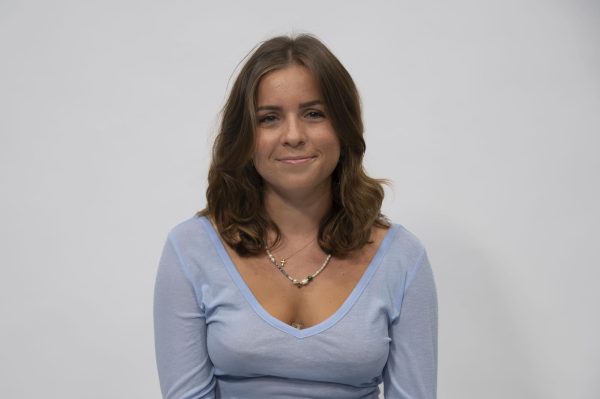
It’s SGA election season, and the Culot-Winkler slate is running for student body president and executive vice president, respectively.
The slate, running under the name “Huskies Unleashed,” is made up of current Vice President of Academic Affairs Molly Culot and Vice President of Operational Affairs Benedikt Winkler. Voting closes March 22 at 11:59 p.m., and results will be announced during the SGA Senate meeting on March 23.
Culot and Winkler, who are running uncontested, sat down with The Huntington News to discuss their priorities if they are elected.
Below is a transcript of the conversation.
This conversation has been edited for length and clarity.
The Huntington News: What’s your experience with SGA to date?
Benedikt Winkler: I’ve been involved in SGA since my very first semester on campus, and I’ve jumped around a lot of different roles over my time here. I started off in a lot more advocacy-focused positions with campus affairs, working on projects like sustainability initiatives with better recycling and composting programs. Last year, I shifted to a more behind-the-scenes role. I worked as the director of information management, doing a lot of management of files and accounts internally and also managing the SGA website. I also worked as the director of student organization governance, working with student organizations on their constitutions and managing that entire process. In this past year, I’ve acted as the VP of operational affairs, doing even more internal management roles, overseeing several other positions that have to do with room bookings, financials and some of our custom software engineering projects that we have here.
Molly Culot: I also joined SGA right in the beginning of my [first] year. I started as a senator, so I was representing my home college, Khoury College of Computer Sciences. I also served as a dean liaison in the academic affairs division for Khoury. At the end of my [first] year, I decided to run for VP of academic affairs, which is what my current role is. In this role, I oversee the academic affairs committee, which works on a lot of really important projects advocating about academics and the student experience in regards to classes, Snell Library and registration, and one of the projects we’re most proud of is implementing the quiet rooms in Snell. I also oversee the dean liaison board, which is what I started on. These have undergraduate representatives from every single undergraduate college here at Northeastern, [who] get to represent their college and talk to administrators within their college about projects that we are bringing forward. I also oversee the AI Advisory Board, which started in the beginning of this year, and I oversaw the creation and establishment of the co-op working group, which I currently chair.
HN: What are your biggest goals for the year if you are elected?
Culot: Before starting this campaign, we spoke to over 450 students. In the past week, as we’ve been campaigning, we’ve been tabling all over campus, talking to students. Our main goal is to get a wide perspective from the student body and hear what students want to hear or want to see change at Northeastern and want to see come from the student government.
We’ve come up with three main priorities so far. The first one is academic advising. We’ve heard from a lot of students, especially students in their combined majors, that academic advising can be a struggle here at Northeastern and that when students are meeting with their advisors, they don’t always have all the right information. So we want to work on improving the advisor student relationship here at Northeastern.
Winkler: Another one of our main goals is to improve the amount of spaces that clubs have access to when booking rooms. Currently, clubs are limited to only a few buildings on campus, and sometimes that’s really difficult, especially at the beginning of the semester, when you’re starting to have new meetings and get new membership. So we’re trying to plan to work with administrators to expand the amount of spaces that clubs can book so that more clubs can have more meetings.
Culot: And one of our other priorities is building a stronger campus community here. Something that we’ve heard from a lot of students, and we continue to hear, is that there’s not a lot of student events beyond initial orientation events for students to get to know one another. So we hope as Student Government Association, we could host large scale events, especially related to hockey.
Student government actively hosts hockey tailgates. We want to expand these initiatives, especially with no longer having Matthews Arena, so that way students can still feel that there’s a sense of community here on campus.
While these are our main campus campaign priorities, our ideas do not end here. We always want to hear from students. We’re continuously tabling throughout the campaign. Ultimately, we want our time in these roles to reflect the student experience.
HN: Can you tell me about the story behind the name of your campaign, “Huskies Unleashed”?
Winkler: We were brainstorming campaign names for a few weeks, and I think one day I was sitting at home, and it just clicked for me. I was like, “Huskies Unleashed,” there’s something about that that just works. “Huskies,” obviously representing the Northeastern student population, and I think “unleashed” really speaks to the way that we want to give more freedom to students on campus. We want to let them have more meeting rooms, we want to let them have more community and just unleash the student population.
Culot: Yeah, and the little slogan that goes with that is “more room to run,” indicating that we want to give students more opportunities. All of these goals are meant to give students more ways to interact with each other and get involved at Northeastern, giving students more room to grow and more room to run.
HN: There have been a lot of conversations recently in higher education about academic freedom, especially throughout the Trump administration. With that in mind, what do you think are the biggest challenges facing SGA right now?
Winkler: You’re probably familiar with the Educational Freedom Project, which worked with several student organizations across campus and other students to pass a piece of legislation through the SGA senate back in November called the “Light, Truth and Courage” legislation, and in that was a very thorough list of requests that the student government has officially passed on to administrators. The current student body president and executive vice president,are working very hard on implementing those requests. If elected, we would definitely continue to work on that legislation and make sure that the wording of that legislation is enacted as best as possible.
Furthermore, there’s also several referenda pieces right now that are available for students to vote on in the exact same election that we’re running in, and we look forward to helping enact all of the referenda that are passed as well.
Culot: Building off of that, talking about the referenda and helping enforce them, something that’s really unique about [the referenda] is that they’re written by a lot of different student organizations here on campus. So something that we hope to do is encourage student organizations, encourage students to come to SGA, and it’s so great that all these students are working on writing these referenda, but continuing to work with organizations, hearing how students are feeling, and using that in our conversations and implementing all the different legislation referenda that pass.
HN: What’s your favorite part of being on SGA?
Culot: I think my favorite part of SGA by far is definitely the people. I’ve met so many amazing mentors that have taught me a lot about Northeastern. Also, being on SGA, you get to meet so many different students, especially through tabling focus groups and having open meetings. SGA is a huge organization, and I’ve absolutely loved every single person that I met.
Winkler: I was going to say the people as well, but I think something else I love is the range of projects that SGA works on. As Molly mentioned, we have over 200 members at this point, and they are spread across such a diverse range of projects, working on everything from tailgates to recycling initiatives, more bike infrastructure on campus, improving student wellness, improving students’ global experience programs. It really improves campus life, and it’s really inspiring to see. Change takes a while to enact sometimes, but it’s all being worked on behind the scenes, and it’s all in progress.
HN: What are some of the things you’re most proud of that you’ve achieved while being on SGA
Culot: My favorite project that I’ve worked on is definitely establishing the AI Advisory Board and the Co-op Working Group — both of these groups are new in the academic affairs division. Prior to this year, the Academic Affairs Division used to just be the committee and the dean liaisons, so it’s great that we’ve expanded the scope of things that we could work on.
Co-op is such an important part of the Northeastern experience and it’s really important that students have a say in that process and are able to work with administration and reflect on their co-op experiences. Additionally, especially now AI is so prominent in everyone’s life, so I think it’s really important to have student voices there as well. I’m really happy that we were able to successfully establish and run these two groups and start working on a ton of projects in them as well.
Winkler: I think my favorite project would probably be one that I’ve worked on for a very long time. I’ve had to delegate parts of it this year because I’ve had a lot of other things to do, but I’ve been working on this recycling and composting initiative since my very first semester, and the entire purpose of the project is to improve recycling and composting on campus.
That’s a very lofty goal, but some ways that we’ve already taken major steps is by introducing new signage that makes it easier for students to see what can be composted, what can be recycled, and what just has to go in the general waste. [That] has been introduced in several residential halls, and we’re working very strongly in collaboration with the waste management and recycling division on campus to be able to make these changes.
HN: What drives you guys to want to take on this role, and makes you want to step into something that is so demanding and takes up so much of your time?
Culot: The biggest thing is I just love SGA, in general. I think I speak for both of us when I say SGA already is a huge part of our lives and a huge part of our days, and it takes up a lot of time, but I wouldn’t do the work if I didn’t love it. Watching like Julian and Dylan, the current president and [executive vice president], in their roles has been super inspiring. Watching them do such an amazing job leading the organization and bringing forward these initiatives has been really inspiring for me, and definitely one of the reasons that I want to take on this role and kind of continue on some of the amazing work that they’ve been doing.
Winkler: I think something that keeps me going every single day is the impact that we have on the student body. As I mentioned earlier, SGA covers such a diverse range of fields all across campus, and SGA has a huge impact on their everyday lives. Wellness Days is something that so many students use on this campus, and it was an SGA project for several years. And there’s so many more projects that students don’t know came from SGA but that are quietly making a huge impact on students every single day. And I think that really inspires me to keep going, to keep improving students’ lives, because that’s why I’m really here. I’m here to make everyone’s lives better, and that’s what we hope to continue doing in these roles if we get elected.