The Student Government Association, or SGA, created an artificial intelligence advisory board at the start of the fall semester, charged with communicating the student body’s thoughts on AI to university administration.
The new board, which Northeastern administrators suggested, was created to provide students with a space to offer feedback on current AI policies. SGA has appointed Sam Iannone, also the Mayor of Huntington Avenue, as chair of the board.
Iannone hopes that with the new board, Northeastern can stay ahead of AI and adapt so students and teachers can leverage the new technology inside and outside the classroom.
“We’re working on a number of different things for the university. It’s a lot of thinking about, ‘Well what is the future of education in an AI world?’ Really thinking about Northeastern students,” Iannone said, adding that his board is focused on keeping Northeastern students at the forefront of education. “Making sure AI is part of our classrooms, making sure that both students and teachers have a really strong understanding of how they could leverage this really awesome new technology to kind of maximize everyone’s learning.”
Student Body President Julian Herzing-Burkard said the new board is important in a rapidly-changing, AI-influenced world.
“As everyone knows, AI is the big conversation on campus and at every campus, so it’s important to have a student voice in those conversations of how that’s implemented at the university and how students can use it as a resource as well,” said Herzing-Burkard, a fourth-year international business major.
President Joseph E. Aoun has been outspoken about AI in higher education for years. In 2017, Aoun published his book “Robot-Proof: Higher Education in the Age of Artificial Intelligence,” which introduced his higher education framework called humanics.
“The AI Advisory Board is composed of students from each undergraduate-serving academic college at Northeastern University (e.g., the College of Social Sciences & Humanities, the College of Science, etc.),” SGA’s website reads. “Members define how Northeastern innovates and leads in the age of artificial intelligence by working directly with university leaders.”
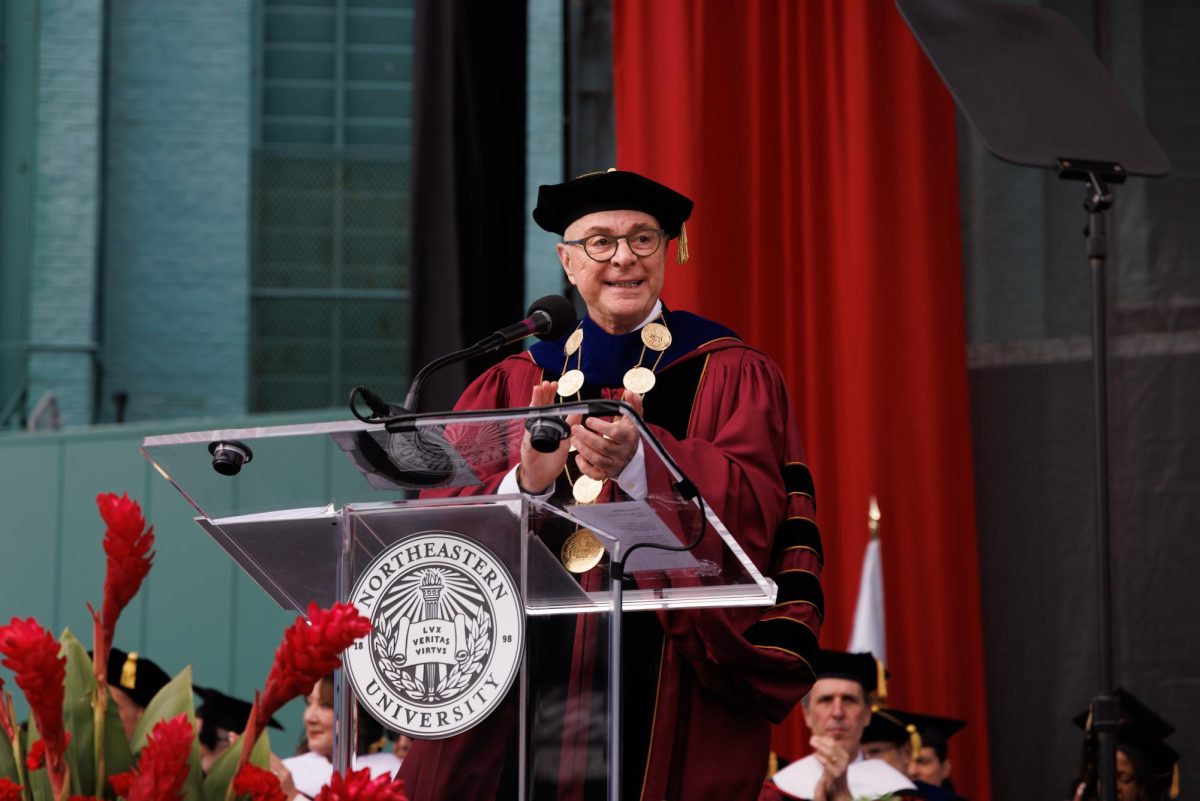
At the Class of 2029 convocation in September, Aoun spoke to incoming students about how AI is going to shape their learning. Aoun previously spoke about AI at the Class of 2025 commencement in May.
“Together, we are going to understand how AI functions,” Aoun told first-years in Matthews Arena Sept. 2. “That’s called AI literacy. We are going to understand the products of AI, which is data literacy, and … we are going to focus on what we humans can do for the time being that AI cannot.”
SGA leaders hope the board reflects a wider range of student perspectives and backgrounds.
“We’re working to ensure that the board has representation from various different types of students, including all the academic colleges, as well as representing voices that may be more hesitant on AI everywhere,” said SGA Executive Vice President Dylan Lee.
“We’ve got some very interested people in the AI Advisory Board,” Lee said. “It’s a full board, they’re operating and they’re meeting with administrators regularly.”
Professors will not be a part of this new board but have the option to voice any concerns relating to AI during faculty senate meetings.
“We don’t know how administration will run this. Like most of SGA, we are an avenue between students and administrators,” Herzing-Burkard said. “We are not privy to how the administration handles that with teachers. We just know we want to provide students input on these things.”
Iannone founded the board after discussing upcoming AI projects with Northeastern’s administration. Iannone said that Northeastern has always been innovating along new world standards.
While the university’s administration pointed Iannone to prospective board members, most were interested in AI before joining and applied through SGA.
“[Northeastern] innovated with co-op, and so obviously AI is something that’s very important and on our radar, and [Northeastern administration] wanted to ensure that student feedback was involved,” Iannone said.