When most people think of museums, science, art or history come to mind. And when you visit history museums, it is not uncommon to find relics of the past: velociraptor bones, moccasins from an Indigenous tribe or ceramics from the Shang dynasty.
But in an alternate universe in the not-so-distant future, human beings just might be those “relics of the past,” or the antiquities of our time.
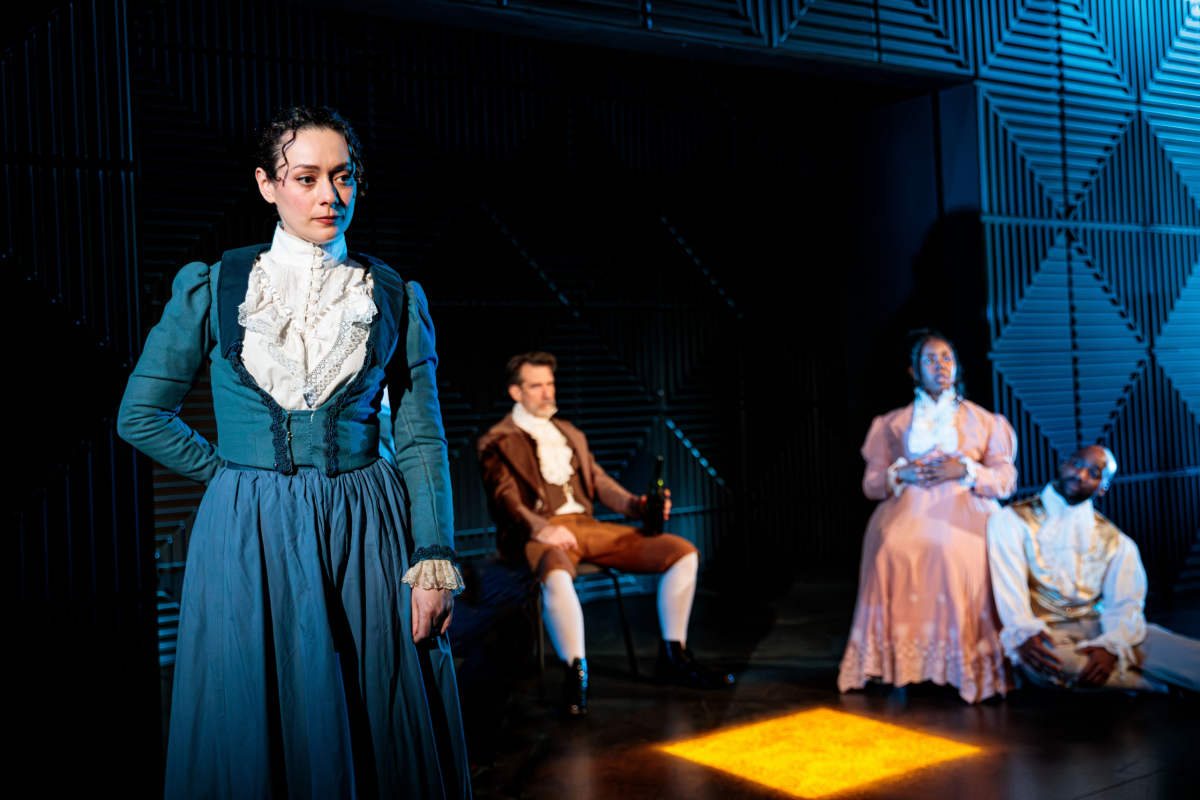
SpeakEasy Stage’s production of “The Antiquities” by Jordan Harrison is running at the Calderwood Pavilion March 6 to 28. Set hundreds of years in the future at the Museum of Late Human Antiquities, the museum curators, who are humanoid robots, take visitors through a series of exhibitions that showcase artifacts from the now-extinct human civilization.
In just one hour and 40 minutes, audience members undergo warped time travel. The first act takes them forward from the years 1816 to 2240, and the second act sends them backward from 2240 until the show ends at 1816.
Just before the tour starts with the 1816 exhibit, two humanoid AI guides (Alison Russo and Kelsey Fonise) introduce themselves as curators. Woman 1 (Russo) robotically asks audience members a series of questions about their own physicality, like if they can feel their weight “smooshing” into the chairs beneath them, the food traveling through their bodies or the hair on their heads.
This kind of bodily hyperawareness is uncanny and prompts audience members to reflect on what it means to be human.
It’s a show that everyone can relate to in at least one way. For the older folks, the 1987 exhibit on the HIV/AIDS epidemic might surface deep memories, while for the younger generation, the 2014 exhibit on the Amazon Alexa smart speaker might bring out some laughs as a child adds a “pile of poop” and a “mako shark” onto the shopping list.
But throughout each scene, it is evident that this play serves as a warning of humanity’s transient nature. In the 2240 exhibit, there are just a few humans left, including a man begging his wife to let him impregnate her to save the human race.
In the same scene, which is set furthest in the future, it seems society has aged backward as a woman uses a wooden butter churn. Instances like these make viewers think about the limits of innovation and whether “doing too much” will lead to societal regression.
Another scene titled “The Reliquary” shows a display case of technological advancements that have earmarked time: an electric lightbulb, a wooden butter churn and smart sunglasses are just a few things on display. “The Reliquary” may have been better placed at the end of the play to aid with summation, but was nonetheless a good reminder of how objects are transient and that modern human beings might become “things.”

Obviously, the “people” on display at the museum are played by real, heart-beating human beings, but they did a darn good job portraying “inorganic beings,” as they are referred to in the play. Just like robots, all actors were able to turn themselves on and off.
With a sudden jolt of the body at the end of each exhibit, or scene, the “beings” moved mechanically, only pivoting through the four main compass points and not diagonally. It was systematic, planned and synchronized with the other characters on display at the live action museum.
There were more than 25 exhibits, but because they moved quickly, it was hard to get bored. The soundscapes for the transitory periods were a mix of electric, new-age beats — the perfect dissonant tune to awaken the sleepy museum visitor.
Because each scene is composed of a different exhibit with different people, the cast of nine actors played more than 40 characters combined. Each actor had at least four different roles, and it is admirable that they were able to switch seamlessly throughout.
During the climax of the play, set in the year 2076, unmodified humans — the ones who resisted technological change — are clearly in danger. Paz (Catia), an unmodified woman, is killed by a modified child who says, “The humans already made their choice — the smart ones, at least. The ones who embraced the improvements. The modifications.”
The audience went silent at that scene. It was well-timed, too. Just before that, a writer begs the doctor for a chip in her brain to improve her craft. He warns her that she won’t be the same anymore, but she insists she must, plagued by worries that her job will be replaced by AI.
“The Antiquities” explores the things that make the human experience so rich: the emotional range to feel grief, the capacity for creativity and more. Though the overall mood of the play is dark, the last scene, reminiscent of the good ‘ol days, shows the joys of telling stories around a campfire, the excitement of becoming parents and the ability to be present — feelings that can only be felt by real humans.
It’s hopeful and reminds audience members, museum visitors and future antiquities that humanity is not yet lost.