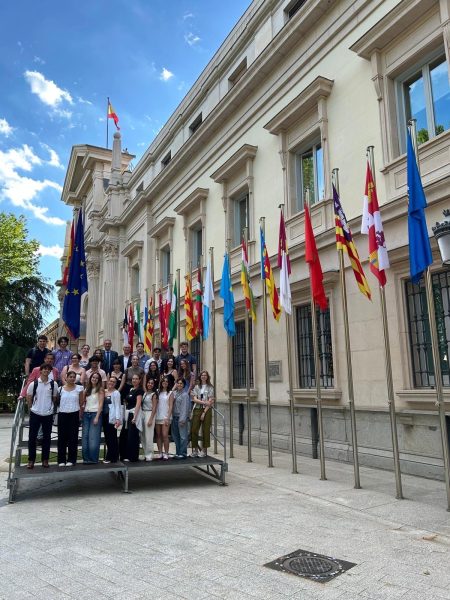
When it comes to political conversations, I’ve always sat on the fence. But everything changed this summer on my Dialogue of Civilizations, “Challenges to the Nation State: Spain.”
During this Dialogue, my classmates and I traveled from the country’s capital, Madrid, to the city of Bilbao in the Basque country and Catalonia’s Barcelona. We met with leaders across numerous political parties as the country emerges from its traditional bipartisan system.
We listened to the groups in favor of the unification of the Spanish nation, as well as others, in the Basque and Catalonia regions, who are fighting for autonomy, independence and restoration of their own language and culture. We also met with lobbyist groups fighting for equal rights and reforms under the current Spanish Constitution.
At the end of our program, the final for the course was a class debate during which we were assigned to represent one of the political parties. During this debate, we were to publicly address hypothetical internal and global conflicts from that party’s point of view.
I, along with two of my classmates, was assigned to represent VOX, a newly formed nationalist right-wing party and, to some, a controversial party of Spain.
This made me uneasy and especially within the classroom, I wanted to escape to my trusty fence. Even though hypothetical, the debate would push me to take a stance on a political issue.
Throughout my college career, I subconsciously sat on the fence on every issue. In my freshman year “Understanding Today’s News” class, I would open my computer every morning to the New York Times headlines, looking for topics to bring up in class discussion. I would rapidly scroll away from articles that contained the scary words: “Trump”, “Biden”, “Harris”. To me, political articles were just deliveries of bad news — the last thing I wanted to read to start my day. Instead, I would gravitate toward lighter and less controversial science, climate or lifestyle related articles.
But my political avoidance dates back even further. As a kid, I was conditioned to never talk about politics. I was told not to ask adults about it, that it was too complicated for someone “not in the know” to figure out and that nothing good came of bringing it up. So, I began to turn a blind eye.
The avoidance I practiced as a kid was essentially the seed that grew into my neutrality as an adult. No matter how much I cared about an issue, I never felt warranted to participate in political conversations because I thought that I hadn’t educated myself enough to make a contribution. I was comfortable going off of remarks from people around me but never willing to formulate my own. I also thought, if I wasn’t someone who was directly affected by an issue, what right did I have to open my mouth about it?
My neutrality was a shield for my insecurities. I feared that if I failed to contribute in the perfect way, someone would look at me as naive, and I would always wear that filter in their eyes. If I stayed neutral, I thought, I would show that I care about hearing both sides of a debate — therefore, it must be better to keep my opinions to myself.
Neutrality became avoidance — my escape to be comfortable in a realm I didn’t feel warranted in. It’s been my way to “bow out” of the political conversation to avoid my fear of judgment.
After seeing my name assigned to VOX, the neutrality fence that I could always fall back on seemed to have been pulled away entirely.

I thought to myself, “Great. Of course I get the most controversial party that everyone is going to come firing back at me for.” This is the type of outcome I had fiercely avoided my whole life.
VOX strongly campaigns for the unification of Spain and has a textbook picture for what it wants Spanish identity and culture to be. It is heavily against immigration from Latin America, Africa and Eastern Europe and opposes LGBTQ+ rights. It also receives criticism for downplaying the era of Francisco Franco’s dictatorship.
To say that I was uneasy was an understatement. If I couldn’t even stand up for myself in conversations, how could I stand up for a party I disagreed with?
During the debate, my team would make our statement at the podium and get booed, laughed at or yelled at by other students sticking up for their opposing political party’s views. Uproar of conversation emerged, flaws of our party used against us after every round.
I couldn’t bow out and stay neutral. I knew that if I wanted to win this debate, I needed to act confident in my party and embody the role. The debate forced me to stick to a side, something I had never done before. It forced me to know the ins and outs of the party’s values. Even though I didn’t align with its agenda, it felt like I was sticking up for something instead of just leaving the table. The debate made me sit with the uncomfortable — to argue the party’s agenda and refute statements against us.
In the end, the debate ended up providing an approachable atmosphere for me to practice voicing my opinions. None of us within the Dialogue truly had any association with these political parties other than what we had gathered from meeting with them. This let our conversation be untainted by the rhetoric of U.S. politics and surrounding stigmas. I had less fear of what my classmates would think with what I had to say because, as I was reminded, we were dissecting it together. It was an opportunity for me to feel like I could handle politics — I didn’t have to be neutral.
Ever since this experience, I have found neutrality to be a complicated word for me.
I don’t think it’s good to be neutral, but rather unbiased, listening to what others have to say and formulating an informed response.
But neutrality? To me, it is actively knowing both sides of a conversation and choosing not to listen — to take the easy way out and protect yourself. Neutrality is to turn away from what’s right in front of you because you would rather not know. It is when you don’t believe in yourself enough to decide what matters to you.
Political conversations are in no way easy, but that doesn’t mean they should automatically be run away from. Sharing ideas, opinions, emotions and personal experiences helps you learn about yourself, others and the complexity of our world, an opportunity I would’ve missed out on if I continued avoiding it.
Elise Peffer is a second-year journalism and international affairs combined major. She can be reached at [email protected].
If you would like to submit a letter to the editor in response to this piece, email [email protected] with your idea.