About 250 people gathered at Forsyth Park Jan. 20, the anniversary of President Donald Trump’s second inauguration, as part of a nationwide walkout to protest his аdministration’s policies.
More than 900 “Free America” events were held across the country at 2 p.m. local time as organizers called for people to walk out of schools and workplaces in protest of U.S. Immigration and Customs Enforcement, or ICE; U.S. military intervention abroad; and legislative attacks on women and the LGBTQ+ community.
The demonstrations come amid the Trump administration’s widespread efforts to crack down on illegal immigration to the U.S. The administration recently deployed large numbers of ICE officers to Minnesota — the Department of Homeland Security, or DHS, called it “the largest immigration enforcement operation ever carried out” — where they have arrested 3,000 people and officers have fatally shot two civilian observers: Renée Good and Alex Pretti.
Suzanna Danuta Walters, director of women’s, gender and sexuality studies at Northeastern, was the lead organizer behind the Boston walkout.
“This is an administration that is mired in and works off of misogynistic ideas. Gender studies, my own field, has been under attack from the very beginning,” Walters said. “We happen to be in a private institution at Northeastern and in a blue, progressive state. But in states all over the country, it is illegal to do the work I do. I never thought this day would come … but that’s why we’re fighting back.”
Walters worked with several Northeastern student groups, who she described as “fabulous and energized,” to make the Boston protest happen.
“During horrible times in history, people have stood up,” Walters said. “Marchers stopped the Vietnam War. Women fought and got the vote. The civil rights movement changed laws and changed minds.”
Other protesters, too, were inspired by resistance movements throughout history.
“We’ve seen this picture before, and it’s not like we don’t know what’s going on,” said Scott Gilbert, a representative of the activist group Refuse Fascism, which advocates for a fascism-free America through nonviolent protests, resistance and teamwork, according to its website.
“Refuse Fascism has a single unifying demand: Trump must go now,” Gilbert said. “The whole fascist regime must go now.”
Gilbert noted that visibility is essential for movements such as this one to gain momentum.
“It’s great that there are 300 people out here, but we need 300,000 people out in Boston. We need to unite all that can be united now before it’s too late,” he said
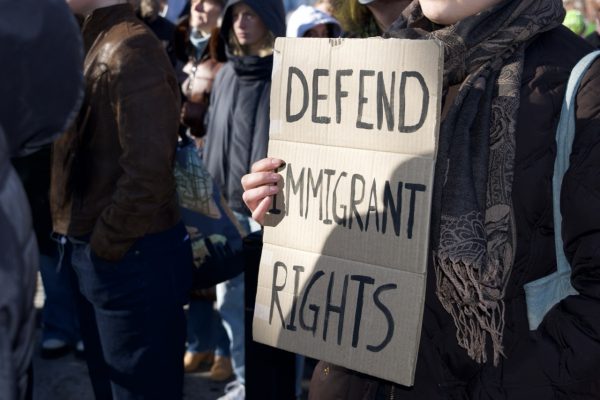
While the turnout for the planned event at Forsyth Park was significant, there were other pockets of civil resistance throughout the city.
At the base of the General Hooker Entrance of the Massachusetts State House Jan. 20, six people stood in a semicircle to protest the first year of Trump’s second term.
Standing at one end was retired Winthrop resident Suzanne Swope, who protests every Saturday from Belle Isle Bridge, a busy highway bridge in Winthrop, Mass., in support of immigrants. For big events, when Swope wants to be energized, she comes to Boston to protest and be among the crowds.
“I have grandchildren, and I am concerned about the future of this country. I am concerned for them and children in general and what life is going to be like and whether we can sustain this wonderful idea of democracy,” Swope said.
A group of roughly 30 students from a local school who participated in the walkout rounded the corner of Bowdin and Beacon Street and marched past the protesters on their way to Forsyth Park. The group joined together in chanting, “¡El pueblo, unido, jamás será vencido!” (The people united will never be defeated.)
“We’re out here to say that enough is enough,” State House protester and local hospital fundraiser employee Dallas Fites said.
She referenced the Jan. 7 incident when an ICE agent fatally shot Good, a 37-year-old U.S. citizen. Trump and federal law enforcement officials argued that Good had attempted to run agents over with her car — which DHS Secretary Kristi Noem described as an act of “domestic terrorism” at the time — and the shooter was acting in self-defense. The claim has been widely disputed by eyewitnesses and Democratic elected officials.
“They’re actively trying to erode all of our civil liberties. They’re trying to intimidate us. They’re shooting people in the face, in their cars, and claiming that they’re domestic terrorists,” Fites said.
Meanwhile, dozens of Northeastern students walked out of their classrooms or workplaces to join the protest at Forsyth Park. Phylicia Dias, Northeastern Black Student Association co-president and a third-year music and communications studies combined major, said she chose to walk out to exercise her right to free speech and encourage others to do the same.
“I’m walking out for two main reasons: to encourage other students who look like us — people of color — to speak up, and because freedom of speech is getting restricted at the university and federal levels,” Dias said. “It’s important to exercise your right to speech, especially when you see other people who feel like they can’t speak up because they’re scared of getting deported or arrested. I know I have a privilege being at this university, so with that privilege, I’m going to speak up.”
Josiehanna Colon, a fourth-year criminal justice and human services combined major and president of the Dominican Student Association, walked out of her workplace and delivered a speech. She said she hoped the walkout’s visibility would be a catalyst for change and inspire action at the university level.
“I was tired of how silent it has been when it comes down to Northeastern’s stance in general on the political climate right now,” Colon said. “Now more than ever, we need institutions that have a lot of power and a lot of influence to speak up.
“I’m really hoping that Northeastern stands on business after this walkout,” she said, “because, Northeastern, your people are showing up. Your community is showing up. Do something about it.”
Dias said she recognized that some students choose not to participate in protests over fear of retribution. She encouraged those students to prioritize their safety and suggested they share any concerns with student leaders like herself.
Colon said representation was critical, adding that, “The most marginalized voices are not being represented in the spaces that need the representation. We need your voices there.”
As demonstrators arrived at Forsyth Park, they held signs bearing handmade art and slogans like “ICE will melt” and “Fight ignorance, not immigrants.” Student leaders were at the forefront of the crowd, which formed a semi-circle around the speakers. Kaylin Daniels, a Northeastern third-year political science and economics combined major, Student-Athlete Advisory Committee president and Black Athlete Caucus administrative liaison, stood beside Dias and Colon.
“Especially being an athlete … we have a direct tie to the university,” said Daniels, who is a varsity volleyball player. “We wear the [Northeastern] name across our chest all the time. My motivation when I’m telling people to come out and participate is like, ‘Be proud of the name that’s on the front of your jersey. Be proud of who you’re representing and on a country level as well.’”
Daniels added that she understood the solution isn’t as simple as just showing up, but she hoped standing up and speaking out could prompt some change.
“Where I’m coming from is both a place of resistance and joy. I love my country, and I think it’s super patriotic to be here to protest, to exercise our right to free speech,” Daniels said. “I’m also here to say to the university and to this administration that what’s happening right now isn’t okay, and this isn’t the America that I love, or the principles that we’re supposed to stand [for].”
Matthew Forkey, the president of Northeastern College Democrats, also gave a speech during the demonstration. He criticized Republicans and some Democratic politicians for failing to effectively oppose Trump and emphasized the need for Americans to vote against and protest the current administration.
“We need to take back the House, we need to take back the Senate and we need to take back our country,” Forkey said, addressing the crowd.
Forkey also called on Northeastern students to push for greater input in Board of Trustees decisions and urge the group to stand up to the Trump administration in light of recent cuts to the university’s federal research funding and the university’s decision to rebrand the Office of Diversity, Equity and Inclusion to the Office of Belonging.
“I think it’s time we make it clear we’ve had enough of the Board of Trustees making policies without any input from their student body,” Forkey said.
Walters said she did not believe Northeastern leadership has been “outstanding in its resistance to the Trump agenda” and the federal administration’s attacks on higher education.
“[Northeastern] leadership needs to come out strongly and say, ‘We are for diversity, equity and inclusion. We believe in those things. We believe in the departments of gender studies and African American studies and Latina studies. We believe that immigrant students belong here,’” Walters said. “We need an administration that takes that position, that defends us.”