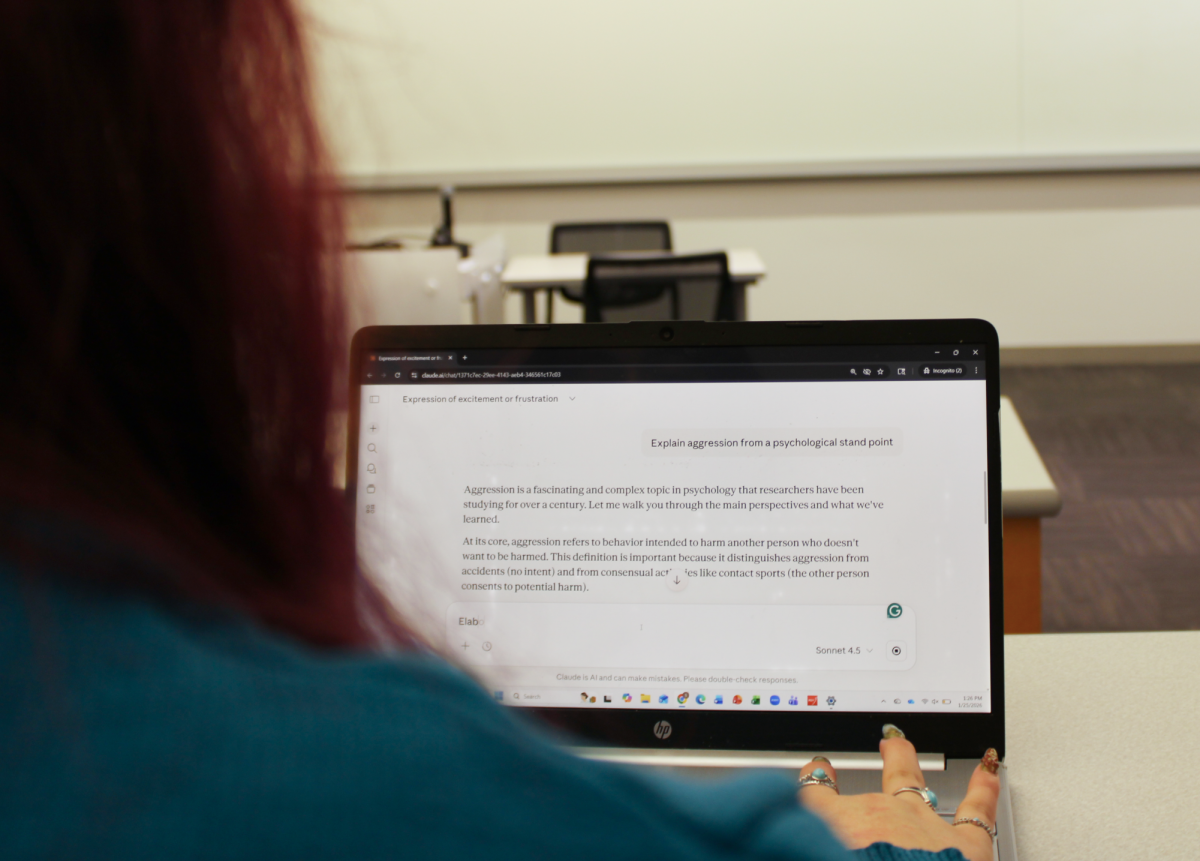
Let’s be honest: If you’re reading this, you have most likely used artificial intelligence, or AI, for schoolwork. So have 90% of college kids. The question for students now is, are universities going to keep us in the past or prepare us for what education and the real world are becoming?
The answer for Northeastern students is detailed on the university’s AI website page. It guarantees that we’ll graduate with “confidence and competency to leverage AI as a powerful tool.”
But I’ve asked multiple Northeastern students: Which of your professors are involving AI in their classes? How many students are taught to use AI to enhance their unique skills?
The answer was: not enough. The AI workshops provided by the school are poorly advertised, resulting in a lack of student and faculty attendance. For example, a College of Professional Studies (CPS) workshop named “Level Up your AI Skills: AI in Professional Practice Badge”, only had 150 students attend out of the approximately 6,000 students enrolled at CPS. Instead, the only AI skills we are gaining is how not to get caught using it.
Northeastern prides itself on being experience-focused to prepare us for our futures, yet the very tool reshaping our future is still treated like a taboo in the classroom.
This isn’t the AI fluency that our generation needs. It is AI anxiety.
Right now, classrooms are built on assumptions that students are cheating unless proven otherwise. Students aren’t learning how to use AI; they are learning to mask the use of it.
A 2024 report from the Center for Democracy & Technology found that the AI-detection tools widely used in classrooms “are not consistently effective at differentiating between AI-generated and human-written text.” When a false positive means failing a class, or getting a bad reputation, nothing about this system makes sense.
AI is here to stay. Embracing it is our way forward. This requires understanding AI’s strengths and limitations so it can be used to enhance human skills. In a time where AI distrust leads professors to use largely inaccurate AI detectors, learning how to collaborate with AI and see it not as a danger but a useful resource is key to this new education system.
The first problem isn’t AI: It is fear.
A local high school English teacher argues that AI makes students dishonest, and that AI can enable cheating or surface-level thinking.
But in a Georgetown University dissertation examining AI use across 3,000 classes at the University of Texas at Austin between 2021 and 2025, researchers found that “AI-generated assignments can match or exceed the typical quality of undergraduate work.” If students have access to a tool that can produce comparable work in far less time, the temptation to rely on it without thinking is obvious.
Research shows that misuse happens under a specific condition: when people aren’t trained. When AI is banned, students continue to use it poorly — copying prompts and responses without evaluation. In contrast, when it is taught and embedded in the classroom, students think critically, assess the response, compare results and draw their own conclusions. This transparency reduces academic dishonesty, as students feel more comfortable discussing AI use with educators. Supporting this, Amy Schumacher-Rutherford, a professor at the University of Mississippi, found that openly discussing and practicing responsible AI use resulted in significant increases in confidence, effectiveness and workforce preparedness.
Fear drives restrictive behaviors. Without dedicating time to address this issue, the cycle of distrust will continue.
The real world isn’t scared of working with AI. Employers aren’t banning AI; they expect that you use it. As Harvard researcher Chris Dede put it, “If someone comes in with something that isn’t any better than Chat AI, they’re not going to get hired, because why hire somebody that can’t outcompete a free resource?”
The more AI advances, the more actual human skills, like critical thinking, creativity and reasoning, become the differentiators. Universities should be preparing us for this reality.
Seeing AI as a threat is a sign of a deeper problem in academics. A lot of assignments require students to follow formulas rather than engage in the process and think deeply. Getting rid of assignments like these allows space for tasks that require higher level reasoning and creativity — skills that AI can’t replace.
Show us how to use AI, and you won’t diminish our learning — you will increase it.
Professors should be open to redesigning assignments and letting AI take over the routine and predictable tasks. Doing so would free up time for teachers and students to focus on the aspects of learning that AI can’t comprehend.
Personalization and creativity are qualities that AI cannot replicate but that some students are slowly losing. So much time is spent doing thoughtless assignments that generative AI could do for us, so we don’t have enough time to nurture our creative side. So why not embrace the tool and bring these more human aspects to the forefront?
Northeastern already promises that we will graduate with the skills we need to use AI. But these promises don’t progress until they are seen in the classroom. NU is on the right track with its co-op experiences, partnership with Claude and putting on workshops designed to teach about generative AI. Programs like AI for Impact already show that students aren’t just learning about AI but actively working with it in their co-ops.
However, not enough students or faculty are engaging in the process. More classrooms should start preparing us for this reality. AI fluency and literacy won’t just come naturally; it happens through practice.
If we want less AI anxiety, all members of the Northeastern community need to participate. Our professors should be openly discussing AI outside of academic dishonesty. We as students need to proactively attend workshops, and the classroom needs to be a place where AI is used ethically rather than treated like some scary, mysterious thing.
AI fluency isn’t optional. It’s preparation for the world we are stepping into after graduation.
Siena Griffiths is a first-year bioengineering major. She can be reached at [email protected].
If you would like to submit a letter to the editor in response to this piece, email [email protected] with your idea.