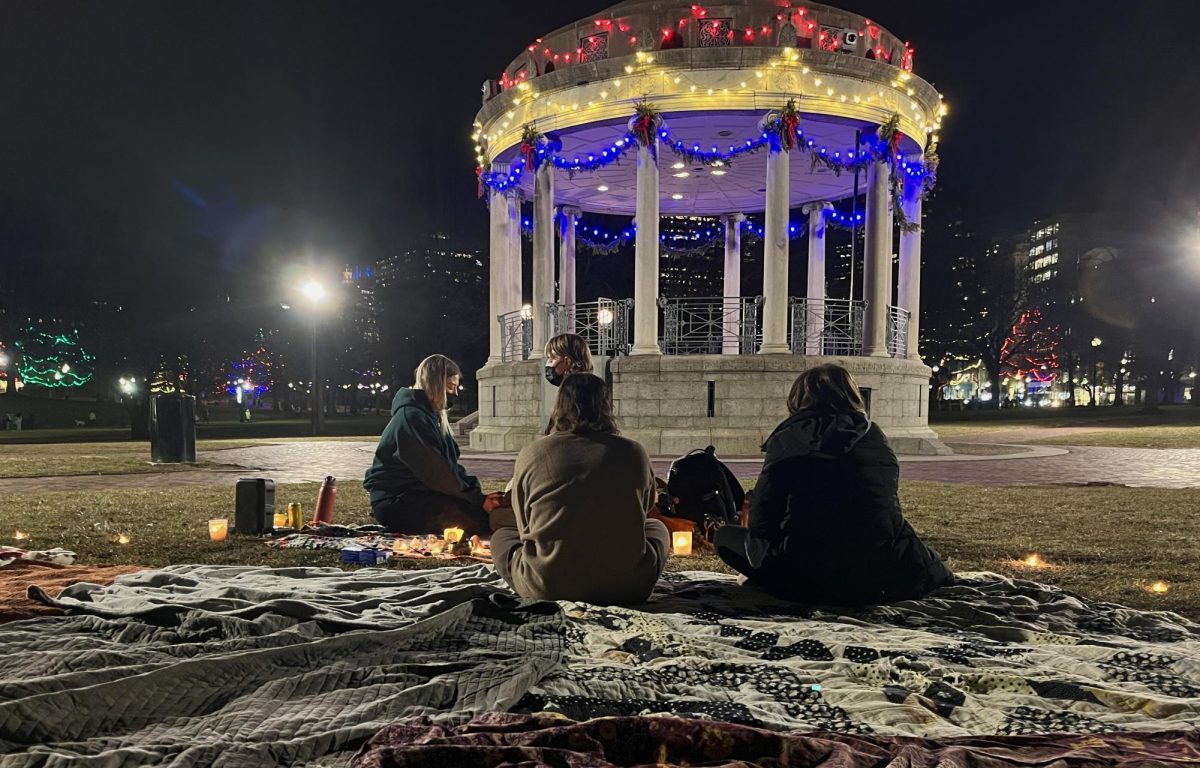
Nearly a dozen people gathered at Parkman Bandstand in Boston Common the evening of Jan. 14 for an intimate, mindfulness-based demonstration protesting the growing presence of U.S. Immigration and Customs Enforcement, or ICE, officers in communities across the country.
Rather than holding a typical rally or march, the two-hour-long “Melt the ICE” event utilised meditation, breathwork and group prayer to spread healing and peace to those affected by ICE’s actions. Organizers Emma Meents and Sophie Caulton also encouraged participants to continue mindfulness practices on their own time.
Caulton, a 22-year-old writing major at Simmons University, said helping lead the protest gave her peace because she could raise awareness and do something to take action.
For Meents, a 24-year-old Reiki practitioner living in Arlington, Mass., the issue is deeply personal. Citing her upbringing in Minneapolis, Minn., Meents felt compelled to respond to heightened ICE activity in the city through the spiritual values and activist techniques she learned while studying yoga and meditation practices in India for the past three months.
“I think the philosophy I learned there [India], and the approach to activism was so much centered around love,” Meents said. “One of my biggest beliefs in life has always been that the world needs more peace and love.”
Attendees, although small in number, came together in opposition to the Trump Administration’s expansion of ICE operations and authorization of more rigorous enforcement. Cities including Minneapolis, Los Angeles and Houston have been targeted aggressively due to their high concentration of immigrant populations.
Caulton spoke at the event about how her recent experiences, including learning Buddhism, have encouraged her to approach protests in a more intentional way.
“What we’re trying to do is bring some positivity, bring some love, bring some kindness and good energy into the world,” Caulton said.
As the sun set, attendees sat on quilts surrounded by softly lit candles. The evening opened with a moment of reflection as Meents guided a meditation emphasizing peace despite the heaviness of current events surrounding ICE’s presence.
Saoirse Green, a receptionist at a veterinary clinic and a Massachusetts resident, said that while meditation and breathwork practices initially didn’t seem like a conventional remedy to the issue, they left believing it served as a reminder of why people gather to confront issues.
“We’re not here because of what we’re fighting against, but what we’re fighting for,” Green said. “We’re here because there are real people being harmed by what’s going on, so we’re here to support them.”

Although it was a cold January night, Green said the protest space remained warm and free of judgment. Meents and Caulton gently reminded participants of their collective goal to send love and solidarity to those oppressed. This mission was woven through chants, intentional breathwork, and Caulton’s reading of “Practicing Peace” by Pema Chödrön, serving as a call for listeners to meet suffering and fear with compassion.
“Those who may be so prejudiced in their minds have very little opportunity to grow and learn … so they’re the ones who ultimately suffer the most,” Caulton read to the group. “There’s nothing that causes more pain and suffering than to be consumed by bigotry.”
Following the reading, Caulton returned the audience’s attention to meditation and led a mindfulness practice that asked each person to send peace to anyone affected by ICE policies and enforcement, whether they are loved ones, people recognized in the media or strangers.
“May you be free from this suffering. May you be kind and gentle with yourself. May you find peace and ease,” Caulton said to the crowd.
Kyra Leininger, a psychology and philosophy major at Boston University, said she was nervous about attending the event but ultimately found the experience quite meaningful.
“I feel like it seemed counterintuitive, but it’s important for us to be able to sit and have compassion for people that are used to being met with anger,” Leininger said. “I love grudges and I love getting angry, but I’ve learned that’s a really harmful way to lead your life.”
Leininger said this gathering, despite its small size and limited public attention, left a lasting impression on her that felt more productive than other means of protesting.
The event concluded with Meents guiding the group through a breathwork session, encouraging participants to release tension and carry the evening’s intentions beyond the confines of their candlelit circle. She hinted at the prospect of future rallies with similar intentions.
“I’ve talked about wanting to be able to cultivate spaces like this, so it feels really special to be sitting here right now,” Meents said to the group. “We definitely want to do more [gatherings] in the future.”