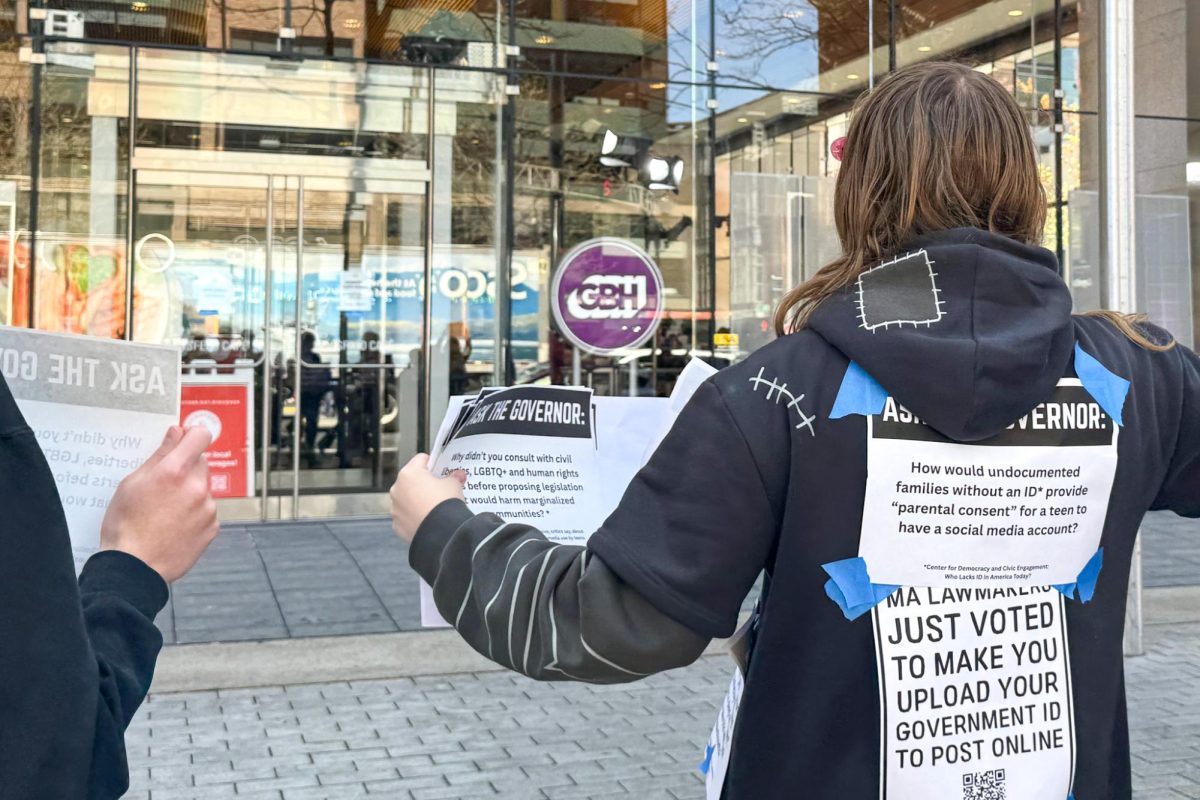
Around a dozen people rallied outside the Boston Public Library April 28 to protest Gov. Maura Healey’s proposed social media legislation, which they said puts users’ sensitive personal data at risk.
Activists pointed to a Massachusetts House Bill, passed April 8, prohibiting children under 14 from creating social media accounts and requiring parental consent for children aged 14 and 15 to create accounts. Additionally, they underscored Healey’s April 14 “online protection” proposal, which would broaden the definition of social media and require age verification to access social media platforms.
The demonstrators held signs with slogans including “Educate, don’t discriminate” and “Governor Healey: please listen to LGBTQ youth” while Healey spoke to constituents at a live taping of Boston Public Radio’s monthly “Ask the Governor” segment inside.
“Reading the governor’s legislation and the legislation that passed the House, it really feels like they didn’t actually sit down with any experts on this, even ones that maybe I’d disagree with,” said Evan Greer, director of activist nonprofit Fight for the Future.
Critics argue the only way for companies to comply with verification requirements would be for platforms to require all users to upload sensitive personal information. At the end of the protest, Greer shared that Healey’s staff agreed to meet with civil liberties experts and LGBTQ advocates to discuss their concerns about the legislation.
“The governor isn’t wrong; these companies are abusive and we can’t trust them,” Greer said. “We’d love to work with her to enact legislation that would rein in these companies and crack down on their abusive practices, without throwing LGBTQ youth under the bus … and without violating the privacy of every Massachusetts resident.”
Healey and other state policymakers have defended the legislation, arguing it protects children from the harmful side effects of excessive social media use, such as phone addiction, heightened risk of mental health disorders and exposure to inappropriate content.
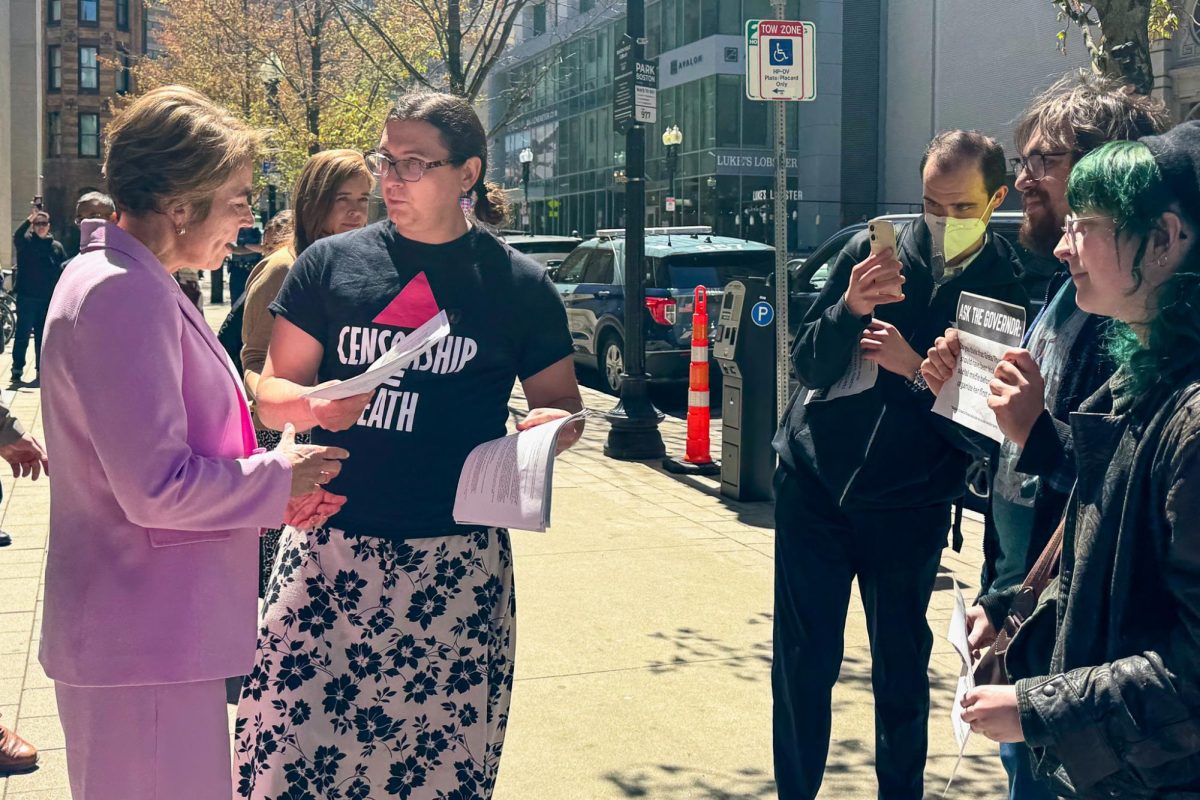
At the conclusion of the broadcast, Healey exited the building and greeted the group. Greer handed Healey several documents, including a line-by-line analysis of the proposal and an explanation of their grievances with the House bill.
“Thank you guys for coming out today. I care very much about your rights and protection, so I’ll take this back, and I’m glad you’re going to sit with us,” Healey told Greer. “I think we have the same interests. We want kids protected, including members of our LGBTQ community.”
Both pieces of legislation would be enforced by social media companies, where users would be required to upload documentary evidence to a social media platform in order to confirm their age. (Although the documents don’t specify what documentation, analysis by Fight for the Future suggested it would be defined as a photo of their government-issued ID or a facial scan.)
Teddy Walker, co-founder of advocacy group Protect Trans Futures, said the legislation would especially harm transgender youth, a community that is already facing extensive legal and social attacks from the federal government.
Walker cited organizing for transgender rights after two nationally recognized medical providers in Massachusetts, Fenway Health and Baystate Health, ceased offering gender-affirming care for minors following pressure from the Trump administration. Several Republican-led states, including Walker’s home state of Texas, have reportedly collected information about citizens seeking to change gender markers on government documents and compiled lists of transgender individuals.
“I was put on one of those lists, so I wouldn’t trust Instagram to keep my ID safe from the Trump administration,” Walker said. “Here, we see a lot of talk from our politicians like Healey. But when it comes to actually taking steps to protect trans youth, to protect our right to care and freedom of speech, we aren’t seeing action … This bill is just another version of that.”
Critics have also denounced the legislation for incentivizing companies to store verification data indefinitely and potentially share it with third parties, such as the federal government. Fight for the Future cited a section of Healey’s proposal requiring companies to publish quarterly reports on minors’ use of their platform where data might be stored to defend reports as accurate, as well as a section of the House bill allowing parents of underaged users to request access to their child’s age verification data at any time, implying that data would be stored in case of a request.
Megara Bell, director of sex education provider Partners in Sex Education, said the negative implications of the bills on online security and freedom of expression outweigh possible benefits.
“As a teacher who works with young people and as someone who feels very strongly about protecting the health and well-being of young people, I’m extremely aware social media has a problem and it’s important to address it. I just think this particular way of addressing it is a huge mistake because it puts everyone’s privacy and data at risk,” Bell said.
There have been several instances of misuse of social media data in the U.S. In 2018, data analytics firm Cambridge Analytica harvested data from millions of Facebook profiles of voting-age Americans to deploy targeted ads with the goal of influencing the 2016 U.S. presidential election in Trump’s favor.
More recently, the U.S. Department of Homeland Security collected sensitive personal information from social media to target immigrants, activists, journalists and U.S. citizens critical of the administration’s policies.
Bell suggested placing more legal guardrails on how companies can collect, use and share data, as well as increasing education about how to mitigate the harms of social media, would be a better approach than online age verification. However, she said, it won’t be easy.
“The place where teaching about digital citizenship and health around your online life is generally going to happen is in health class. But now [under the Trump administration], health isn’t protected,” Bell said.
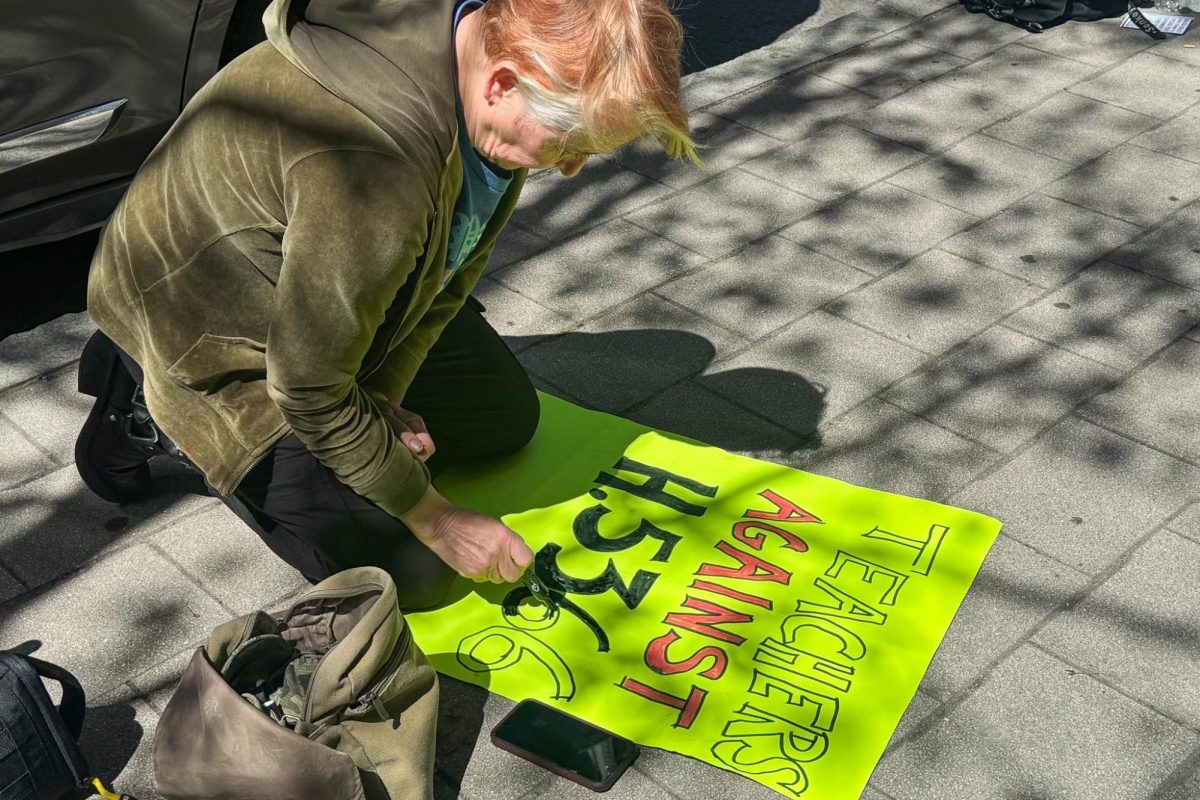
Walker described social media as a platform where young people can speak freely about issues that affect them and argued that limiting access to that digital space would place already targeted communities at further risk.
“What we’re looking at is a decision of who is allowed to speak on social media about the issues of our day and about the issues that pertain to us,” Walker said. “Specifically for trans youth, we’re facing attacks on every level right now. Our rights in schools, our rights on our IDs, our rights to health … If we can’t speak up against what’s happening to us, then it just disappears into thin air.”
In a May 4 follow-up phone interview, Greer told The News that representatives planned to meet with Healey’s staff May 5.
“We’ll know a lot more after the meetings this week, in terms of whether Massachusetts leadership just wants to give lip service to these concerns, or whether they’ll take them seriously and make the meaningful changes to the legislation needed to ensure it protects all kids,” Greer said May 4.
Fight for the Future posted a draft of an alternative bill May 5, which instead proposed social media platforms be prohibited from leaving certain controversial features — personalized algorithms, autoplay, infinite scroll and location sharing — on as the default.
“Instead of trying to segregate users by age and apply different protections depending on age, we’d require social media companies to apply protections for every single user,” Greer said. “Doing that eliminates the need for dangerous, unreliable and intrusive age verifications.”
A coalition of Fight for the Future and several other advocacy organizations, as well as State Rep. Mike Connolly, held a press conference outside the Massachusetts State House at 10 a.m. May 13. The coalition delivered an open letter condemning age verification legislation, which has been signed by over 50 human rights groups, including Fight for the Future, Partners in Sex Education, Mass 50501, MassEquality, the Massachusetts Transgender Political Coalition and more.
Later that same day, Boston City Council voted unanimously to adopt a resolution opposing mandatory online verification laws, including those in Healey’s proposal and the House bill. The resolution, co-sponsored by Councilors Henry Santana and Julia Mejia, encouraged state lawmakers to “work with the community to create and advance legislation that holds Big Tech accountable while protecting online free expression.”
As of May 12, Healey’s proposal has not progressed and the House bill is set to be initiated in October.