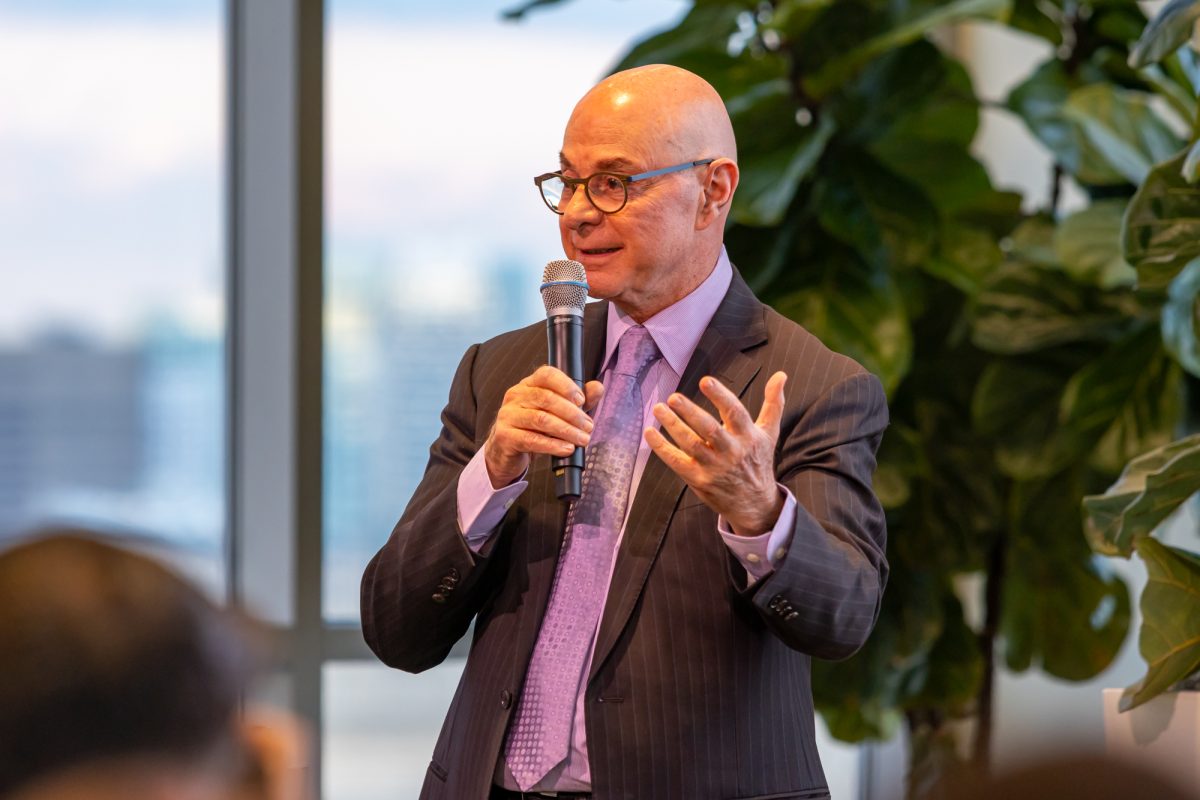
Dec. 14, 2022 — President Joseph E. Aoun sits down with The Huntington News to talk about the global student experience and a new Miami campus, telling us to “stay tuned” throughout the interview. Naturally, one would expect more to come, perhaps a follow-up interview of some sort.
However, over the next three years, 11 official follow-up interview requests, plus requests from members of The News during in-person conversations, will ultimately go ignored. Some receive no answer, others are dismissed and some receive only the most generic of replies, like offers to check the president’s schedule.
This lack of communication deteriorates The News’ attempt at building a community of trust. It’s hard to trust people — especially leaders — when you sense they may be hiding something from you. Not to mention, secrecy around federally-driven changes — addressed primarily through an unattributed FAQ page — is detrimental in the face of political upset, both on and off campus. Announcing major changes through an FAQ page is not adequate communication — if no one knows there’s been a change, it can’t count as an “update.” There are much better ways to draw attention to developments, like taking advantage of schoolwide email announcements or even hosting events.
This is the perfect time for frequent, clear communication between the student body and the administration; instead, we’re seeing a complete unwillingness to be forthcoming about Northeastern’s policies, stances and future plans. For instance, many students have asked about the recent tuition increase and where that funding is going — questions that remain largely unanswered. As participants in and funders of this institution, it’s vital we know how our university functions, including decisions on funding, stances on current federal government policies and information on the administrators behind it all.
Northeastern’s hesitance to be open with its students and the public isn’t a new issue, either — it just keeps getting worse. A May 1973 editorial from The News read, “That is all students are really asking, President Knowles, why? Surely a university of all places should attempt to satisfy a student’s curiosity. That’s not really too much to ask.” And it’s not too much to ask at all. If decisions are being made, surely there’s a record of the reasoning behind them somewhere. It shouldn’t be that difficult for the administration to release them.
Despite student criticism, Asa Knowles, Northeastern’s president from 1959 to 1975, was far more open with students than Aoun has ever been. He held “press conferences,” issued public announcements and responded directly to student demands, speaking openly about current issues. Meanwhile, Aoun stays quiet behind a shield of overly formalized language and vague statements that should sound generally pleasing to the public ear. But that’s not enough.
It isn’t like this for other student newspapers in the area, either. Student journalists at The Suffolk Journal, Suffolk University’s newspaper, report that their paper (which is funded by the university but editorially independent) has a good relationship with Suffolk University’s media relations team. Waiting more than a couple of hours for a response is unusual for them.
Emerson College’s independent student newspaper, The Berkley Beacon, has had six interviews with Emerson’s presidents since 2020 — Aoun gave The News three. Aoun’s 2020 interview with The News came after a seven-year-long stretch of silence from 2013 to 2020, only broken after a month-long social media campaign, a Boston Globe article and a petition that garnered 436 signatures.
Boston University’s independent student paper, The Daily Free Press, last spoke to its president in 2024, and Boston College’s spoke with its president in 2025.
Aoun’s apparent avoidance of his students is worrying. Northeastern stands out here, and it’s not for a good reason — this isn’t the type of differentiation that’s going to help the university or its students.
This silence problem spans beyond our institution. It reflects a broader issue in higher education, where students too often have limited, if any, access to the reasoning behind decisions that affect their academic and social lives. Decisions made by a small group of people can go on to affect tens of thousands of students’ everyday routines. No matter how big or small the change, transparency is necessary.
When information is hidden, we have to ask why. Often, it points to a lack of accountability. Rarely do institutions want to admit wrongdoing, or to not doing enough. Secrecy breeds misdeeds, or at a minimum, allows them to continue undetected. If we refuse to take a stance on anything — any federal action, any event — it undermines the core principles of education: engagement with the world around us, encouragement of discourse and the courage to speak up for what we believe to be true.
The turmoil of current events in our country and beyond presents a powerful opportunity for Aoun to build trust and truly connect with his student population. Speaking with The News, the only independent, student-run publication on campus, could significantly boost his reputation among the student body. We want to work with him to strengthen the bridge between the administration and students, not undermine the work Northeastern does.
Aoun, your students need you to speak up. We, The Huntington News editorial board, urge you to speak with a reliable, student-run news outlet, a way for you to show your students you’re invested in their success. To the public, you are the face of this school — but you need to sit down face-to-face with your students, too.
The Editorial Board reflects the official voice of The Huntington News’s opinion section and consists of the opinion editor, the deputy opinion editor and The News’ opinion columnists. Each editorial is the product of unanimous agreement from the Board. The Editorial Board operates independently from the newsroom of The Huntington News.
The Huntington News Editorial Board urges all readers, both those who support the stance laid out within this piece and those who do not, to make their voices heard. If you would like to submit a letter to the editor in response to this piece, email [email protected].