About six months ago, I came across a TikTok from a Northeastern freshman. She was a couple weeks into her first semester, venting to her camera about the fact that she had no friends. She was not sorry for herself; she was actually making a relevant observation about university social life. Personally, I was lucky enough to meet my friends during orientation week. But this is not the case for everyone — and her video made me realize that.
I’ve heard from numerous people that they have a lot of acquaintances. But having friends — the ones that might one day be your bridesmaids — is a seemingly rare experience for many on campus.
The Northeastern student said she goes outside. She goes to class. She goes to club meetings. She was doing all the things you’re supposed to do.
The comments were exactly what you’d expect: people tagging friends and offering invitations. One girl even invited her to taco night. But the most common response wasn’t advice or encouragement. It was just people saying, “Same.”
My observations were confirmed.
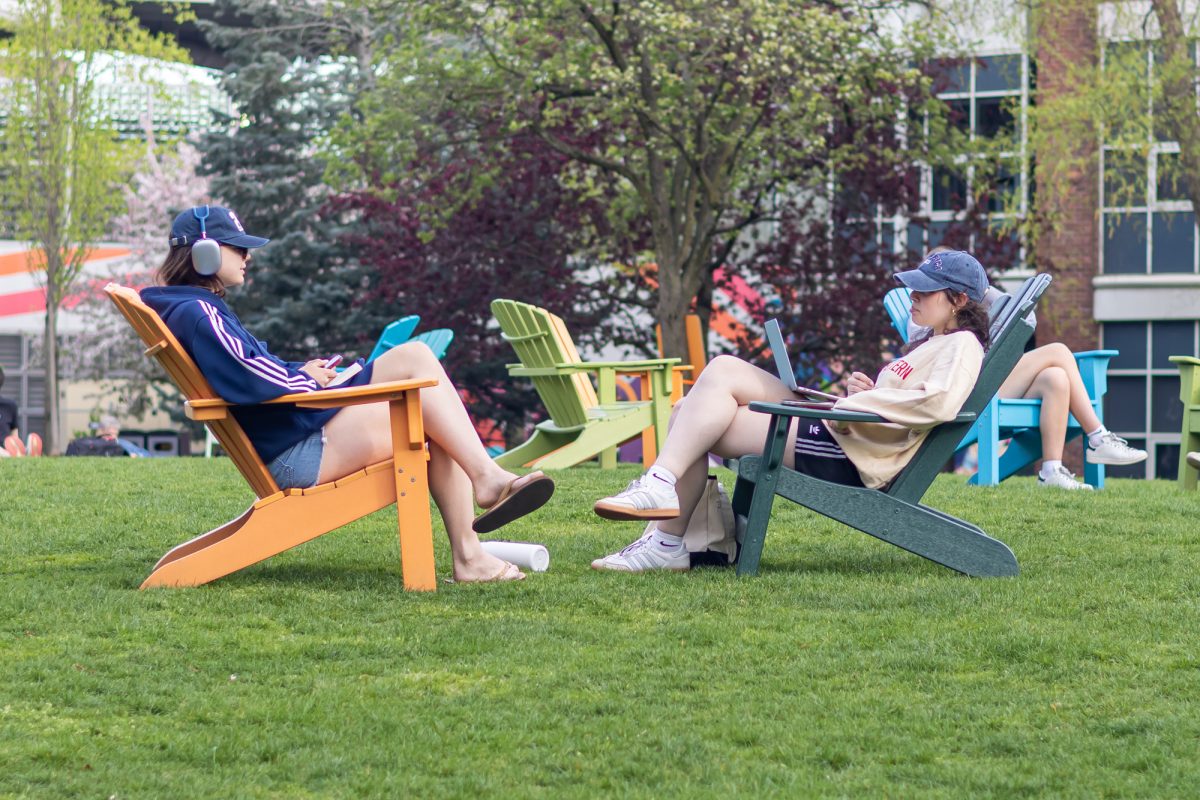
I watched it, kept scrolling and then kept thinking about it for the next six months. Because the more I paid attention, the more I started noticing the same thing everywhere. People walking through campus with AirPods in, not looking at each other. Lecture halls where 200 students sit in complete silence before and after class. As the clock strikes the end of class and the doors open, so does everyone’s AirPods case. You can spend an entire day surrounded by people and still not have a single real conversation with anyone.
Making friends in college is hard. Genuinely, unexpectedly hard. And I feel like nobody talks about that.
What they do tell you is everything else. “You’ll find your people,” “College friends are forever” or “There are so many clubs and opportunities to meet others.” Parents say it. College admissions brochures say it. Every college movie ever made says it. By the time you actually get to campus, you’ve basically pre-written your whole story: You’ll bond with your roommate on move-in day. You’ll click with someone in your first lecture. You’ll walk into a club meeting as a stranger and walk out planning brunch.
And then you get here, and it’s just not like that.
Classes move fast. Professors start talking immediately and everyone leaves immediately. The girl in the video brought up a great point — in college, there is no built-in social time like in high school. No hallway chats, no study hall, no five minutes between each period to catch up with someone. If you want to talk to the person sitting next to you in a 300-person lecture, you basically have to psych yourself up like you’re about to give a TED Talk. And for what? To say, “So … that exam, right? Hope the professor curves our grade … ” Most of the time — if you are anything like me — you just don’t bother.
And the headphones thing is real. Walk around campus any day of the week and actually look. Almost everyone is plugged in. Heads down, phones out, AirPods doing their thing. Nobody means anything hostile by it. But when everyone is wearing the universal sign for “Don’t talk to me,” the result is a campus full of people who are physically inches apart and socially miles away from each other.
The data backs this up. A 2024 survey from Active Minds and TimelyCare found that nearly 65% of college students report feeling lonely. More than one in four feel isolated. The U.S. Surgeon General called loneliness a public health epidemic in 2023. So if you’ve ever felt like you’re the only one eating alone in Curry, you’re statistically very much not.
Northeastern adds its own twist.
Nobody here is on the same schedule. Some people co-op in the fall, some in the spring. Some do four years, some do five. NU.in freshmen arrive on the Boston campus a semester later than the others. You finally get into a groove with a group of people, and then half of them leave for six months to go work in San Francisco or wherever. By the time they’re back, the dynamic is different. Nobody did anything wrong, but it’s hard to maintain friendships when the calendar keeps shuffling everyone around like a deck of cards.
First-year students on the Boston campus talk about feeling like they missed some window where everyone else made their friends. And past the first year, that feeling doesn’t totally disappear. You just stop talking about it.
Then there’s Instagram, which exists specifically to make you feel like you’re the only person on earth without a friend group. Everyone else has the group photos, the birthday dinners and spontaneous weekend trips that look so effortless it’s almost suspicious. Nobody posts about the nights they stayed in because they had no one to go out with.
If you are reading this and feel the same way, I promise you that half of the people you’re seeing on Instagram are not even real friends with each other. The gap between what college social life looks like online and what it actually feels like in person is enormous.
Here’s what I think people miss about making friends: It’s not that students aren’t trying. Most of us are. We go to the club meetings, we show up to orientation events and say yes whenever someone invites us somewhere. But friendship isn’t really built on effort. It’s built on repetition and proximity. Running into the same person over and over. Sitting near them enough that you eventually just start talking without thinking about it. That kind of thing happened naturally in high school because you saw the same 30 people every day for years. College takes that completely away and then says, “Good luck, go make friends,” as if you can just squeeze that in between your 9 a.m. class and your campus job.
That girl on TikTok did something useful, probably without realizing it: She said the thing out loud. And because she did, people showed up. Someone offered to become her friend. Someone dropped their Instagram handle. A bunch of strangers just said, “I feel this.” While that’s not a fix, it’s something.
Because the truth is, the people who eventually find their friends in college aren’t the ones who had it all figured out in the first three weeks. They’re the ones who were willing to admit they didn’t.
Sana Gandhi is a second-year business administration major. Sana can be reached at [email protected]
If you would like to submit a letter to the editor in response to this piece, email [email protected] with your idea.