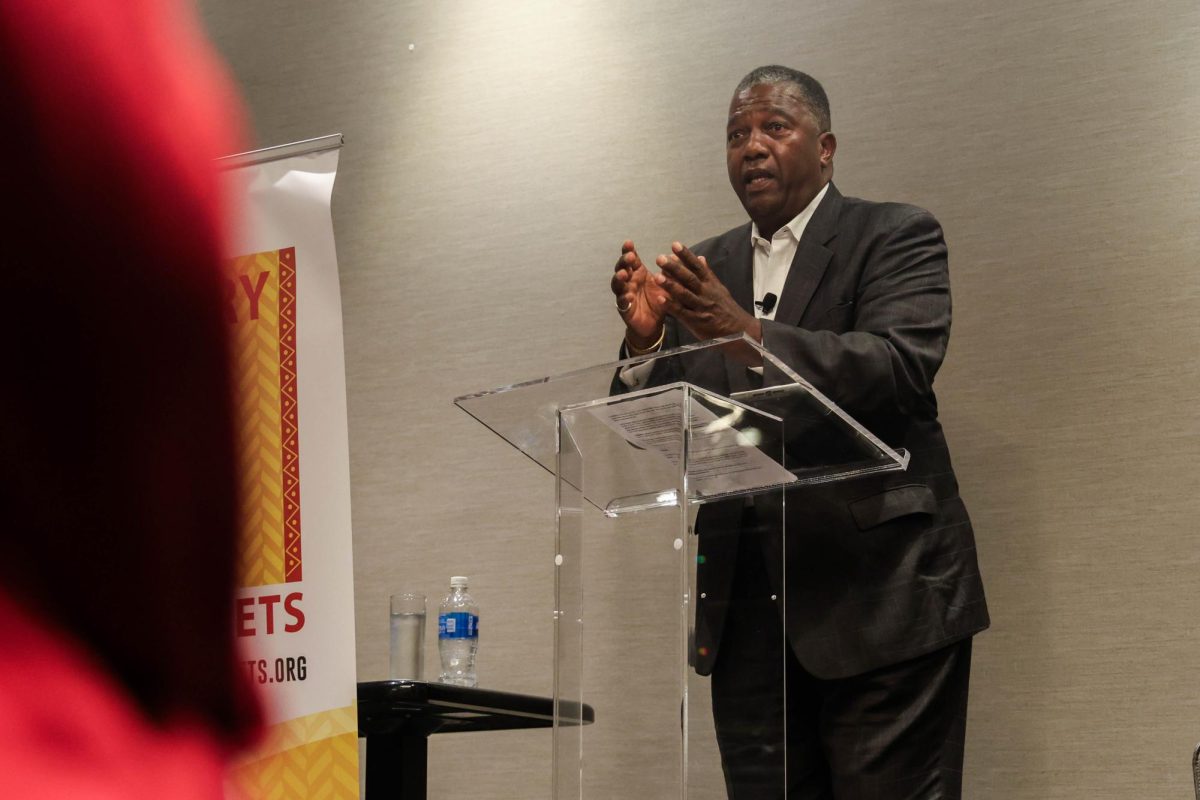
The candidates for Boston’s District 7 City Councilor race faced off in a debate Oct. 16, discussing a variety of issues important to voters in the upcoming election.
The candidates, Said Ahmed and Miniard Culpepper, won the hotly contested September primary by a slim margin after a recount. The race was crowded, with 11 candidates originally in the running.
The election has been highly publicized since December 2024, when former District 7 Councilor Tania Fernandes Anderson was arrested on federal corruption charges for violating Massachusetts law after collecting $7,000 from a staffer’s bonus and employing two of her family members. Anderson pleaded guilty to the charges and will serve a one month sentence, beginning Oct. 17.
The debate, hosted by Roxbury Main Street, a nonprofit organization that aims to support the Roxbury community, focused on issues most applicable to voters in the district including public safety, the local economy and transparency among leaders.
The debate began with questions about Roxbury’s local economy and how the candidates planned to support struggling small businesses. Culpepper advocated growing the economy — specifically in Nubian Square and Grove Hall — by adding an empowerment zone, an initiative created by the U.S. Department of Housing and Urban Development in 1993 that tries to reduce unemployment and stimulate economic growth through federal tax incentives and grants.
“[We have to] work with the city to bring resources specifically to those businesses that have been ignored for many years,” Culpepper said.
Ahmed said that he would focus on working directly with business owners to help them stay afloat.
“Day one, I’m going to start having an office right here in District 7,” Ahmed said. “We want to make sure everybody has someone that they can reach out to, that motivates them, that walks them [through how] to open their own businesses.”
The questions shifted to focus on public safety, specifically in Nubian Square and “Mass and Cass,” the intersection of Massachusetts Avenue and Melnea Cass Boulevard known for its issues with homelessness and addiction.
Culpepper again emphasized supporting local businesses, saying that Roxbury residents “need to shop and buy Roxbury.”

Ahmed said that he believes in dismantling the negative stereotypes that keep residents from visiting both areas, since Nubian Square has gained a reputation of being one of the most dangerous neighborhoods in Boston due to its history of open air drug use. The city is currently reevaluating the 2004 Roxbury Strategic Master Plan and the 2007 Dudley Square Vision Project, two plans to revitalize the community, to see if they align with the community’s current goals for the region.
“Nubian Square is a diamond in the dirt in our community,” Ahmed said. “We want to make sure that we market Nubian Square as the best place in the city of Boston.”
Though the debate was mostly civil, the two sparred over Culpepper’s history, with Ahmed calling for a fact check after Culpepper said that he facilitated the merger between Boston University and Boston City Hospital while working for the U.S. Department of Housing and Urban Development.
Attendees’ reactions to the debate were mixed, with some wishing the candidates expanded on certain topics.
WaWa Bell, a former candidate in the race and event attendee, said he was disappointed in the candidates’ responses to a question about reparations and the creation of an office of reparative justice in City Hall.
“Reparative justice is the most important issue for my community,” Bell said. “It was a little disheartening when they asked that question, it didn’t seem like [the candidates] knew what it was.”
Lucilda Dassardo-Cooper, a Boston resident for 24 years, mentioned the age and experience differences between the two candidates.

“We saw Miniard as the more seasoned candidate versus Said presenting himself as a younger, proactive person,” Dassardo-Cooper said.
The debate finished with closing statements from the candidates, where Ahmed drew on his personal experiences.
“One of the big reasons why I’m running is because I see the neglect that goes on in District 7,” Ahmed said. “I used to be in a refugee camp, so I know how it feels being voiceless, being hopeless.”
Alternatively, Culpepper decided to close out the debate by talking about his prior experience.
“I believe that I have the experience, the knowledge and the commitment to be an effective city councilor for District 7,” Culpepper said.
Many residents, like Angela Allen, a lifelong Roxbury native, have high hopes for the future of the neighborhood and the entire district.
“I would love to see changes in the schools and changes in the whole direction of Roxbury,” Allen said.
Evelynn Lin contributed reporting