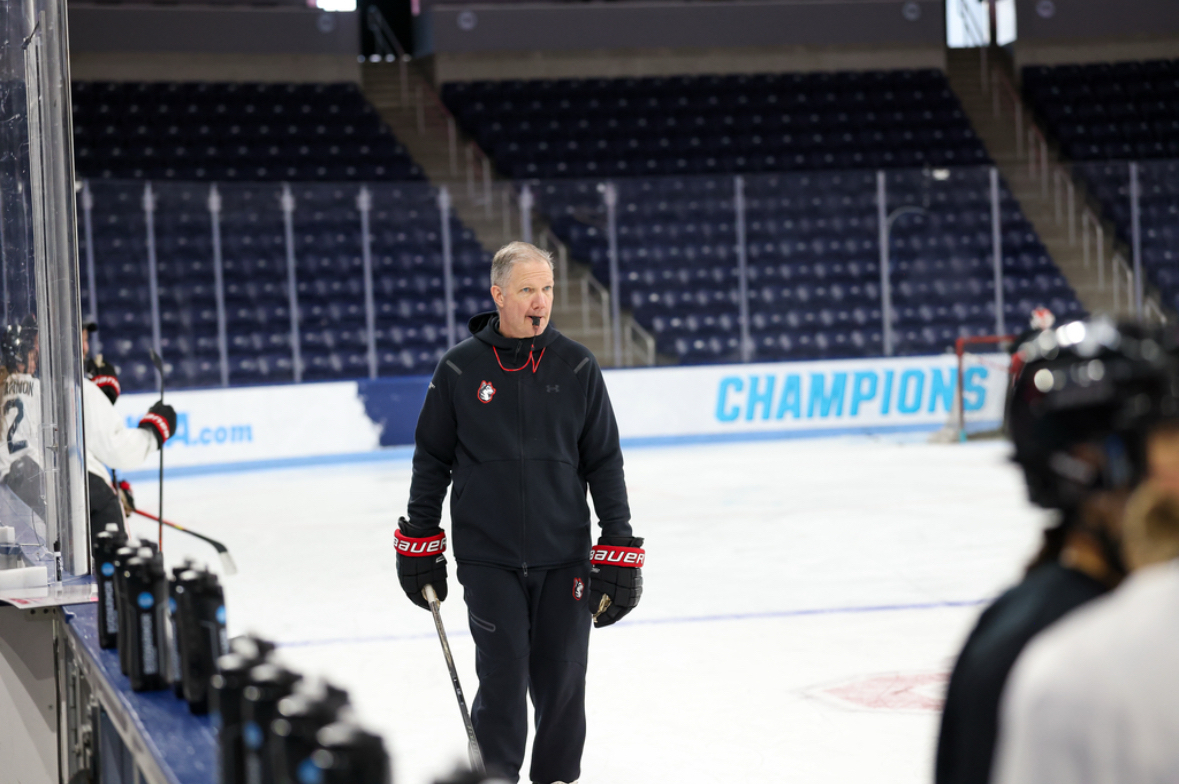
Northeastern has been a staple in Jim Madigan’s life since 1981. He’s seen the institution from every angle — from student-athlete to associate dean of advancement for the D’Amore-McKim School of Business to head coach of the men’s hockey team and now the university’s athletic director.
“I thought all my experiences kind of aligned up to this role … It was one that I embraced and enjoyed, and I was honored that the institution had thought about me in that role,” Madigan said of his promotion in 2021 to athletic director.
As a hockey player, Madigan made an impact on the ice with a career record of 67-59-5. He helped the team to the NCAA Frozen Four and two Beanpot trophies in 1984 and 1985.
He stepped into the head coach position in 2011, and under his leadership in just the first season, the team tied for the third-most wins in program history. Two of these victories were against the highly-ranked hockey programs at the University of Notre Dame and the University of Minnesota. At the end of his time coaching the Huskies, Madigan had a 174-132-39 record, helping earn a reputation for Northeastern’s program.
Despite years of experience, Madigan faces his most difficult challenge yet as Northeastern’s home rink is demolished, with a replacement not slated to open until 2028. Northeastern is also a smaller institution when it comes to name, image and likeness, or NIL, deals and revenue sharing, making it more difficult for the Huskies to compete for big-name athletes.
In June, a federal judge approved a settlement allowing universities to pay athletes directly through a revenue-sharing model — in addition to traditional scholarships — for the first time. Athletes have been allowed to make money off name, image and likeness, or NIL, deals since 2021, with most of the money coming from third parties.
Bigger schools like Texas A&M and Ohio State can pay more to their athletes due to their larger budgets, boosted by donors. These institutions also receive more exposure for their athletes, bringing more opportunities for them to profit off NIL deals.
In a Dec. 4 interview with The Huntington News, Madigan discussed the new arena and how Northeastern plans to compete with larger schools regarding NIL deals.
This interview has been condensed and edited for clarity.
The Huntington News: NIL deals are a hot topic in college sports right now, with recent changes affecting how athletes will get paid. How does Northeastern plan to make itself a competitor against bigger schools, like Michigan or Penn State?
Madigan: NIL and revenue sharing — there’s two different elements there. With revenue sharing, the institution is allowed to pay up to $20.5 million [to student-athletes]. NIL is through an outside third party, and we’re active in both. The landscape has changed significantly. I don’t know if we’re ever going to be able to compete against the Big Ten schools.
You mentioned Michigan and Penn State, and certainly, those schools are paying a lot of money. The hockey level for us is more reasonable.
In basketball, our competitors in our conference are increasing their contributions and commitments to the NIL, so it’s forcing us to be more assertive with our opportunities to create more revenue through support from alumni, individuals and corporations. I’m not sure if we need to be competitive at basketball with the Power Four schools, but we need to be competitive within our own conference so we can maintain and sustain success.
On the hockey side, the dollars are a little bit less than they are in basketball and football. We’re certainly involved in supporting our men’s and women’s hockey players or women’s and men’s basketball players with NIL, and we’ll continue to do so and continue to articulate the message to our alums that, if you want to support the program, then it is through NIL and revenue sharing, because that’s where the landscape is now.
HN: Is there a strategy the school is trying to take in promoting our athletes for big deals within the league?
Madigan: Revenue sharing is pure revenue sharing, right? So it’s not NIL. It’s different — you can just compensate student-athletes, so we have a strategy with some of our programs and how we can generate additional funds for revenue sharing and through NIL. A big part of that is through individual donations, utilizing our family, friends, parents and alumni to support the program, which they’ve been doing for a long time. And it’s been going to program support [or] endowment support. Now, it can still go to those two areas, but also there’s another third area, a bucket that they can support, and that’s through NIL that will allow us to maintain excellence more than ever in our programs.
HN: How are you attracting alumni?
Madigan: It’s through our advancement office, in the same way that individual [Northeastern] colleges are reaching out to their alumni. The good thing about athletics is that, regardless of what college you came from, if you’re an athlete, you cross over all colleges. So we’re just being aggressive and assertive with the outreach and letting [alumni] know about the changing landscape, messaging them, informing them of where things are.
Most of our alums are pretty in-tune to the changing landscape. I mean, in some ways, you’d have to be living under a rock if you haven’t seen the last four years or so of NIL and revenue sharing taking place. You can just pick up the paper and see the numbers get sensationalized a little bit around football and basketball. So those get elevated a little bit, but it’s still NIL. It’s maybe a little bit less in the sport of ice hockey, maybe a little bit less in the mid-major level, but it’s still out there. It’s still prevalent in all of our conferences.

HN: Moving on to the new arena. First, Boston University has a Raising Cane’s. Is it possible to request a Chick-fil-A in Northeastern’s new arena?
Madigan: I’m a big lover of Chick-fil-A, so I’ll eat it. I’ll leave that up to our food service folks, who do a great job with food services here.
The greatest thing about the new arena is it’s going to enhance the fan experience tremendously. From seating, the amenities, food and beverage, it’s going to be tremendous. There’s going to be more options than our students have ever seen. Our food service organization is limited in Matthews Arena just because of the equipment that we can put in there and how tight the lobby is.
We’ll have more than one concession stand in the new building; they’ll be around the lower concourse and the upper concourse. We’ll have hospitality suites. There’ll be a lot of different amenities, so I think the fans, students, alumni, the Boston fans, our faculty and staff will certainly enjoy the fan experience in the new facility.
HN: What has been the biggest challenge with the demolition of Matthews?
Madigan: There are a lot of challenges as you put together a plan and a strategy to build a new facility. And kudos, first of all, to our president and university leadership, who took charge four plus years ago when we realized that Matthews Arena, structurally, was starting to fail. The leadership under President [Joseph E.] Aoun looked at it and said, “Okay, how can we create a facility down on the existing site but enhance it and provide more opportunities for all of our students?” And that’s what this facility is.
One of the challenges was how to fit everything in for the whole university student body: from the varsity athletes to the club and intramural student athletes, as well as our general students for academic celebrations, convocations, university events and student events that happen during homecoming.
If you look at Matthews Arena right now, it’s a one-activity facility. In the new facility, you could have either a basketball or hockey game going on in the rink or basketball court. If it’s a hockey game, you can have varsity men’s and women’s basketball practicing upstairs in their practice facility. There’s just so much activity that can take place at the same time, which is great, because we need to continue providing services to our students here at Northeastern.
It’ll also be an opportunity for the City of Boston, [as] they’ll continue having their high school graduations in the building. It’s always been a home for polling and elections, so it will be connecting the Northeastern community to the City of Boston.
HN: Boston approved the plan for the project at 262 St. Botolph in November. When can we expect construction to start?
Madigan: On [Dec.] 15, we [turned] the building over to Suffolk Construction, and the deconstruction will begin first. Then the demolition of the building will happen, I’m assuming sometime in January.
The plan and the schedule is built and would take us an estimated two and a half years, right through to August of 2028, when the new building will be ready and turned back over to the university. There’s going to be a lot going on over the next two and a half years, but there’s been a lot that’s happened behind the scenes the last four years to get it to this spot.
I think people just see the finished drawings now and don’t realize all the work and effort that’s gone in at the leadership level and the project team level to get us to this point. So there’s a lot of excitement at this point. There’ll be sadness when the old building comes down, but when that first set of steel starts to be erected, I think there’ll be a lot of, “Wow, this is really happening,” and momentum.
HN: For the second part of the hockey season, there will be different home rinks. Next season, will you try to have one rink as some sort of home base?
Madigan: On the men’s side, we’ve got the Boch Ice Center as a practice facility for the next two and a half years. For games, it’s very challenging and difficult to get one rink, because if you go to Boston University or if you go to Harvard … they also have men’s and women’s hockey, so the schedules don’t always align. So that’s why we need multiple rinks and have that flexibility to go to those different rinks.
This spring, the men’s team is going to Portland, Maine, in February to play University of Maine. We have the Roux Institute right there. So we’re able to bring Northeastern [players] to one of our other campuses in Portland where they’ll come in and be able to support the program.
It’s an American Hockey League rink, so it’s exciting for our kids, and we’ll look at some of those unique, different opportunities to try and keep it fresh for the student-athletes. Will it be a little disruption? Absolutely, there’ll be disruption, but I’m confident our coaching staff and our student-athletes have the resolve and the resilience to work through this. And at the end of the day, they’re still attending a top-50 institution. They’re still playing in the best conference in college hockey, Hockey East, men’s and women’s. They’re still in Boston. They’re still at Northeastern. They’re still playing in the Beanpot, so there’s still a lot of positives to experience while you’re here during this disruption period.
HN: With games as far as Portland, Maine, will there be fan buses to support the DogHouse getting out there?
Madigan: We’re going to look at this second half of the season as a template for us moving forward for year two and year three. We just don’t know [how many students will want to attend games]. When you’re going from the arena to Cabot, it’s easy. But if you’re going from Cabot to BU or Bentley or wherever, it becomes more challenging.
Certainly, it’s at the top of our mind that we’d like to provide some transportation to our DogHouse students. The spirit group is just tremendous, so we want to help them as much as we can. The good news is when we’re playing at Harvard or BU, even if we provided a fan bus, I think [students will] still take an Uber because it’s a lot easier for them to do that. We want to stay close to our campus, so that will at least enhance our students’ opportunities to get to those rinks and watch us play.
HN: The women’s basketball team never played in Matthews, always in Cabot. Can we expect them to play in the new arena?
Madigan: We’re gonna look at that also. That decision doesn’t have to be made right now — it can be made in the next two to three years. The challenge with that is that men’s and women’s hockey are on a Friday-Saturday cadence. Men’s basketball is on a Thursday-Saturday cadence and women’s basketball is on a Friday-Sunday cadence, so Fridays are challenging because sometimes we have two hockey games down there. The women will play sometimes at 2 p.m. and the men will play at 7 or 7:30 p.m., so you can’t fit in a game there. Sunday becomes a better option for us.
We’re also mindful that Sunday’s a major activity day for our club and intramural programs at the arena for hockey and broomball and everything else. So, through my lens, I’m looking at varsity sports, but I’m also looking at club sports and I’m also looking at intramurals and recreation sports. That all comes within our department.
The other thing is, if the calendar ever shifted within our conference for women’s basketball to, say, a Wednesday-Saturday, giving a little flexibility, then that becomes a little bit easier to do. So, we’ll keep playing with that.