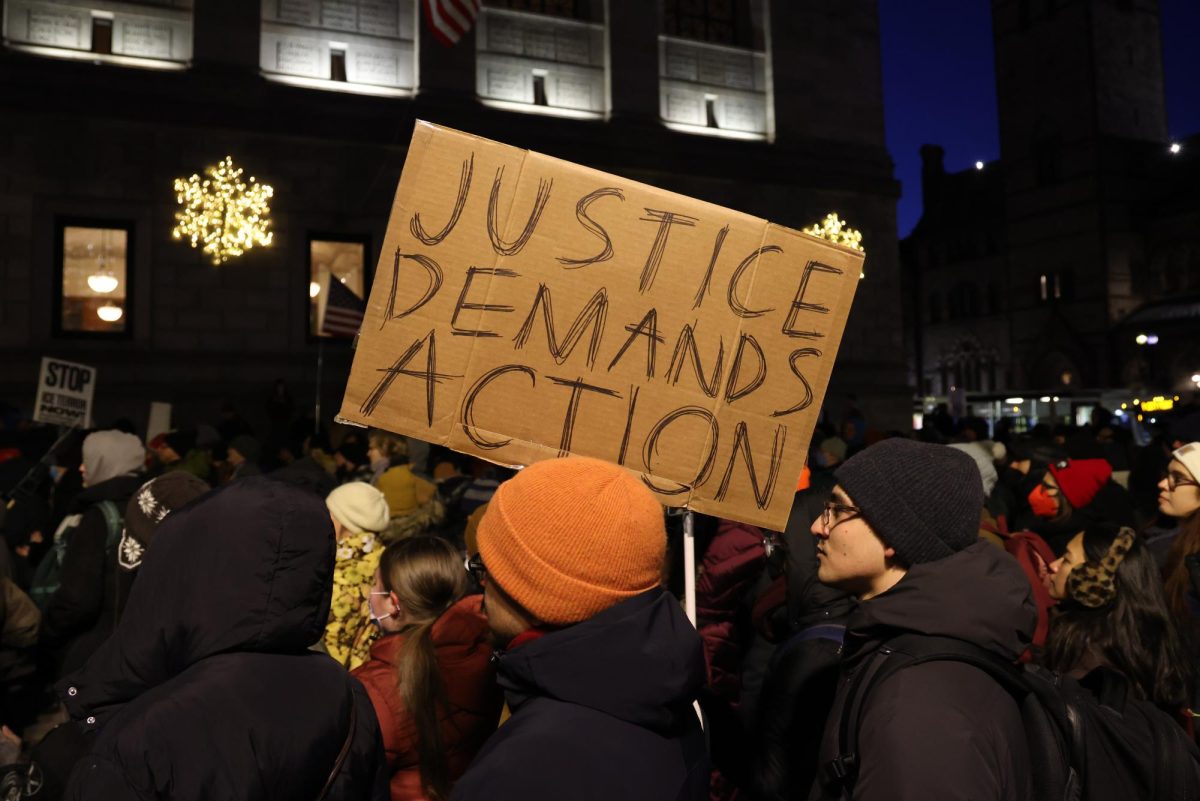
Going to protests is hard. Hearing about them, finding time, making signs, standing in the Boston cold and trying to keep time with ever-changing chants — it’s all hard.
And that’s before you consider the existential feelings of dread at your own ineffectiveness in the face of a cruel, mean-spirited world that seems intent on hastening its own slide into death and disorder.
But I want to argue that despite these facts, protests are not only good for the world — they’re good for you, too.
First, let’s dispel the commonly held misconception that protests are ineffectual. Protests are empirically one of the most effective methods of enacting political change. According to political science research, it only takes 3.5% of the population actively participating in a protest to ensure serious political change.
Think about that — the recent No Kings protests are more than halfway to achieving this number, and looking at polls, only a small percentage of those dissatisfied with the current administration actually joined the movement. It wouldn’t take a lot to tip the scales.
For examples of protests’ potential to create change, look to the past: protesting gave us civil rights and women’s suffrage and helped end the Vietnam war. Northeastern itself was a key part of this movement, as students joined the national wave of anti-Vietnam protests.
More recently, even protests that seemed to have failed in their stated goals led to real change. The Black Lives Matter protests may not have resulted in a defunding of the police, but they contributed to the record-breaking voter turnout in 2020 and nationwide police reforms.
So, protests can effect real change, even if it doesn’t always feel that way. But that’s not the only reason to protest.
The world is a scary and harmful place. If you follow the news, it’s almost always concerning. If you don’t, I’m confident the feelings of dread at the state of the world still loom just beyond the horizon, maybe brought to the fore by a scary video of a federal immigration agent killing someone or a TikTok commentator mentioning that the U.S. just killed the supreme leader of Iran.
Society is intent on telling us to ignore these feelings. It tells us that we should look away, keep scrolling past those videos and become engrossed in our personal lives. Capitalism is built on this idea: that the success of the individual is the success of the collective, so if we all keep focusing on ourselves, everything will turn out alright.
It’s increasingly clear that this is false. Loneliness has hit America in a silent wave, wealth inequality only grows and individuals increasingly feel a lack of agency over the world systems that govern them. Society’s answer is to keep going about your daily life like nothing’s wrong.
But this rings hollow, and on some level, we all know it. The cognitive dissonance between feeling a world collapse and then doing the philosophical equivalent of putting your fingers in your ears and saying, “I can’t hear you,” can’t continue forever. You can only doomscroll past so many horrors before the act of looking away starts to feel worse than the horrors themselves.
Protesting cuts through this. It’s a declarative, full-bodied statement against the state of the world, one that takes the dread sitting in your stomach and turns it outward.
You show up. You stand with thousands of other people who feel the same things you do. You chant, you march, and for a few hours, you get to feel like a tangible part of progress, a somatic embodiment of the will towards change. It’s empowering in a way that no amount of looking away or distracting yourself can ever replicate. It addresses the actual source of the anxiety, instead of teaching you to live with it.
This is not to say that protesting is the end all be all. Similar things could be said about volunteering at a foodbank, working for an organization that you care about or just spreading goodwill and getting to know your community. But if you are someone who feels the weight of the world and isn’t sure what to do about it, protesting is the perfect place to start. It’s one of the few things that can make you feel lighter, and in a world as heavy as ours, that matters.
You will come home tired, cold and hoarse. But you will also come home feeling better about the world and your place in it. So at the next protest, I’ll hope to see you there!
Arvind Chettiar is a third-year business administration and political science combined major. He can be reached at [email protected].
If you would like to submit a letter to the editor in response to this piece, email [email protected] with your idea.