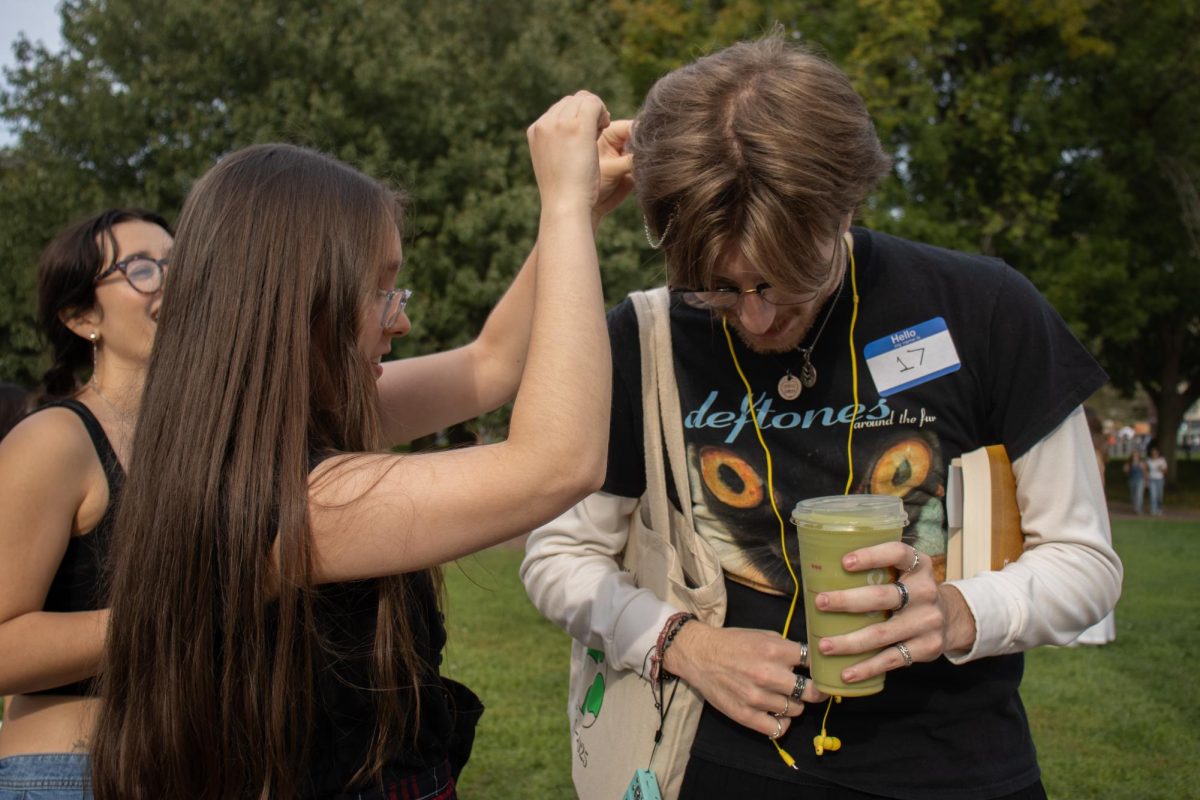
What does it mean to be performative? Is it drinking matcha and listening to Clairo? Reading feminist literature and wearing a carabiner? According to participants at the Performative Person Contest Sept. 27, it’s all of those things combined, exaggerated and put to the test.
You might’ve seen the “performative male” archetype taking over social media or trickling its way onto college campus competitions this fall semester. But Alastaire Balin, one of the founders of the Boston contest and second-year computer science and business administration combined major at Northeastern, thought to do things differently and invited people of all genders.
“We want everyone to participate, [to] make it inclusive,” Balin said.
The contest, held in collaboration with fashion brand IKONICCO, invited contestants to own their performativity without the traditional masculine boundaries.

Around 4 p.m., participants and spectators began to crowd the Parkman Bandstand on Boston Common, carrying tote bags over their shoulders and menstrual products in one hand and matcha lattes in the other. Performative attire ranged from jorts, band tees, casual button-ups and leather jackets to a complete Alexander Hamilton costume. As if clothing wasn’t enough, many also brought props of their own: Sonny Angels stuffed in jean pockets, Labubus hanging off carabiners and instruments to play in their 30 seconds of fame.
Before long, the crowd was distributed on either side of the walkway and performers were asked to form teams for the first part of the competition. Following group eliminations on the Parkman Bandstand walkway-turned-runway, teams of three followed and eventually, the finalists emerged.
Audience participation played a key role in deciding the winners: contest organizers listened for the loudest cheers when advancing groups and individuals, and ties were broken through simple best-out-of-three rock-paper-scissors games. Each finalist was also given a 30-second window to perform and persuade the crowd for votes. As an increased incentive, contest organizers had a $100 prize for the first-place performer as well as Labubu dolls for second and third place contestants.
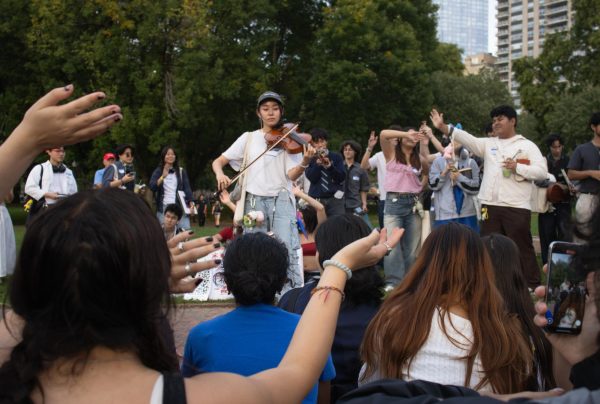
In the final individual rounds, participants responded to questions while aiming for the $100 first-place prize. Contestants were not only judged by their attire and appearance, but also how well they could embody performativity on the spot. One contestant said, “If I was given $100, I would donate it to an urban guerilla movement, dedicated to destroying the patriarchy through armed struggle. I swear. Tax free.”
Another participant imagined spending the prize on an anniversary date, but many leaned toward donating it.
During the contest’s final moments, Balin and Theint Thwe, IKONICCO’s founder and creative director, asked the crowd to drum roll for the finalists announcement. In third place came contestant No. 37, a young man dressed in sunglasses, a gray beret and an all black outfit complete with a “Certified Munch” t-shirt.
Landon Manteau, a first-year computer science major at Northeastern, secured second place sporting chunky jewelry, Clairo merch and an Adrianne Lenker-inspired phone case with cover art from her album, “songs.”
Juhee Kim, a second-year integrative biology and East Asian studies major at Harvard, claimed first place at Boston’s performative person contest. In blue cargo jeans, thrifted Clairo merch, a tote bag carrying Sylvia Plath’s “The Bell Jar” and a combination of wired and bluetooth headphones, Kim struck the crowd with style. For her 30-second performance, she impressed the crowd by playing Laufey’s “From The Start” on her viola, a song she practiced for only 10 minutes before the contest.
When asked what she would do with the prize money, Kim said, “I would like to give it back to [people who are struggling to make a living] because I’ve been blessed with so much.”
Her answer follows a familiar pattern across such contests, where charitable acts and community gestures often become part of the performance itself. Performativity often becomes a competition online, showcasing not just how well you can follow a trend, but also how well you exemplify appealing qualities like generosity, selflessness and humor.
Unlike other contestants who owned their performativity, Kim commented on the absurdness of it all. “[The performance is] definitely a step out of my comfort zone because I’m usually quite the shy person. But I think it’s a great way to show how stupid performativity is,” she said.
The recent wave of performative stereotypes in mainstream culture is likely exasperated by a desire to conform to expectations deemed attractive to women. In Boston, the city opens up the doors for everyone to decide what performativity actually means. If it truly is a tactic in securing women’s attention, then who better to win than one?