Severe blizzard conditions are slamming the Northeast between Feb. 22 and 24, with forecasters warning that the storm could become one of the most powerful this season.
Meteorologists estimate that Boston can expect between one to two feet of snow, with other New England and mid-Atlantic cities seeing even greater accumulations. The storm comes after nearly two feet of snow blanketed Massachusetts Jan. 25 and 26, leaving behind lingering snowbanks and icy sidewalks.
“This is a very serious storm that has the potential to be a historic nor’easter,” said Boston Mayor Michelle Wu at a press conference Feb. 22, declaring a snow emergency. “Please make plans to stay inside, stay warm, do not be on the roads.”
The city of Boston has issued a parking ban to allow plows to clear main roads as snowfall intensifies. The move comes after cleanup challenges during the storm last month, when heavy snowfall left some residential streets narrowed and took crews several days to fully clear.
“[I’m] definitely weary [of the snow], because I know last time it took them a long time to just shovel roads. I know the snow is going to fall at a rate that’s going to be faster than the rate that they’re going to be able to shovel at,” said Shreya Iyer, a first-year business administration major at Northeastern University. “As a freshman, leaving the dorm just to get food will definitely [be] a headache. So I have to stock up.”
Northeastern announced several facilities on campus, including Snell Library and Marino Recreation Center, will be closed Feb. 23 and 24.
“It’s just the headache of being in the same room as my roommate who also is going to be on [virtual] class at the same time, not knowing where to go because Snell is also closed,” said Iyer, who lives in the Stetson West residence hall. “So there’s just a lot of uncertainties to figure out.”
Flights and trains across Boston have been canceled, with hundreds of departures grounded at Boston Logan International Airport and Commuter Rail service suspended. The Massachusetts Bay Transportation Authority announced subway trains and buses will also be operating at reduced levels, notifying riders to expect delays.
“I’ll be working from home,” said Divya Gopalakrishnan, a second-year business administration major at Northeastern who is currently on co-op. “I have an apartment, so I’m pretty set.”
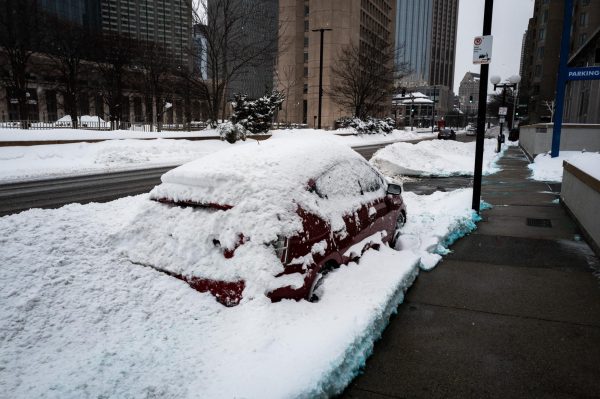
Massachusetts Gov. Maura Healey signed an executive order Feb. 23 banning non-essential motor vehicle travel in several counties due to weather concerns. Healey also activated 350 National Guard members for storm response in southeastern Massachusetts.
Boston Public Schools have also cancelled classes.
“We are giving out clothes and a ton of dry goods … because it just makes sense to have people prepared,” said Seth Loomis, an employee of nearly two years at Haley House, a soup kitchen in Boston’s South End.
According to the Massachusetts Emergency Management Agency, over 270,000 homes and businesses are experiencing power outages as of 8 p.m. Feb. 23.
“Based on current forecasts, we’re preparing for a restoration that could take 3-5 days, depending on the actual severity of the storm,” read an email sent to customers by Eversource Energy, a residential energy provider, on Feb. 22.
“If we lose power, it can be kind of catastrophic, but all we do is try to make sure that our neighborhood, like our block, is accessible,” Loomis said. “As early as we can, [we’ll] shovel the steps, shovel the sidewalk, shovel the intersection, and besides that, hope for the best.”
The several winter storms this season have made it clear that Boston needs to be prepared for freezing temperatures and heavy snowfall. Last month, Carvell Curry, a homeless man, was found dead outside South Station when Boston temperatures dropped to as low as 12 degrees.
“As someone who has a place to live and enough food, I love the snow and I think it’s beautiful … but for a lot of the guests who come in, snow is kind of devastating,” Loomis said.
For many of the people Loomis serves, missing even a single day’s worth of meals can have serious health risks.
“I’m coming from a mission and they give me food. I’m carrying a bag of food — a little bit of cereal and other provisions,” said Boston resident Armando Sanchez, speaking in Spanish. “When the storm happens, everything closes, everything is paralyzed. One leaves to get food to maintain in the house when the storm happens.”
Throughout Boston, students and residents alike will be hunkering down in preparation for the storm.
“During the last snowstorm, I kind of just stayed inside and didn’t leave unless I absolutely had to, and I feel like that’s going to be my strategy this time too,” Gopalakrishnan said.