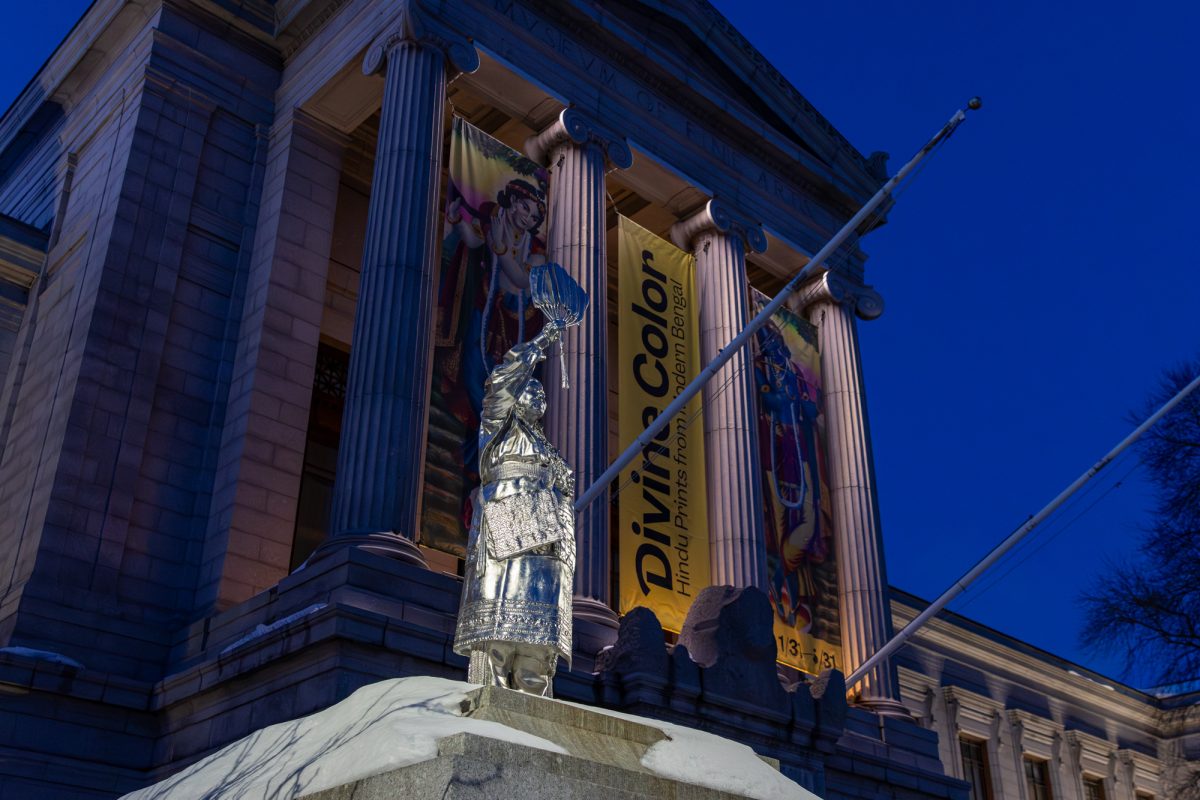
While Generation Z — those born roughly between the years 1997 to 2012 — is known for participating in phenomena such as “bed-rotting” and “doomscrolling,” where they sit on their beds and scroll for hours, many of Boston’s college students are ditching their phones to walk around the Museum of Fine Arts Boston. They grab coffee, flash their student ID for free entry and wander the galleries for a mental reset after their classes, internships and club commitments.
The Museum of Fine Arts, or MFA, offers free admission to participating schools, including but not limited to Northeastern University, Boston University and Massachusetts College of Art and Design. According to the American Alliance of Museums, 34% of museum visitors are young adults; the MFA’s 2024 annual report stated that the museum had 971,000 visitors, a 13% increase from 2023, and a 20% rise in university memberships and institutional passes.
Sitting on chairs outside the MFA were Willow Hauver, a first-year painting student at Massachusetts College of Art and Design, and Addison David, a first-year business and finance major at Bentley University.
“Honestly, I like going [to the MFA] in the morning; it’s a nice start to my day. I can just go and take my time,” Hauver said. “If I don’t have a morning class, I just wake up and start my day with art. It’s a good de-stressor.”
As a passionate MFA visitor, Hauver said she was excited to bring her friend to the museum for the first time — and according to David, it showed.
“[Hauver] talks about it all the time,” David said with a smile. “She loves it.”
Kristen Gresh, the Estrellita and Yousuf Karsh senior curator of photographs at the MFA, said she loves when students visit the museum. She said closely examining artwork is especially vital for students.
“There’s such a different experience to be had from looking at an image on a screen versus looking at a physical object; the object has so much more depth,” Gresh said. “For a student viewer, seeing the content of the photograph brings you to a completely different time and place. [You witness] everywhere that the photograph has been or all the people that have owned the photograph or used it in some way.”
Gresh added that when professors bring their students to the museum as an educational outing, it serves as exposure to the myriad of exhibitions students may not otherwise know about.
“I think it is really significant to be reminded of the larger world and cultural histories that are out there,” she said.
Admiring artwork inside the museum, Boston University student Marina Berger, a third-year advertising major, and Northeastern University student Matthew Wheeler, a third-year computer science and design combined major, said the museum helped them relax while also serving as an educational experience.
“It’s a very relaxing and quiet environment,” Wheeler said. “I find it easy to forget about the stuff that’s going on when you’re there.”
Berger agreed and pointed out that “you’re learning instead of sitting in your bed” during free time.
Mira Cantor, an art professor at Northeastern, said she recently noticed more students going to the MFA after years of decline. She said she requires her students to visit the museum, and they are often in awe after seeing the artworks.
“They learn a lot about how one sees the world. Every artist has a different way of showing the world to you, and I think that’s a way of learning,” Cantor said. “So I think students are waking up a little bit more now to the fact that that’s available to them, and it’s really great to see.”
Cantor added that when students take time to admire a painting, they slow down and connect with something beyond themselves. That way, she said, they can absorb the artwork’s energy and fully engage with what they see.
“If you’re constantly thinking inward and about the tools you have in front of your nose, like the iPhone, you can’t get beyond [it],” Cantor said. “You have to step outside of that at some point in your life and then you can breathe, otherwise you’re claustrophobic. The museum helps you do that.”
For students like Gregory Koudijs, a third-year corporate innovation major at Northeastern, moments of quiet observation and engagement turn into a source of inspiration — especially at a time when, as he believes, Gen Z lacks creativity.
“The MFA makes me feel so much more inspired than watching an art history video on TikTok; I actually get to see the physical art,” Koudijs said.
To him, visits to the MFA are something to look forward to, giving him the chance to connect with his community.
“It’s a much more valuable use of my time to get some fresh air, get dressed up, wear something nice and go and see art and be in this community where you feel almost civilized in a way,” Koudijs said. “[Each time] I’m at the museum for so long, and every time I go I feel like I’ve unlocked a new place.”