Boston, one of America’s renowned hubs for higher education, attracts thousands of students each year, in addition to scores of working professionals.
Yet, more than a month after Boston residents moved into new apartments the first week of September, hundreds still remain vacant.
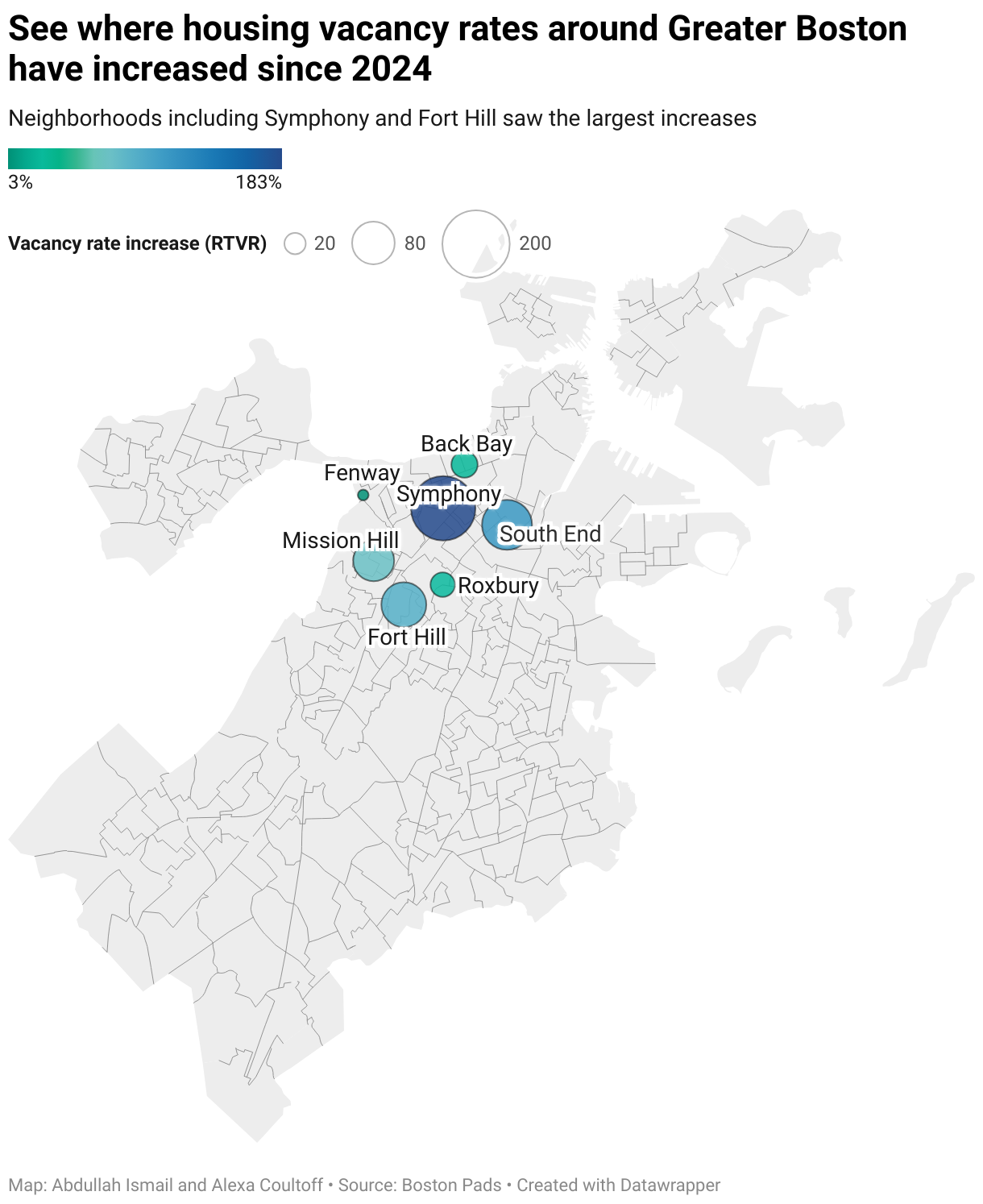
According to data collected by Boston Pads, the city’s largest apartment and real estate portal, the availability rate of apartments in Boston is up 10.1% compared to last year. In 2024, 1.6% of units remained vacant. This year, that number is closer to 1.86%. Near Symphony Hall and Northeastern University, the number of available apartments more than doubled from 0.81% to 2% over the past year. While some neighborhoods remain unaffected, others are feeling an acute impact.
Demetrios Salpoglou, the chief executive of Boston Pads, told The Boston Globe that landlords have been confused about the vacancies.
“When I checked the other day, we had 76 units available on Mission Hill alone. That is virtually unheard of,” Salpoglou said in an interview with the Globe. “I have landlords calling me saying, ‘What’s going on with the universities? Why aren’t my apartments rented?’”
The vacancies come as international students nationwide grapple with the Trump administration’s changes in visa policies. In late May, the State Department stopped scheduling interviews for international students seeking visas, implementing an expansion of the social media vetting process in its place. The suspension was lifted June 18, but the timing of the pause overlapped with the peak issuance season for fall semester student enrollment.
Though enrollment statistics have yet to be released for most universities, data suggest that visa delays and cancellations may partially explain the unusual uptick of available units as people are unable to enter the United States. In August, The New York Times reported a 19% decrease in the number of international students entering the U.S. compared to the previous year, the steepest drop since COVID-19.
In an interview with The Huntington News, Salpoglou said several factors play a role in the increase of vacancies, notably the state broker bill that passed on Aug. 1. The broker bill, officially known as Bill S.224, prohibits real estate professionals from charging renters a “broker fee” along with the first month’s rent when they are applying for, leasing or renting a residential space. According to Salpoglou, 40% of landlords had paid the brokerage commission before the bill passed, which is considered highly unusual for that summertime period. This had an impact due to the fact landlords had to pay the broker fee regardless and there weren’t renters to pay for it.
“The international kids that didn’t show up or showed up late caused the market to recoil, so in other words, the fact that 40% of landlords were already paying the broker commission prior to the broker bill being passed told you that there were some significant impacts of international college students not showing up,” Salpoglou said.
Salpoglou urges university housing advisors to take this opportunity to make changes and be aware of international visa trends in next year’s housing application cycle.

Despite the vacancies, students continue to flock to neighborhoods including Mission Hill, commonly known as “the Hill,” Fenway-Kenmore and Back Bay. Jacob Blair, a third-year business administration major at Northeastern who lives on the Hill, said the convenience of the neighborhood attracted him.
“There are a lot of students around, which is good,” Blair said. “It’s pretty easy to get to the T and get into the city, which is nice. I’d say it’s a pretty good, pretty quiet area, as well.”
Julia French, a fifth-year business administration and political science combined major at Northeastern who lives on the Hill, said the renting process was stressful because the area is so popular.
“I feel like it’s always been stressful and a fast turnaround because you have to find a place and sign a lease so far in advance, and I feel like that’s been like a common theme throughout every year,” French said. “But I know that housing prices have definitely increased significantly. I’ve just been luckier, or unlucky enough, to have places that are relatively cheaper, but, you know, at a cost, for sure.”
Theodore Fairchild-Coppoletti, a third-year mathematics and physics combined major at Northeastern, said he hasn’t noticed much of a difference in housing density where he lives near Parker Hill Avenue.
“It seems about as full as last year, though I’ve definitely heard that there’s more space,” Fairchild-Coppoletti said. “Anecdotally, it seems slightly less busy when I’m walking down the campus. I’ve also noticed less people on campus, probably more so than I have here.”
Caroline Davis, a fifth-year public health major at Northeastern, noted there has been an increase in vacancies by the Symphony and Massachusetts Avenue MBTA stops.
Sadie Ferguson, a second-year commercial dance major at Berklee College of Music, said it isn’t uncommon for students there to live off campus starting their first year. With a student population of more than 1,000, Ferguson noted the competitive nature of finding housing is ever-present in the Fenway area, with many students turning to realtors for assistance.
Jingwen Sun, a second-year media and screen studies major at Northeastern who lives in Fenway, noted that the close proximity of shops and restaurants makes the neighborhood a good fit for herself and other students.
While students like Sun appreciate the livelihood of Fenway’s neighborhood, there are negative financial implications for landlords when rental properties go unoccupied, even if for a short time.
“If you’re vacant, you can’t make that month up,” Salpoglou said. “It’s just very hard.”
The increased vacancies come with both positive and negative sides, Salpoglou says. While students may get a better deal from the impact of the policy, rents may also increase.
“It was the fact the kids didn’t show up,” he said. “International or national, it doesn’t matter. I think to most landlords, it’s just who’s living on the properties. If no one’s living on the property, you’re not collecting any rent.”
Deputy campus editors Lily Cooper, Maddie Evangelist and Auden Oakes contributed reporting.