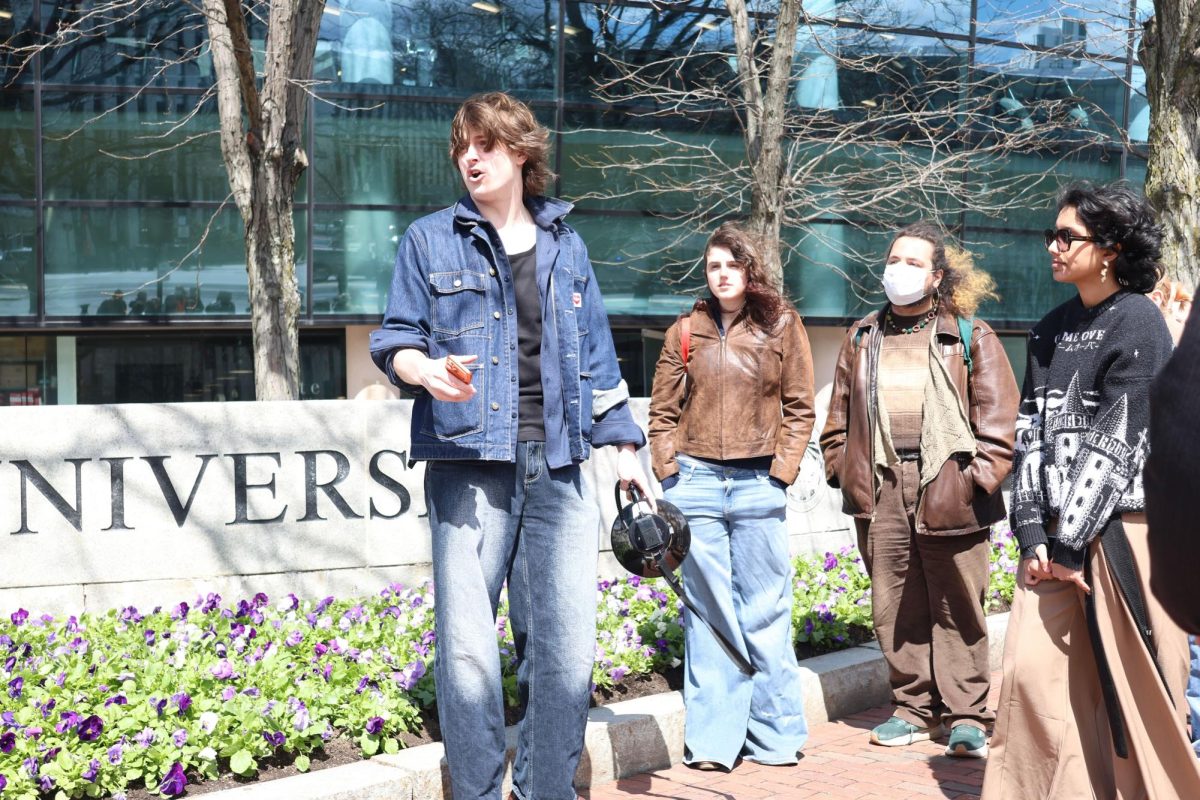
Dozens of students gathered outside Marino Recreation Center at 1 p.m. April 6 to voice dissatisfaction with the Northeastern administration’s reaction to several recent violent crimes around campus.
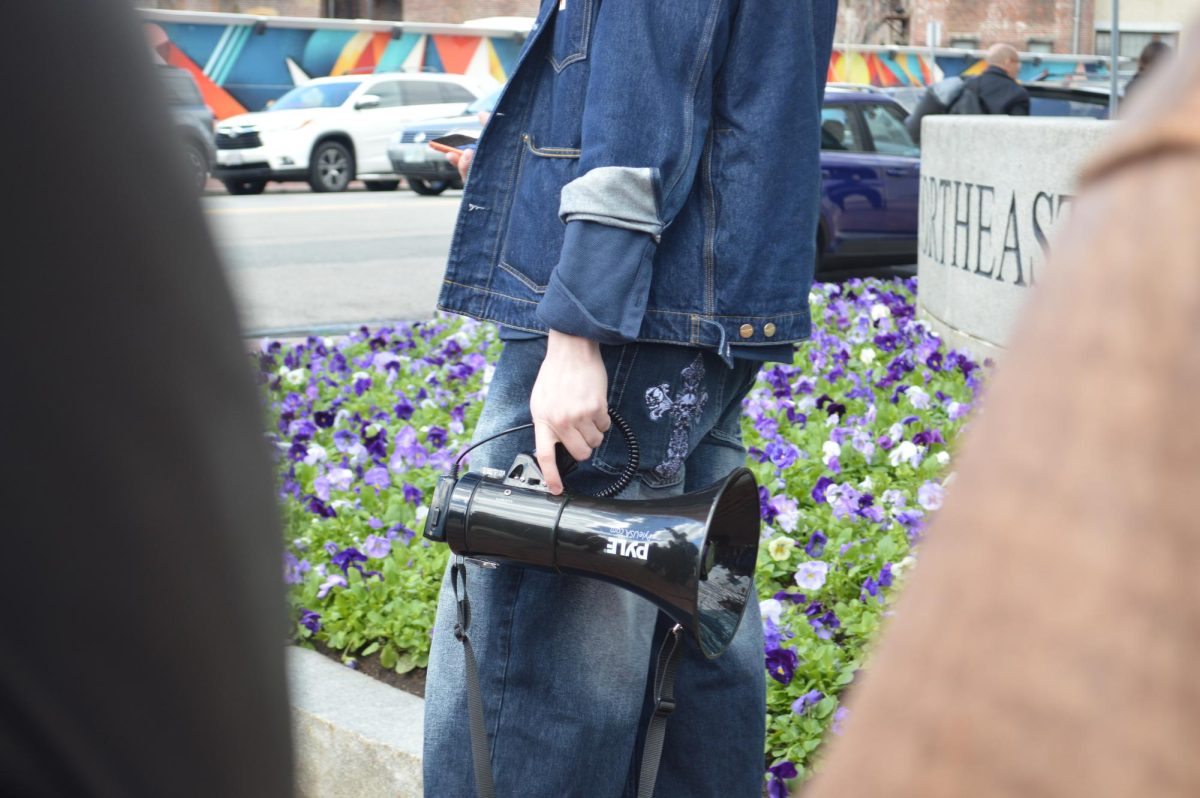
The demonstration, organized by students and attended by various clubs, called for increased transparency from the university about campus safety policies. Several student leaders gave speeches criticizing the university for its response, which they said failed to provide timely or detailed information about the crimes as they happened.
Jeffrey Franchetti, director of outreach for the Educational Freedom Project, a student group advocating for academic freedom and free expression in higher education, described the university’s alleged lack of communication as a “long-standing pattern” in his speech. He said the university has yet to publicly release a policy about federal immigration agents on campus, publish meeting minutes from the Board of Trustees or explain recent budget cuts.
Franchetti, a third-year politics, philosophy and economics major, specifically named Northeastern President Joseph E. Aoun, whose leadership was criticized at a March 23 Boston City Council hearing about transparency in higher education. Emily Spatz, editor-in-chief of The Huntington News and a fourth-year journalism and political science combined major, spoke at the hearing about The News’ ongoing push to interview Aoun, which Franchetti also mentioned in his speech.
“Now they’ve left us completely in the dark about a slew of violent incidents that have happened on and near campus,” Franchetti said of university administration. “This lack of transparency, [and] this belief that [the] administration has that communicating with its own community is optional, is directly leading to increased danger to every student on this campus.”
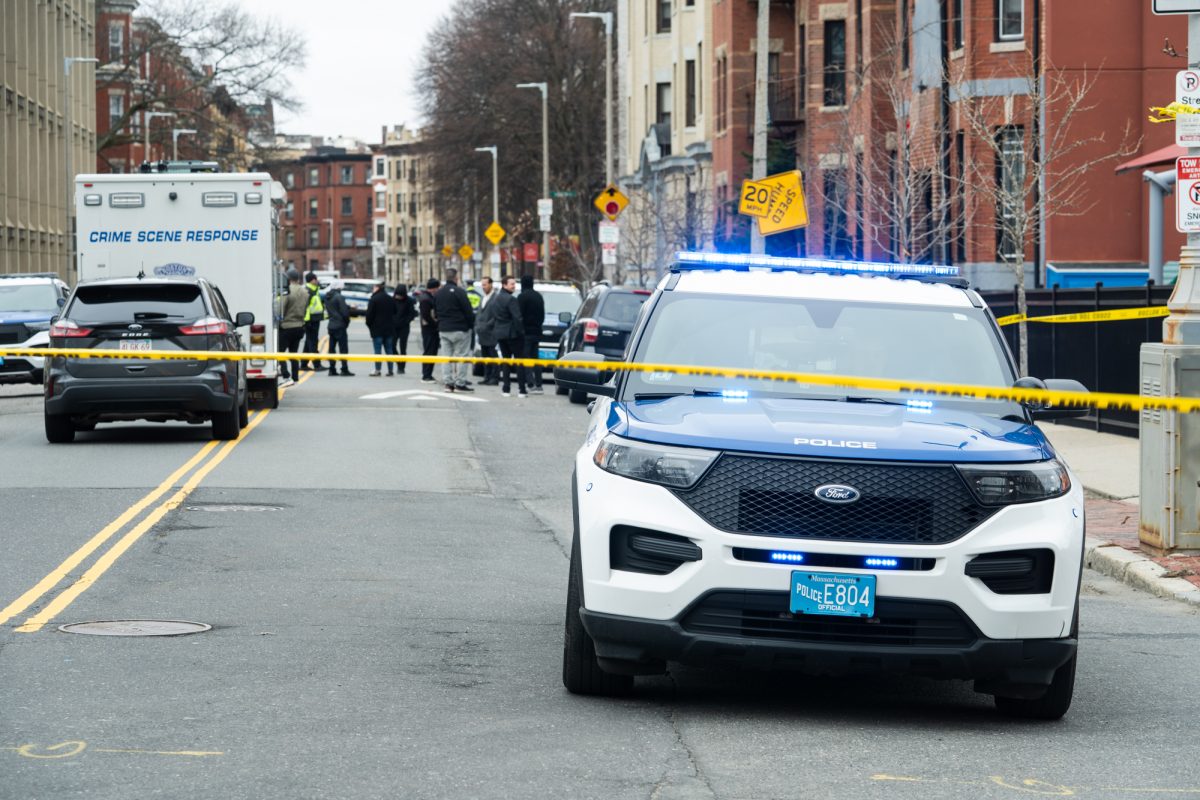
The protest came just two days after Boston police fatally shot a suspect likely experiencing a mental health crisis after he stabbed first responders inside an apartment building on Hemenway Street around 10:44 a.m. Following the incident, Northeastern students received one alert at 11:57 a.m. stating there was police activity reported in the area and “no active threat to campus,” advising students to avoid the area.
The incident was the latest of a string of alleged assaults, including a stabbing near East Village the morning of April 1, reports of shots fired on Gainsborough Street later that evening and a stabbing of a Northeastern student outside Marino March 27.
Sam Clock, a second-year environmental studies major, was in her off-campus apartment on Gainsborough Street the evening of April 1 when she heard gunshots. Clock said that she attended the protest because Northeastern did not send any emergency alerts to the community about the shots fired. The incident report obtained by The News revealed that police recovered ballistic evidence but did not find any victims.
“I heard the gunshots and then I heard the car zoom away, but I didn’t think it was gunshots at first because I got no information about it,” Clock said. “The least [Northeastern] could have said was, ‘Hey, this happened.’”
The area, which borders Northeastern’s campus, is also a popular off-campus housing spot for students at the Berklee College of Music, who received an emergency public safety alert from the college within an hour of the April 1 incident. The alert included details about the possible gunshots and the police response, along with Berklee’s plan to increase patrols in the area.
“We understand that the cluster of incidents near the Boston campus have caused concern for many,” Northeastern Director of Global Media Relations Dan Sarro wrote in an April 8 email to The News. “As we have communicated it in messages and in conversations with parents, students, and other members of the university community, it is important to emphasize that Northeastern’s Boston campus is safe, supported by a robust public safety infrastructure and a great partnership with municipal law enforcement agencies.”
Sarro said NUPD and BPD work in close coordination and both are increasing patrols around campus following the incidents.
Northeastern’s Chief of Police Ruben Galindo told the university-run media outlet Northeastern Global News April 2 that NUPD did not issue an alert about the reported gunshots because they believed there was no “imminent or continuing threat to campus” and that they responded to the incident by increasing patrols.
Clock said the approach failed to properly address students’ concerns.
“I live across the street from Smith Hall and down the street from Stetson East. That’s not off campus to me,” Clock said. “It’s not a good way of defending themselves, not that that’s what they’re doing, but it’s not a good way of portraying the issue.”
In an interview with The News, Franchetti said he and fellow students were still shaken by the crimes, citing both safety concerns and the subsequent lack of communication from administration as ongoing concerns discussed in the Student Government Association.
“I’m also a student senator, and students have told me that they hear construction noises and they think it’s gunshots,” Franchetti said. “There’s just an overall sense of fear stemming from confusion because the administration is not telling us about off-campus crimes.”
Robin Côté, a first-year electrical engineering and physics combined major, lives in Melvin Hall, a residence hall close to Hemenway, Gainsborough and Marino. She said she was “shocked” by how little the university seemed to support students after the incidents.
“Me and my friends are all really scared and we don’t even know that [we] should be scared sometimes because there is absolutely no adequate communication,” she said. “Northeastern [administration] has so many more resources than us students. They have so much money from our extremely expensive tuition which they just decide to pocket and leave us out to dry when there are a lot of dangerous things happening on campus.”
Zavi, a first-year behavioral neuroscience and data science major who asked for her last name to be anonymous due to concerns about retaliation from the Northeastern administration, said fear following the incidents has detracted from enjoying her overall college experience.
“I really don’t want to be out past 10 p.m. anymore, which is really sad because I feel like it’s college, I want to go out and have fun with my friends, but I’m too scared to go out now,” Zavi said.
Zavi said recent events left her worried about the potential of larger-scale crimes. She described reading the results of a recent survey conducted by The News, which detailed how students were largely unaware of the university’s active shooter protocols. The survey was conducted after the December mass shooting at Brown University and the subsequent murder of a Massachusetts Institute of Technology professor.
“When I read the article, I was assured knowing we have protocols in place, even if I didn’t know about them before … But after all of the incidents that have happened on campus, I’ve lost my trust in those protocols, and now I’m scared,” Zavi said. “If there was a shooting on campus, I don’t really know that I would be safe. I don’t know that I would be alerted in a timely manner.”